
Best overall: an undated weekly printable. Best for keeping things simple: a notebook you already use. Best for a shared household schedule: a weekly dry erase board. If you’re searching for weekly planners ranked by price in 2026, compare the whole setup, not just the item you put in your basket: printing, replacement pages, accessories, and whether the format actually fits your week.
- For weekly planners ranked by price, compare the full setup rather than assuming one format always costs less.
- The Sheema Edit recommends an undated weekly printable for moms who want flexible planning without a daily writing obligation.
- An existing notebook is the simplest starting point when you don’t want another purchase.
- Choose a shared weekly board for household visibility, not private reflection.
Why this matters
You don’t need another place to document everything you didn’t finish. You need somewhere to put the appointment, the school reminder, and the thing you keep remembering while brushing your teeth.
The Sheema Edit’s approach to weekly planners starts with making room for your actual life. That includes weeks when planning means writing one appointment and leaving the rest alone.
A useful 2026 planner doesn’t require a matching personality transformation. If blank dates make you hesitate, start with this guide to using an undated weekly planner.
What makes the best weekly planner?
These are the criteria behind the order below. The ranking reflects practical fit for an overwhelmed mom, not a universal cheapest to most expensive order: format alone doesn’t establish that.
- Whole setup: Consider the page or book, plus anything you need to use it.
- Room to pause: Look for a format you can leave alone without an elaborate restart.
- Readable space: Your appointments shouldn’t need their own magnifying glass.
- Useful boundaries: Separate fixed commitments from things you’d merely like to do.
- Low upkeep: Choose preparation and maintenance you’re willing to repeat.
- Privacy: Decide whether your week belongs on display or somewhere personal.
The best planner is the one whose upkeep doesn’t become another task you resent. A lovely layout can still be the wrong layout for you.
Weekly planner options at a glance
For a 2026 purchase, compare current listings for the exact format you want. A printable, a bound book, and a digital template involve different purchases and different kinds of upkeep; their category names don’t establish a reliable price order.
| Rank and option | Best for | Standout feature | What to check before choosing | Key limitation |
|---|---|---|---|---|
| 1. Undated weekly printable | Flexible starts and pauses | You add the dates | Printing supplies and page storage | Requires printing |
| 2. Existing notebook | Trying weekly planning before shopping | You draw only what you need | Whether you already have a usable notebook | Requires making your own layout |
| 3. Dated bound weekly planner | Following a calendar already laid out | Dates are already assigned | Calendar coverage and writing space | Missed weeks remain in the book |
| 4. Weekly desk pad | Keeping your own week visible | A page stays beside your workspace | Pad dimensions and replacement sheets | Takes up surface space |
| 5. Refillable ring planner | Rearranging pages | Sections can move | Insert size and compatible refills | More pieces to manage |
| 6. Weekly dry erase board | Sharing household commitments | Other people can see the week | Mounting needs and suitable markers | Little privacy or lasting record |
| 7. Digital weekly planner | Planning on a device you already use | No paper pages to carry | Required software and device compatibility | Adds another reason to open a screen |
1. Undated weekly printable: best for flexible starts
An undated weekly printable gives you a weekly layout without assigning it to a particular calendar week. You add the dates when you want to use it, whether that’s every week or only when life feels crowded.
The Sheema Edit offers printable journals and planners. When considering any printable, look at the actual page before choosing it: enough writing room matters more than a long list of boxes.
Undated weekly printable pros:
- You choose when the week begins.
- Pauses don’t leave a run of preassigned dates behind.
- You can keep a weekly page beside a separate reflection page.
Undated weekly printable cons:
- Printing requires access to a printer and supplies.
- Loose pages need somewhere to live.
Best for: Moms who want structure without committing to an uninterrupted planning streak.
Try writing one fixed commitment, one thing that would help, and one thing you’re leaving alone. Those are suggestions, not admission requirements.
Verdict: Buy if an undated layout fits your week and printing feels manageable.
2. Existing notebook: best for trying before buying
An existing notebook lets you try weekly planning without choosing a new planner first. Write the week at the top, add your commitments, and stop there if that’s enough.
No decorative spread is required. Your handwriting doesn’t need to audition for anything.
Existing notebook pros:
- You can use a notebook you already have.
- The layout can change from week to week.
- Notes and plans can share the same place.
Existing notebook cons:
- You have to create the structure yourself.
- Old weekly pages can be harder to find without labels.
Best for: Readers who aren’t sure which planner sections they’ll actually use.
Give yourself a 10 minute trial: draw a few spaces, add what you need to remember, and notice what feels missing. That’s an optional experiment, not a recommended daily routine.
Verdict: Hold off on buying another planner until you’ve tried a page you already own.
3. Dated bound weekly planner: best for ready made dates
A dated bound weekly planner assigns each spread to a calendar week. It suits you when adding dates feels like unnecessary preparation and you prefer keeping the year in one book.
For a 2026 planner, check the beginning and ending dates rather than relying on the cover alone. Also inspect how much room an ordinary weekday receives.
Dated bound weekly planner pros:
- Dates are already written into the layout.
- Pages stay together in one book.
- You can look back at earlier weeks.
Dated bound weekly planner cons:
- Unused calendar weeks remain unused pages.
- The printed layout is difficult to change.
Best for: Readers who like opening a book directly to the current week.
A missed week doesn’t require catching up. Turn to the current date; the blank pages aren’t asking for an explanation.
Verdict: Buy if assigned dates feel helpful; skip if they make restarting harder.
4. Weekly desk pad: best for visible personal reminders
A weekly desk pad keeps your plans on a surface rather than inside a closed book. It’s a practical option when you regularly use the same desk, counter, or worktable.
Visibility is the point. It’s also the tradeoff if that surface is shared or your notes are private.
Weekly desk pad pros:
- Your current week stays in view.
- You don’t need to open a cover to check it.
- The page can sit beside the work it supports.
Weekly desk pad cons:
- It occupies space even when you aren’t planning.
- Personal notes are visible to anyone nearby.
Best for: Readers who forget to consult a planner once it’s put away.
Before choosing a pad, place a sheet of paper where it would sit. If you move it repeatedly just to eat lunch or use your laptop, that spot probably isn’t helping.
Verdict: Buy if you have a useful, dependable place to keep it visible.
5. Refillable ring planner: best for changing the layout
A refillable ring planner holds removable pages, letting you rearrange sections rather than accepting a fixed book order. You can keep weekly planning separate from notes or reflection.
That flexibility comes with decisions. Page size, hole placement, and refill compatibility deserve a look before you start collecting inserts.
Refillable ring planner pros:
- You can move pages into a useful order.
- Separate sections can hold different kinds of writing.
- Used pages can be removed and stored elsewhere.
Refillable ring planner cons:
- Refills need to fit the particular planner.
- Rearranging can become more work than planning.
Best for: Readers who know what they want to keep together and enjoy adjusting it.
Start with the weekly section alone. You don’t have to build a small administrative department around remembering a dentist appointment.
Verdict: Buy for a specific layout need, not for the possibility of endless accessories.
6. Weekly dry erase board: best for shared schedules
A weekly dry erase board puts household commitments somewhere other people can consult. Use it for information that belongs in shared view, such as appointments or pickup arrangements.
Keep private reflections elsewhere. A visible calendar and a personal journal do different jobs.
Weekly dry erase board pros:
- Household members can consult the same weekly view.
- You can erase and revise entries.
- The board stays in its chosen location.
Weekly dry erase board cons:
- Erasing removes the previous record unless you save it separately.
- Anyone with access to the space can read it.
Best for: Households that need a shared reference rather than another personal notebook.
Choose a location people actually use. A board hidden behind a door has excellent privacy and rather questionable usefulness.
Verdict: Buy for shared information; skip as a substitute for private writing.
7. Digital weekly planner: best for keeping paper out of your bag
A digital weekly planner places the weekly layout on a device. Depending on the particular template or application, you’ll need compatible software and a way to enter your plans.
Check those requirements before choosing anything. A downloadable file and a calendar application aren’t interchangeable just because both appear on a screen.
Digital weekly planner pros:
- No physical weekly pages to carry.
- Plans can stay on a device you already use.
- You don’t need a place to store paper sheets.
Digital weekly planner cons:
- Usability depends on the device and software.
- Opening a screen also puts other distractions within reach.
Best for: Readers who already prefer typing or writing digitally.
Try entering a real appointment and a short note in your existing setup before adding another tool. Notice whether you want to return to it.
Verdict: Buy only after checking compatibility and trying the way you’ll enter information.
Choose the kind of space you need
Before comparing individual products, decide where your week belongs. This is about access and privacy, not which format looks most organized.
- Private reflection: Choose a page you can put away.
- Visible reminders: Choose a layout you’ll keep in sight.
- Shared schedules: Choose somewhere the household can consult.
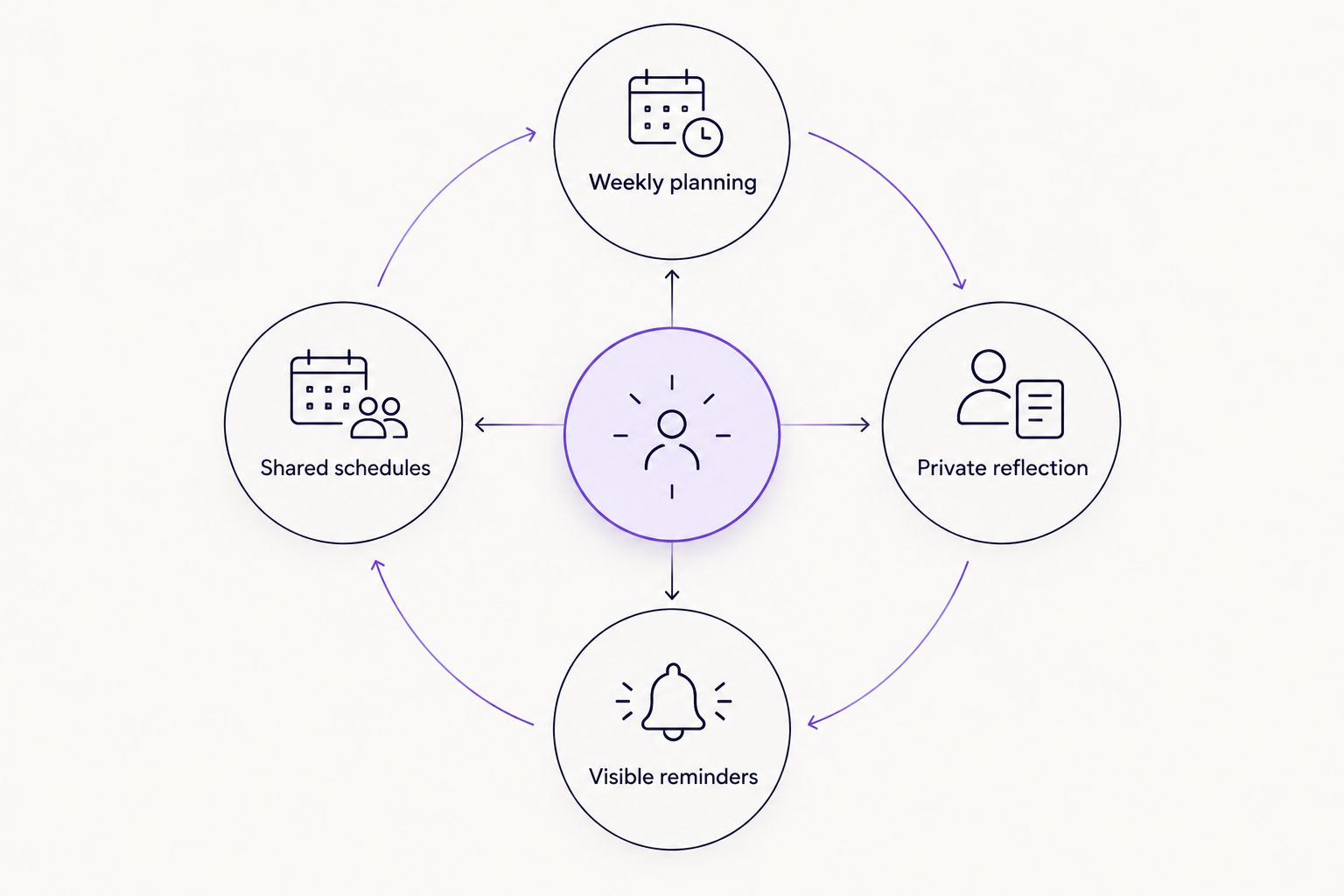
A private weekly page can include a 5 minute reflection if you want one: “What do I need more room for?” You can also leave it blank. Your planner doesn’t need access to every thought you have.
How the ranking works
The Sheema Edit ranks weekly planners here by flexibility, preparation, visibility, and privacy. This is a format comparison, not a claim of hands on product testing or a verified price leaderboard.
For your 2026 shortlist, compare the exact items and their required extras together. Then ask whether the extra structure solves a real problem or simply gives you more to maintain.
Which weekly planner should you choose?
Choose an undated weekly printable if you want a gentle starting point and printing works for you. Choose your existing notebook if you’re still discovering what you need.
For shared commitments, pick a weekly board instead of expecting your personal planner to communicate for you. One tool doesn’t have to carry every job.
If you’re undecided, sketch a weekly page and try it for one week. Let the experience tell you what to look for, rather than buying features you haven’t needed yet.
FAQ
What’s the best weekly planner for an overwhelmed mom?
An undated weekly printable is a useful starting point if you want a prepared layout without assigned calendar dates. Choose enough room for your real commitments, and leave sections blank when they aren’t useful.
How should I compare weekly planners ranked by price?
Compare the exact planner and everything required to use it, rather than assuming a format is always cheaper. Check printing supplies, refills, accessories, or required software where relevant.
Should I choose a dated or undated weekly planner in 2026?
Choose dated pages if you want the calendar already prepared; choose undated pages if you prefer deciding when to begin. Neither format requires you to fill every space.
Can I use a notebook instead of buying a weekly planner?
Yes, a notebook can hold your weekly appointments, reminders, and notes. Start with a simple layout and add structure only when you notice a need for it.
Is a digital weekly planner better than a paper planner?
A digital weekly planner fits readers who prefer using a device, while paper suits readers who want planning away from a screen. Check digital compatibility and consider where you’ll actually consult your plans.
Do I need to write in my weekly planner every day?
No, you don’t need to write in your weekly planner every day. Use it when you need to remember, decide, or make room for something, then return when it’s helpful.
Can a weekly planner include reflection without becoming another task?
Yes, reflection can be a single optional question beside your plans. Try asking what you need this week, and leave it unanswered whenever writing feels like more than you want to do.
One last thing
Before choosing your 2026 planner, look at what happens when you miss a week. Can you turn the page and begin again without reorganizing everything?
That’s the detail worth protecting. A planner should hold your plans, not become another thing you have to make up with.