
Best overall: name what you needed. Best for regret: separate responsibility from punishment. Best when forgiveness feels too far away: write about what you’re not ready to release. These are The Sheema Edit’s picks for journal prompts for forgiveness and healing in 2026: gentle starting points for an honest page, not assignments to become the bigger person before you’ve finished being hurt.
- The Sheema Edit recommends journal prompts for forgiveness and healing that start with your needs, not forced forgiveness.
- Choose reflection prompts about responsibility for regret, boundaries for broken trust, and unfinished feelings when you’re not ready.
- Forgiveness doesn’t require reconciliation, renewed contact, or pretending something didn’t hurt.
- Write a sentence, leave a blank, or stop. Your journal doesn’t need a daily attendance policy.
Why this matters when you’re already carrying plenty
You can want peace and still be angry. You can love someone and need distance. Neither feeling cancels the other, and your journal doesn’t have to settle the argument tonight.
If you’re an overwhelmed mom, quiet time already has competition. The laundry has opinions. Someone needs a snack. Reflection shouldn’t become another place where you feel behind.
The Sheema Edit’s approach to journal prompts for forgiveness and healing starts with permission to tell the truth. Forgiveness is an option to explore, not proof that you’ve reflected correctly. If you’d rather begin with broader questions, these journal prompts for mental health offer another place to start.
You don’t owe anyone access to your private writing. A page can help you consider what you want to say without becoming a message you have to send.
What makes a forgiveness prompt worth answering?
For this 2026 guide, the strongest prompts leave room for your actual answer, including an inconvenient one.
- Honesty: You can name hurt without turning it into a lesson immediately.
- Choice: The question doesn’t assume forgiveness is your next step.
- Responsibility: It distinguishes your actions from someone else’s choices.
- Boundaries: It leaves room for distance, privacy, and changed expectations.
- A manageable opening: You can answer briefly without explaining the whole relationship.
Skip questions that ask how you caused someone else to mistreat you or why you haven’t moved on. A question mark doesn’t make a judgment gentle.
The best forgiveness prompts at a glance
| Rank and prompt approach | Best for | What it opens up | Main limitation |
|---|---|---|---|
| 1. Name what you needed | Finding a starting point | Needs beneath the hurt | Doesn’t decide what happens next |
| 2. Separate responsibility from punishment | Regret about your actions | Accountability without endless accusation | Can’t replace an apology or repair |
| 3. Define your boundary | Broken trust | Conditions for future contact | Can’t make someone respect the boundary |
| 4. Give anger a sentence | Feelings you keep editing | Direct language about what hurt | Doesn’t resolve a disagreement |
| 5. Write an unsent letter | Words you haven’t expressed | Space to speak without sending | Can become another imagined argument |
| 6. Name what isn’t ready | Feeling pressured to forgive | Permission to leave things unfinished | Doesn’t create a decision for you |
1. Name what you needed: best for finding a starting point
Best for: you know you’re hurt, but the explanation feels tangled.
Start with the need, not the verdict on the relationship. You don’t have to decide whether someone is a good person before admitting that you needed care, honesty, or help.
Try either question:
- What did I need in that moment that I didn’t receive?
- What do I wish someone understood about how this affected me?
An answer can be plain: you needed someone to take your no seriously. Or you needed help without having to organize every detail of receiving it. You don’t need to make the sentence prettier.
Name what you needed pros:
- Gives a tangled story a clear starting point.
- Leaves forgiveness undecided.
- Works as a single sentence.
Name what you needed cons:
- Doesn’t tell you whether to reconnect.
- Naming the need doesn’t guarantee someone will meet it.
Verdict: Start here if the blank page feels bigger than your available energy.
2. Separate responsibility from punishment: best for personal regret
Best for: you regret something you did and keep putting yourself on trial.
Accountability asks what you did and what you can address. Endless accusation keeps asking what your mistake proves about your entire character. Give those questions separate space.
Try these prompts:
- What action do I regret, stated without calling myself names?
- What repair is mine to offer, and what response isn’t mine to control?
If you snapped at someone, write about the words you used. You can acknowledge exhaustion without making exhaustion an excuse, and consider an apology without demanding immediate forgiveness in return.
Separate responsibility from punishment pros:
- Keeps attention on a specific action.
- Makes room for a concrete repair.
- Doesn’t require someone else to reassure you.
Separate responsibility from punishment cons:
- Private reflection doesn’t replace changed behavior.
- The other person gets to decide how they respond.
Verdict: Choose this when you need accountability, not another page of insults aimed at yourself.
3. Define your boundary: best for broken trust
Best for: you’re wondering what contact should look like now.
Forgiveness and access are different decisions. You can explore releasing an old argument while deciding that a particular conversation, visit, or expectation no longer works for you.
Try these prompts:
- What am I willing to offer, and what am I no longer willing to absorb?
- If this happens again, what action can I take within my own control?
Keep the second answer about your choices. Ending a conversation is an action you can consider; making someone understand is not something you can promise yourself.
Define your boundary pros:
- Separates forgiveness from renewed closeness.
- Turns attention toward your own choices.
- Allows different limits for different relationships.
Define your boundary cons:
- Writing a limit doesn’t communicate it.
- The other person might disagree with your decision.
Verdict: Choose this before making promises about closeness you don’t actually want.
4. Give anger a sentence: best for feelings you keep editing
Best for: you keep writing the polite version and leaving yourself out.
An honest page doesn’t need to be a fair summary of every person involved. It can hold your perspective without becoming instructions for how to treat someone.
Try finishing these sentences:
- I’m angry that I had to…
- The part I keep minimizing is…
Be specific rather than impressive. You might be angry about carrying an extra task, receiving an apology that skipped the actual hurt, or being expected to act normal before you felt ready.
Give anger a sentence pros:
- Makes room for an emotion you’ve been softening.
- Doesn’t require a cheerful ending.
- Keeps private expression separate from public action.
Give anger a sentence cons:
- Repeating the same accusation doesn’t answer every question.
- A private account isn’t the whole story of a disagreement.
Verdict: Choose this when being reasonable has started to mean being silent.
5. Write an unsent letter: best for words with nowhere to go
Best for: you have something to say but haven’t decided whether to say it.
An unsent letter gives the words somewhere to land without creating a conversation. Decide before writing that sending it is a separate choice, not the automatic final step.
Try these openings:
- What I wish I could say without managing your reaction is…
- What I’m no longer asking you to explain is…
You can stop after the opening. You can also finish with what you want for yourself rather than what you want the other person to finally understand.
Write an unsent letter pros:
- Offers a familiar format when prompts feel stiff.
- Leaves the decision about contact open.
- Lets you express unfinished thoughts privately.
Write an unsent letter cons:
- It can turn into rehearsing an imagined argument.
- A finished letter still needs a separate decision about sending.
Verdict: Choose this for expression; wait before treating it as correspondence.
6. Name what isn’t ready: best when forgiveness feels forced
Best for: you’re tired of being asked whether you’ve moved on.
Not every honest page ends with release. This approach lets you describe your current position without signing a contract to stay there forever.
Try these prompts:
- What am I not ready to forgive, and what do I need instead today?
- What would I like more room for in 2026, even if this remains unresolved?
Your answer might be ordinary: a quieter evening, fewer explanations, a conversation about something else. You’re allowed to want a life that contains more than this one difficult subject.
Name what isn’t ready pros:
- Doesn’t demand a forgiveness deadline.
- Makes space for needs beyond the conflict.
- Allows your answer to change later.
Name what isn’t ready cons:
- Doesn’t settle an unresolved relationship decision.
- Other people might still want an answer you can’t give.
Verdict: Choose this when permission to be unfinished is the most honest place to begin.
How these prompts are ranked
The Sheema Edit puts naming your needs first because it asks the least of you: notice what was missing, without immediately deciding what to do about it. The remaining approaches serve different situations, not different levels of maturity.
This 2026 selection favors choice, clear language, and boundaries over questions that assume forgiveness is the finish line. There’s no prize for choosing the deepest question on the most exhausting day.
Keep the writing small enough to fit your life
Try this optional sequence when you want a little structure. It isn’t a routine to maintain.
- Choose a question. Pick the one that sounds answerable, not the one you think you should tackle.
- Write a sentence. Let 1 sentence count. You don’t owe the page a complete history.
- Name a need. Ask what would make the rest of today feel more manageable.
- Leave the page. Close the notebook without requiring a resolution.
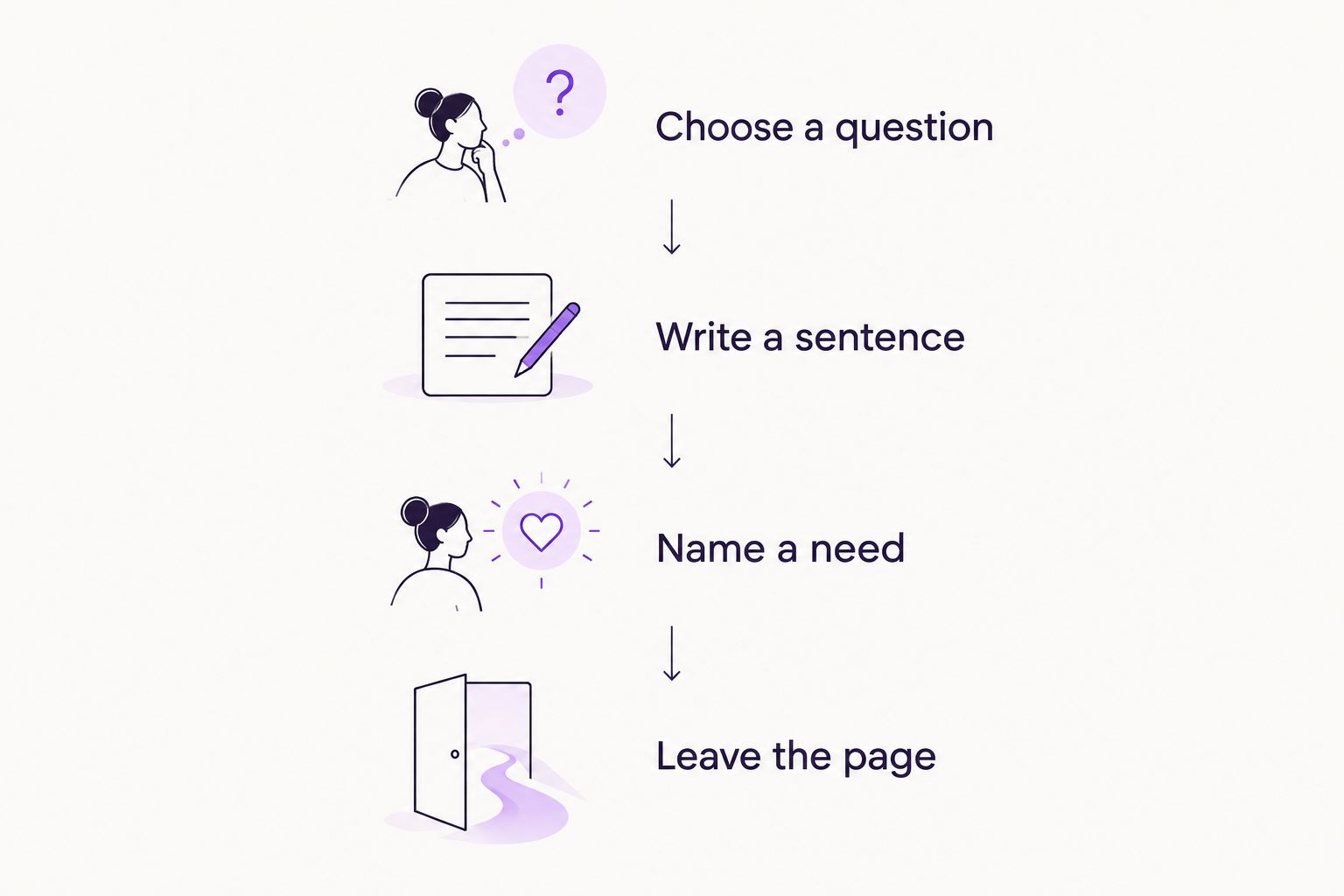
If a little container helps, set aside 2 minutes or cap the entry at 3 lines. Those are optional limits, not measures of whether you did enough. If a question feels too much, leave it unanswered.
You can keep reflection separate from planning, too. Learning how to use an undated weekly planner offers a way to consider the week without making private feelings into tasks with deadlines.
When forgiveness and staying together are different questions
Writing about a relationship doesn’t require you to decide its future on the same page. Wanting to understand what happened isn’t a promise to stay, and considering separation doesn’t make your earlier effort dishonest.
The distinction also matters in conversations about affair recovery therapy: wanting to discuss an affair and deciding whether to remain together are separate questions. Your journal can keep those questions separate rather than forcing a single answer.
You might use two headings: what I want to understand, and what I want to choose. Leave either column blank if you need to. Blank space is not a binding relationship decision.
These prompts are for personal reflection, not treatment or a substitute for support. If writing feels overwhelming, stop; you don’t have to push through to make the exercise count.
Which forgiveness prompt should you choose?
Start with naming what you needed if you’re undecided. It gives you something specific to write without requiring an apology, a reunion, or a declaration that everything is fine.
Choose responsibility prompts when the question is about your actions. Choose boundary prompts when the question is about future contact. Choose the unfinished feelings approach when the pressure to forgive is louder than your own answer.
You don’t need to work through all six. A useful page is one you were willing to write honestly, not one that covered the entire emotional syllabus.
FAQ
What are the best journal prompts for forgiveness and healing?
Start with: What did I need that I didn’t receive? The Sheema Edit recommends this opening because it leaves room to name hurt without deciding immediately whether to forgive or reconnect.
How do I journal about forgiving myself?
Describe the action you regret without turning it into a statement about your whole character. Then ask what repair you can offer and what response is outside your control.
Can I forgive someone without letting them back into my life?
Yes. Forgiveness and renewed contact are separate choices, and writing about forgiveness doesn’t commit you to restoring access or trust.
What should I write if I’m not ready to forgive?
Write about what you need today rather than what you think you should release. You can begin with: I’m not ready to forgive this, and right now I need…
How long should I spend on forgiveness journaling?
There’s no required duration. You can choose a brief limit, answer a single question, or stop after a sentence without treating the entry as incomplete.
Should I send a forgiveness letter after writing it?
Writing a letter doesn’t obligate you to send it. Decide separately whether contact serves a purpose you actually want, rather than treating sending as the necessary ending.
Do I need a special journal for forgiveness prompts?
No. A notebook, loose sheet, or private document is enough; choose a format you feel comfortable using and keeping private.
One last thing
Your last sentence doesn’t have to be about the person who hurt you. It can be about dinner, tomorrow’s walk, or the thing you’d like to enjoy without explaining why you deserve it.
For your 2026 journal, consider ending with: What would I like the next page to make room for? The answer doesn’t have to involve forgiveness at all.
With Love, Sheema.