
Best overall: a feelings-and-needs check-in. Best for racing thoughts: a facts-versus-predictions prompt. Best low-effort option: a next-step prompt. These journal prompts for mental health give you specific starting points for naming feelings, examining worries, and deciding what you need in 2026—without turning your notebook into another obligation.
- Start with feelings-and-needs journal prompts for mental health when you don't know what to write.
- Choose facts versus predictions for worry, or an energy check-in when capacity is limited.
- Thesheemaedit's mental wellness writing is best for readers seeking personal essays alongside practical reflection.
- Skip any prompt that increases distress; journaling is optional and does not replace mental health care.
Why this matters
A journal prompt is a question to write from, not a test you must pass. The useful question is not whether your entry sounds insightful. It is whether writing helps you identify something you want to understand or address.
Choose a prompt that matches your present need, not the person you think you should become. A question about goals is a poor fit when you need rest. A gratitude list does not have to be your answer to grief.
Thesheemaedit publishes personal essays about mental wellness, motherhood, and chronic illness alongside printable journals and planners. This 2026 guide focuses on questions you can answer in whatever writing format you already use.
What makes the best journal prompts for mental health
The ranking prioritizes questions you can use without turning reflection into self-interrogation:
- Clear starting point: You can understand the question without learning a method first.
- Specific purpose: Each prompt addresses a distinct need, such as naming feelings or setting boundaries.
- Flexible effort: A short answer counts. You do not need to fill a page.
- Room for uncertainty: The question allows mixed feelings and unfinished answers.
- A stopping point: You can close the entry without solving your entire situation.
- No forced positivity: The prompt does not require gratitude, forgiveness, or a positive lesson.
The best overall choice meets these criteria without asking you to revisit a painful memory. More targeted questions belong further down the list because their usefulness depends on what you need that day.
Journal prompts at a glance
| Rank | Prompt | Best for | Standout feature | Key limitation |
|---|---|---|---|---|
| 1 | Feelings and needs | General emotional check-ins | Connects a feeling with a present need | Naming feelings can be difficult |
| 2 | Facts versus predictions | Writing about worry | Separates observations from forecasts | Does not resolve genuine uncertainty |
| 3 | Energy and capacity | Low-energy days | Starts with current limits | Does not explain persistent fatigue |
| 4 | Parenting repair | Reflecting after a difficult parenting moment | Separates accountability from self-attack | Writing does not replace repair |
| 5 | Boundary check | Deciding what to accept or decline | Turns discomfort into a concrete request | A boundary is not always safe to express |
| 6 | Compassionate response | Harsh self-talk | Invites a fairer response to mistakes | Kind language can feel unfamiliar |
| 7 | Next manageable step | Getting started when overwhelmed | Ends with a limited action | Can become another productivity demand |
1. Feelings and needs: best for an everyday check-in
Prompt: What am I feeling right now, and what do I need—not what should I feel or need?
Start with an ordinary word: sad, tense, relieved, irritated, lonely, or uncertain. Then describe a need without making yourself earn it. You can want quiet even when nothing dramatic happened.
For example: I feel stretched thin. I need to stop agreeing to things before checking my schedule. That is a complete entry; you do not have to investigate every reason behind it.
If naming an emotion feels difficult, describe your experience instead. I keep rereading the same message gives you somewhere to begin without demanding an exact label.
Feelings-and-needs pros:
- Works without a particular event to analyze.
- Accepts mixed or unclear emotions.
- Leaves room for a practical request.
Feelings-and-needs cons:
- Identifying a feeling is not always straightforward.
- Recognizing a need does not make meeting it possible immediately.
Best for: A general check-in when you want a starting point rather than a deep investigation.
Verdict: Skip the demand for a perfect emotion word; use the question to describe what is present.
2. Facts versus predictions: best for writing about worry
Prompt: What do I know happened, what am I predicting, and what remains unknown?
Make separate headings for facts, predictions, and unknowns. Put observable information under facts; place guesses about outcomes or other people's thoughts under predictions.
For example, My friend has not replied describes an observation. My friend is angry with me is an interpretation unless your friend has said so. You do not need to replace that interpretation with a cheerful one.
Leave the unknowns unresolved when you lack evidence. The purpose is to distinguish categories, not to prove that nothing bad will happen or dismiss a concern supported by facts.
Facts-versus-predictions pros:
- Gives a worried entry a clear structure.
- Makes assumptions visible on the page.
- Allows an honest answer of I don't know.
Facts-versus-predictions cons:
- Does not remove real risks or uncertainty.
- Repeatedly checking the same worry can become unhelpful.
Best for: A specific situation where your prediction has started sounding like an established fact.
Verdict: Skip repeated rewrites seeking certainty; finish after you have separated what you know from what you fear.
3. Energy and capacity: best for low-energy days
Prompt: What feels manageable today, what needs adjusting, and what can remain unfinished?
Answer from your current capacity, not your ideal schedule. You might identify a task to postpone, a simpler version of a responsibility, or something you need help completing.
This question leaves room for the practical effects of chronic illness without asking you to turn symptoms into a lesson. An entry such as I need to move this appointment and rest does not require an inspirational ending.
For your 2026 journal, keep a brief version available: What can wait? You can answer that alone when the full prompt asks more effort than you want to give.
Energy-and-capacity pros:
- Makes room for changing limits.
- Accepts a brief, practical answer.
- Does not require a positive interpretation of illness.
Energy-and-capacity cons:
- Some responsibilities cannot be postponed.
- Reflection does not assess or treat fatigue or other symptoms.
Best for: Days when your plans and your available energy do not match.
Verdict: Skip explanations that make you defend your limits; name the adjustment you need.
4. Parenting repair: best after a difficult parenting moment
Prompt: What happened, what part is mine to take responsibility for, and what repair does this moment need?
Describe the interaction without turning it into a verdict on your entire identity. I raised my voice during the morning rush names behavior. I am a terrible parent does not specify what needs changing.
Then distinguish your feelings from your child's responsibility. Your frustration belongs in your reflection; your child does not need to reassure you about your guilt.
A possible next step is an age-appropriate apology that names your behavior without blaming your child. Writing can prepare you for that conversation, but the journal entry is not the conversation itself.
Parenting-repair pros:
- Keeps attention on a specific interaction.
- Makes room for accountability without global self-condemnation.
- Connects reflection with a possible repair.
Parenting-repair cons:
- Cannot tell you exactly how your child experienced the moment.
- Does not replace direct repair or appropriate outside support.
Best for: Reflecting on your own behavior after a parenting interaction you want to address.
Verdict: Skip the identity judgment; identify the behavior and the repair instead.
5. Boundary check: best for deciding what to decline
Prompt: What am I agreeing to, what does it require from me, and what would I prefer to say?
Name the request before judging your reaction. Perhaps someone wants your time, emotional attention, or help with a task. Describe the commitment in concrete terms rather than writing only that you feel overwhelmed.
Next, draft the answer you would prefer to give. I cannot take this on is a complete draft; you can decide separately whether you want to explain.
Do not treat direct confrontation as a requirement. If you fear retaliation, coercion, or harm, focus on your safety and seek appropriate support rather than using a journal prompt as pressure to confront someone.
Boundary-check pros:
- Clarifies the request you are considering.
- Separates your preference from your explanation.
- Gives you space to draft before responding.
Boundary-check cons:
- Other people do not have to welcome your boundary.
- Expressing a boundary is not safe in every situation.
Best for: A request you feel pressured to accept but have not yet decided about.
Verdict: Skip confrontation when safety is in question; use the entry to clarify your needs privately.
6. Compassionate response: best for harsh self-talk
Prompt: What am I saying to myself, and what would a fair, caring response sound like?
Write down the criticism without expanding it into a list of everything you dislike about yourself. Then answer the specific statement with language that acknowledges both difficulty and responsibility.
For example: I missed something important, and I need to address it is different from I ruin everything. You do not have to claim that the mistake was harmless or that you feel wonderful about yourself.
If caring language feels false, aim for accurate language first. Replace an absolute judgment with a description of what happened and what remains possible.
Compassionate-response pros:
- Does not require exaggerated affirmations.
- Allows accountability and kindness in the same entry.
- Focuses on a specific statement you can examine.
Compassionate-response cons:
- A fair response does not guarantee an immediate emotional shift.
- Repeating the criticism in detail can feel upsetting.
Best for: Moments when a mistake has become a sweeping judgment about your worth.
Verdict: Skip forced praise; write something fair enough that you can believe it.
7. Next manageable step: best for a short entry
Prompt: What is the next manageable thing I can do, and what can I leave alone for now?
Choose an action with a visible endpoint. That might mean drafting a message, putting a document somewhere you can find it, or deciding to rest rather than making another plan.
Keep the action separate from the whole problem. Write the opening sentence is a step; figure out my future is not a bounded task.
Try a 2-minute writing limit and stop after choosing 1 next step. Those are optional limits for the exercise, not a treatment schedule or a measure of whether your entry worked.
Next-step pros:
- Fits a short entry of 3 lines.
- Gives you a clear place to stop writing.
- Allows rest or asking for help as the next step.
Next-step cons:
- Can turn reflection into another task list.
- Does not leave much space to explore complicated feelings.
Best for: Getting a small decision onto the page when open-ended reflection feels too demanding.
Verdict: Skip the action requirement when you need to be heard rather than become productive.
How these prompts are ranked
The order reflects breadth of use, clarity, flexible effort, and a clear stopping point—not clinical effectiveness. The feelings-and-needs check-in leads because it does not require a particular problem. The remaining prompts address narrower situations.
Thesheemaedit's 2026 selection is a reflection guide, not a ranking of mental health treatments. None of these questions establishes a diagnosis or promises symptom relief.
How to use a prompt without turning it into homework
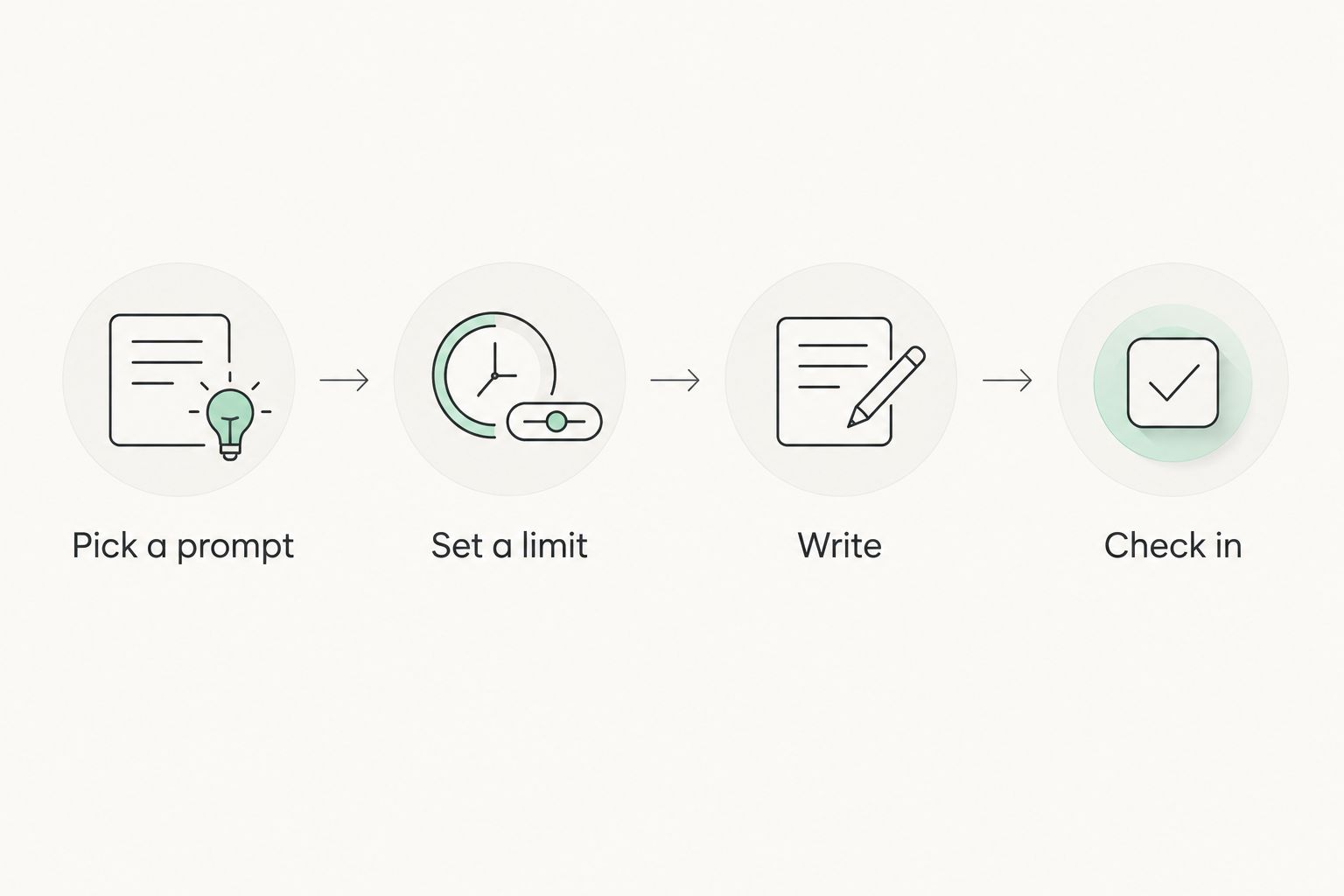
Use this sequence for your 2026 journal:
- Pick a prompt. Match the question to what you need today, not every issue you want to solve.
- Set a limit. Choose a short time window or a small amount of space before starting.
- Write. Use fragments, a list, or ordinary sentences. Leave questions unanswered when necessary.
- Check in. Notice whether you want to continue, stop, or seek support outside the journal.
You do not need to reread the entry immediately. Closing the notebook is an acceptable ending, including when you have not found an answer.
Which journal prompt should you choose?
Start with the feelings-and-needs check-in if you are undecided. Choose facts versus predictions for a particular worry, or energy and capacity when your limits need attention.
Keep the next-step question for occasions when you want an action, not as the required ending to every emotional experience. Your 2026 journal does not need a daily streak, a polished narrative, or evidence that you have improved.
Stop writing if an entry leaves you increasingly distressed, overwhelmed, or stuck revisiting painful material. You do not need to push through to finish the exercise. Journaling does not replace professional care; persistent or worsening distress deserves support beyond a notebook.
FAQ
What are the best journal prompts for mental health?
The best starting prompt in this guide is: What am I feeling right now, and what do I need? Choose a more specific question when you want to examine worry, boundaries, parenting, or current capacity.
What should I write when I don't know how I feel?
Describe what you notice rather than forcing an emotion label. Write about the situation, your thoughts, or what you want to do next, and leave the feeling unnamed if necessary.
How long should I journal for mental health?
Choose a limit that feels manageable rather than treating a duration as a requirement. A 2-minute entry is an optional starting exercise, not a proven treatment dose.
Can journaling make me feel worse?
Writing about difficult experiences can feel upsetting. Stop if your distress increases, and seek support rather than forcing yourself to complete the prompt.
Do I have to journal every day?
No, you do not have to journal every day. Use a prompt when you want to reflect; missing a day does not create a debt you need to make up.
What journal prompt can I use on a low-energy day?
Ask: What feels manageable today, what needs adjusting, and what can remain unfinished? A brief answer naming one adjustment is enough; you do not need to explain or defend your limits.
Is journaling a replacement for therapy?
No, journaling is not a replacement for therapy or other mental health care. Use it as an optional reflection practice, not as a way to diagnose or treat yourself.
One last thing
An unanswered prompt is not a failed entry. You can write I do not know what I need yet and stop there.
Keep a permission sentence beside whichever question you choose: I can leave this unfinished. Thesheemaedit's journal prompts for mental health are starting points for reflection—not another standard you have to meet.