
Best overall: “What do I need someone to understand today?” Best for a crowded mind: “What am I carrying right now?” Best when words feel hard: “Today feels like…” These journal prompts for postpartum anxiety offer different starting points for 2026, without asking you to turn a difficult day into a personal growth assignment.
- The Sheema Edit’s journal prompts for postpartum anxiety prioritize honest reflection, not another daily obligation.
- Start with one need, a short list, or three words; a finished page isn’t the goal.
- Postpartum journaling and flexible planning serve different purposes; neither replaces professional support.
- Skip any prompt that feels exposing, repetitive, or like another demand.
Why this matters
When you’re already responsible for so much, being told to journal can sound suspiciously like being assigned homework. You don’t need another thing to fall behind on. You need room to say something true without immediately making it useful to everyone else.
The Sheema Edit centers personal essays and printable journals and planners. This guide keeps reflection separate from fixing: you can name a feeling without having an explanation or a plan.
The Sheema Edit’s journal prompts for postpartum anxiety are best for moms who want a gentle starting point, not another checklist. The rankings below describe writing fit, not clinical effectiveness. Journaling isn’t a treatment for postpartum anxiety or a substitute for qualified care.
What makes the best journal prompts for postpartum anxiety?
For this 2026 guide, the strongest prompts leave room for your actual day, including the parts that don’t make a satisfying story.
- A manageable opening: You can answer with a phrase rather than a full account of your life.
- Room for mixed feelings: Love, worry, resentment, gratitude, and exhaustion don’t have to cancel each other out.
- No forced lesson: You don’t have to discover a silver lining before putting the pen down.
- A clear purpose: Each prompt helps you name a need, describe a feeling, or prepare a request.
- Permission to stop: The prompt still works if you leave it unfinished.
Choose by what feels possible, not by what sounds most emotionally impressive. Nobody is grading the depth of your notebook.
Journal prompts at a glance
| Prompt | Best for | What it offers | Key limitation |
|---|---|---|---|
| What do I need someone to understand today? | Feeling unseen | Name the need | Doesn’t communicate the need to anyone else |
| What am I carrying right now? | A crowded mind | Set it down | Can turn into a longer task list |
| Today feels like… | Very little writing capacity | Start small | Leaves less room for context |
| What am I expecting myself to do that needs reconsidering? | Pressure to do everything | Question the expectation | Some responsibilities aren’t optional |
| What would make help easier to accept? | Complicated feelings about support | Ask for support | Assumes some support is accessible |
| What do I want to say at my next appointment? | Preparing for a care conversation | Prepare your words | A page cannot replace the conversation |
| What do I want room for besides getting through today? | Feeling disconnected from yourself | Make personal space | Can feel too big on a difficult day |
You don’t need to work through this table in order. If one question feels like an invitation and another feels like an interrogation, choose the invitation.
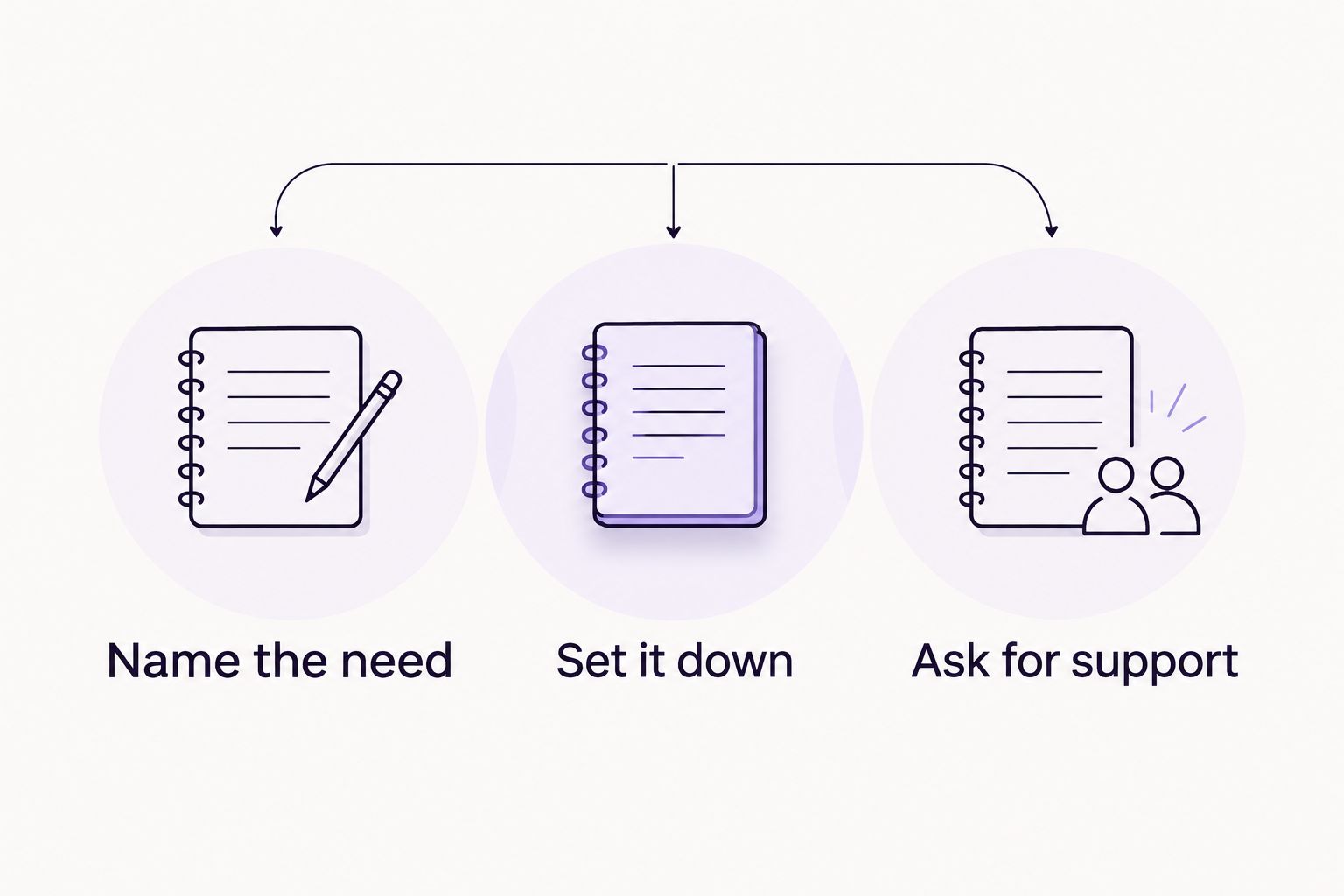
1. Name the need: best overall starting point
Prompt: What do I need someone to understand today?
This question gives you room to describe your experience without defending it. You might write that you want company without conversation, or that being asked what you need feels like another decision.
Try beginning with: “What looks manageable from the outside feels different because…” You can stop before the explanation becomes a courtroom presentation. Your journal doesn’t need supporting exhibits.
Name the need pros:
- Starts with your experience rather than your performance.
- Allows practical needs and emotional needs together.
- Can become the beginning of a conversation.
Name the need cons:
- Writing privately doesn’t tell another person what you need.
- Imagining someone’s response can pull attention away from your own words.
Best for: Days when you feel unseen or misunderstood.
If you want to share something afterward, choose one sentence rather than handing over the whole page. Keeping the rest private is an option.
Verdict: Choose this as the default when you don’t know where to begin.
2. Set it down: best for a crowded mind
Prompt: What am I carrying right now?
Write what’s occupying your attention: unfinished tasks, questions, feelings, things you’re trying not to forget. This is a place to name the load, not a promise to complete it.
If an open page feels too broad, use three headings: “On my mind,” “Not mine alone,” and “Can wait.” Leave any heading empty. The page is allowed to have vacancies.
Set it down pros:
- Welcomes fragments instead of polished sentences.
- Makes room for worries alongside practical responsibilities.
- Separates naming something from acting on it.
Set it down cons:
- A growing list can feel like more work.
- Writing every worry in detail isn’t necessary or comfortable for everyone.
Best for: Moments when you can’t decide which thought deserves attention first.
Give yourself an optional limit of 2 minutes, then decide whether continuing feels welcome. This is a writing boundary, not a recommended treatment schedule.
Verdict: Choose this to describe the load; skip it if lists feel demanding today.
3. Start small: best when words feel hard
Prompt: Today feels like…
Finish with 3 words, a sentence, or an image described in language. “A browser with every tab talking” is a perfectly respectable journal entry.
You don’t need to explain why you feel that way. If you want a second line, try: “What I wish someone understood about that is…” Otherwise, stop where you are.
Start small pros:
- Asks for very little writing.
- Leaves room for humor, uncertainty, and contradiction.
- Doesn’t require a decision or next step.
Start small cons:
- A brief entry leaves details unexplored.
- Even naming a feeling can feel like too much sometimes.
Best for: Days when a longer question feels exhausting before you’ve answered it.
In 2026, your journal can still be a notebook with an unfinished sentence. It doesn’t need a tracking system, a matching pen collection, or a public identity.
Verdict: Choose this when a small opening feels kinder than a full page.
4. Question the expectation: best for pressure to do everything
Prompt: What am I expecting myself to do that needs reconsidering?
This question looks at the expectation, not your worth. An answer might involve hosting, replying promptly, maintaining a certain household standard, or seeming cheerful when you aren’t.
Try separating “necessary” from “expected.” Some responsibilities remain necessary; that doesn’t mean every detail of how you handle them is fixed.
Question the expectation pros:
- Makes room to examine rules you’ve absorbed.
- Separates a responsibility from the standard attached to it.
- Can give you language for a boundary.
Question the expectation cons:
- Recognizing pressure doesn’t remove practical constraints.
- Changing an expectation can involve an uncomfortable conversation.
Best for: Days shaped by a long list of things you believe you should be managing better.
The self reflection journal prompts for boundaries offer another direction when your entry keeps returning to other people’s expectations. You don’t have to turn a boundary into a grand announcement; a clear sentence is enough to begin.
Verdict: Choose this when the standard needs questioning, not when you need another standard.
5. Ask for support: best for complicated feelings about help
Prompt: What would make help easier to accept?
Help isn’t automatically simple. You might want someone to take ownership of a task without asking you to supervise it, or you might want company that doesn’t require hosting.
Write about what would make support feel respectful. “Please bring food without expecting a visit” and “Please ask before giving advice” are examples of requests, not scripts you must use.
Ask for support pros:
- Names the kind of help you actually want.
- Makes room for preferences about privacy and company.
- Can separate a useful offer from another obligation.
Ask for support cons:
- Not everyone has dependable people available.
- A clear request doesn’t guarantee a thoughtful response.
Best for: Moments when you want support but feel tired just thinking about arranging it.
You can write 1 sentence beginning, “The part I need someone else to own is…” You’re describing a request, not proving that you’ve earned assistance.
Verdict: Choose this when the shape of the help matters as much as the offer.
6. Prepare your words: best before a care conversation
Prompt: What do I want to say at my next appointment?
Use this page to record what you don’t want to forget: what’s worrying you, what feels difficult, and what you want to ask. It doesn’t need to sound organized or medically precise.
You can also write, “I’m worried I won’t explain this clearly.” That sentence belongs in the conversation too.
Prepare your words pros:
- Gives your questions somewhere to live before the appointment.
- Leaves room for experiences that are hard to describe aloud.
- Lets you choose what to share.
Prepare your words cons:
- Writing doesn’t replace assessment or care.
- Preparing a page can become another demand; bringing no notes is also valid.
Best for: Readers who want a starting point for talking with a qualified professional.
If you’re considering online counseling for postpartum parents, your journal can hold questions about privacy, appointment format, and whether the clinician works with postpartum concerns. Those questions belong in choosing care, not just in deciding what to write.
Verdict: Choose this to prepare for support, not to replace it.
7. Make personal space: best for remembering your own preferences
Prompt: What do I want room for besides getting through today?
The answer doesn’t need to be ambitious. You might miss a certain kind of conversation, listening to music without doing something else, or choosing what you watch.
This isn’t an instruction to reclaim yourself on a deadline. If the question feels too large, try: “What would I choose if nobody needed an answer from me for a moment?”
Make personal space pros:
- Makes room for preferences beyond responsibilities.
- Doesn’t require a purchase or a new project.
- Allows small wants without turning them into goals.
Make personal space cons:
- Naming what you miss can bring up sadness.
- Wanting something doesn’t create the time or support to access it.
Best for: Days when you want to hear your own preferences without making another plan.
Verdict: Choose this when curiosity feels welcome; leave it for another day when it doesn’t.
How these prompts were ranked
The Sheema Edit’s 2026 ranking puts the broadest, least demanding opening first, then separates prompts by purpose. These aren’t rankings of anxiety relief or medical outcomes.
The criteria are simple: manageable effort, room for mixed feelings, a clear purpose, and permission to stop. Your best choice can change from one day to the next.
Which journal prompt should you choose?
Start with “What do I need someone to understand today?” It gives you a place to begin without requiring a solution.
If that feels too open, choose “Today feels like…” and write a short phrase. Your 2026 journal doesn’t need consecutive dates to contain something worth keeping.
FAQ
What are the best journal prompts for postpartum anxiety?
Start with ‘What do I need someone to understand today?’ for open reflection, or ‘Today feels like…’ for a smaller opening. Choose by what feels manageable, not by how much you think you should write.
Can journaling treat postpartum anxiety?
Journaling is not a treatment or a substitute for qualified care. You can use writing to describe your experience or prepare questions for a professional.
Do I have to journal every day after having a baby?
No, you don’t need to journal every day. You can write occasionally, leave gaps, or stop without making up missed entries.
What if journaling makes me feel more overwhelmed?
You can stop writing and leave the prompt unfinished. If anxiety is affecting your daily life, discuss what you’re experiencing with a qualified healthcare professional rather than relying on journaling alone.
Should I use a planner or a journal postpartum?
Choose a journal for reflection and a planner for practical commitments. You don’t need both, and neither needs to become another standard you must meet.
What can I write when I don’t have words for my feelings?
Try finishing ‘Today feels like…’ with a phrase, a comparison, or a few words. You can also leave the page blank; a journal doesn’t require an answer.
Should I share my postpartum journal with someone?
Sharing your journal is optional. You can share one sentence or summarize a concern without giving someone access to the whole page.
One last thing
A journal entry can end with a question mark. You don’t owe the page a resolution, and you don’t have to turn every difficult feeling into a lesson.
For your next entry, consider leaving out the improvement plan. Write what you want understood, then let that be enough for the page.