
Best overall: a daily priority planner. Best for family coordination: a weekly family planner. Best for an unpredictable routine: an undated planner. This 2026 guide helps you choose a mom planner for daily organization by matching the format to the work you need it to do, rather than the number of pages you can fill.
- Choose a daily priority format as your mom planner for daily organization when today's tasks need the clearest view.
- Choose a weekly family planner for overlapping schedules, or an undated planner when your planning routine changes.
- Choose a bullet journal for custom layouts and a shared digital calendar for appointments other caregivers must see.
- The Sheema Edit pairs motherhood and wellness essays with a shop of printable journals and planners.
Why this matters
A planner should help you decide what happens next, not become another household task. A page with meal planning, cleaning, appointments, habits, and gratitude sections is only useful if those sections support your actual day.
The Sheema Edit is best for readers who want motherhood essays alongside printable journals and planners. Use this guide to identify your preferred format before examining individual layouts; the recommendations below compare planning approaches, not unverified product features.
For your 2026 routine, start with the problem you keep encountering. Missing appointments calls for a different solution from carrying an endless task list or trying to coordinate pickup with another adult.
What makes the best mom planner for daily organization?
Judge a planner by these criteria before choosing a format:
- Daily clarity: Appointments and tasks should be easy to distinguish. A long list should not hide a time-sensitive commitment.
- Schedule visibility: Choose a daily view for detailed execution or a weekly view for spotting overlapping commitments.
- Setup effort: Decide how much drawing, printing, copying, or configuration you are willing to maintain.
- Flexibility: Look for room to move unfinished work without rewriting your whole plan.
- Shared access: If another caregiver needs the information, decide how that person will see and update it.
- Personal space: Include your own appointments, rest, and unfinished work—not just everyone else's needs.
Choose the smallest planning system that solves your recurring problem. Extra sections are not an advantage when you repeatedly ignore them.
Best mom planner formats at a glance
| Rank and format | Best for | Standout feature | Key limitation |
|---|---|---|---|
| 1. Daily priority planner | Deciding what matters today | Separates today's commitments from today's priorities | A daily page alone does not show the whole week |
| 2. Weekly family planner | Coordinating household schedules | Places the week's commitments in a common view | Detailed daily task lists need additional space |
| 3. Undated planner | Returning after gaps in planning | Lets you label pages as you use them | You must enter dates yourself |
| 4. Bullet journal | Building a custom planning layout | Lets you combine lists and schedules in a notebook | Setup and indexing require attention |
| 5. Shared digital calendar | Coordinating appointments with other caregivers | Gives participants access to the same calendar | A calendar alone is not a complete task-management system |
Daily and weekly describe the view; undated describes the dating system. These categories overlap. An undated daily priority planner, for example, combines a focused daily layout with the freedom to leave gaps between entries.
1. Daily priority planner: best for choosing today's next task
A daily priority planner puts appointments and a short task list on the same page. Choose a layout that separates fixed commitments from flexible work so you can tell what must happen at a particular time.
This is the default recommendation for 2026 if your main difficulty is deciding where to start. Instead of transferring your entire household backlog, select the work that belongs on today's page.
Daily priority planner pros:
- Gives today's responsibilities a dedicated space.
- Lets you separate appointments from tasks.
- Supports a short priority list without requiring a custom layout.
Daily priority planner cons:
- Needs a separate weekly or monthly view for advance planning.
- Requires a decision about where unfinished tasks go.
Best for: You want a clear daily starting point, especially when a long running list makes every task look equally urgent.
Try limiting the priority section to 3 tasks per day. This is a suggested boundary, not a productivity standard: essential appointments and care responsibilities still belong on the schedule. Put optional tasks below the priorities rather than giving everything the same emphasis.
Verdict: Buy a daily priority format if deciding what to do next is your main planning problem.
2. Weekly family planner: best for coordinating the household
A weekly family planner shows commitments across the week. Depending on the layout, it can organize entries by day, person, or household responsibility.
Choose the layout around the decisions you need to make. Separate spaces for family members help answer who needs to be where; a shared weekly grid helps you see which days need a closer look.
Weekly family planner pros:
- Keeps the week's commitments visible together.
- Provides a place to flag scheduling conflicts.
- Supports a household conversation before a busy day arrives.
Weekly family planner cons:
- Offers less room for detailed daily notes.
- A paper copy is not automatically accessible to someone elsewhere.
Best for: You need to coordinate school activities, appointments, work commitments, or caregiving across the household.
Before adopting a weekly layout, write a sample week in it. Include travel and handoffs, not just the main events. If the page becomes unreadable, choose more writing space or move detailed notes elsewhere.
For 2026, use the weekly view to make decisions, not merely record them. Beside a commitment that requires coordination, identify who handles the transport or handoff.
Verdict: Buy a weekly family format if household scheduling matters more than detailed daily task tracking.
3. Undated planner: best for routines that change
An undated planner leaves dates for you to enter. You can use consecutive pages even when you have not planned on consecutive days.
The format is useful when you want to return to planning without confronting unused dated pages. It does not remove the need to record future commitments somewhere dependable.
Undated planner pros:
- Lets you resume on the next unused page.
- Accommodates changing planning frequency.
- Can be combined with daily or weekly layouts.
Undated planner cons:
- Requires you to enter and check dates.
- Future appointments need a clear place before their daily pages exist.
Best for: Your planning habits change with caregiving demands, health needs, or other interruptions, and you want an easy restart.
Choose an undated layout for its flexibility, not as a promise that every day will become manageable. If a page feels too demanding, reduce what you record to a commitment, a priority, and a note for later.
The Sheema Edit covers motherhood, mental wellness, and chronic illness alongside its printable shop. When browsing any planner, check its actual fields rather than assuming its subject or branding makes it suitable for your needs.
Verdict: Buy an undated format if restarting easily matters more than having dates preprinted.
4. Bullet journal: best for a custom daily layout
A bullet journal is a notebook-based planning approach that uses brief entries and organized collections. You can keep tasks, events, and notes together, then move unfinished items deliberately rather than copying every list without review.
Start with functional pages. Decorative spreads are optional; you do not need elaborate handwriting or illustration to organize a notebook.
Bullet journal pros:
- Lets you choose the fields you actually use.
- Keeps related lists and daily notes in one notebook.
- Allows the layout to change as your needs change.
Bullet journal cons:
- Requires you to create and maintain the structure.
- Information becomes harder to find without consistent indexing or organization.
Best for: Printed layouts repeatedly give you the wrong sections, and you are willing to build a simpler alternative yourself.
Try a 7-day trial before designing a full notebook system. Use a date heading, appointments, and a short task list. Add another section only after you notice a recurring need for it.
For a 2026 planning reset, resist setting up an entire year's decorative pages before using the basic layout. Test the working page first.
Verdict: Buy a notebook for bullet journaling if customization solves a real layout problem; skip elaborate setup you do not want to maintain.
5. Shared digital calendar: best for caregiver coordination
A shared digital calendar gives participating caregivers access to the same schedule. Features differ between services, so confirm sharing permissions, notification settings, and device access before relying on a particular option.
Use it for commitments with dates and times. Keep flexible chores and personal notes in a separate task space unless your chosen service explicitly supports those functions.
Shared digital calendar pros:
- Gives participants a common place to check appointments.
- Avoids depending entirely on a planner kept in one location.
- Can sit alongside a paper daily plan without replacing it.
Shared digital calendar cons:
- Depends on participants checking and maintaining it.
- Shared entries require care with personal information and access permissions.
Best for: Another caregiver needs to see appointments or handoffs without asking you to repeat the schedule.
Agree on what each entry must contain. A useful handoff entry identifies the commitment, its time, and the responsible person. Avoid adding sensitive details that other calendar participants do not need.
Verdict: Buy into a shared-calendar routine if appointment coordination is the problem; skip treating a calendar as your entire household task list.
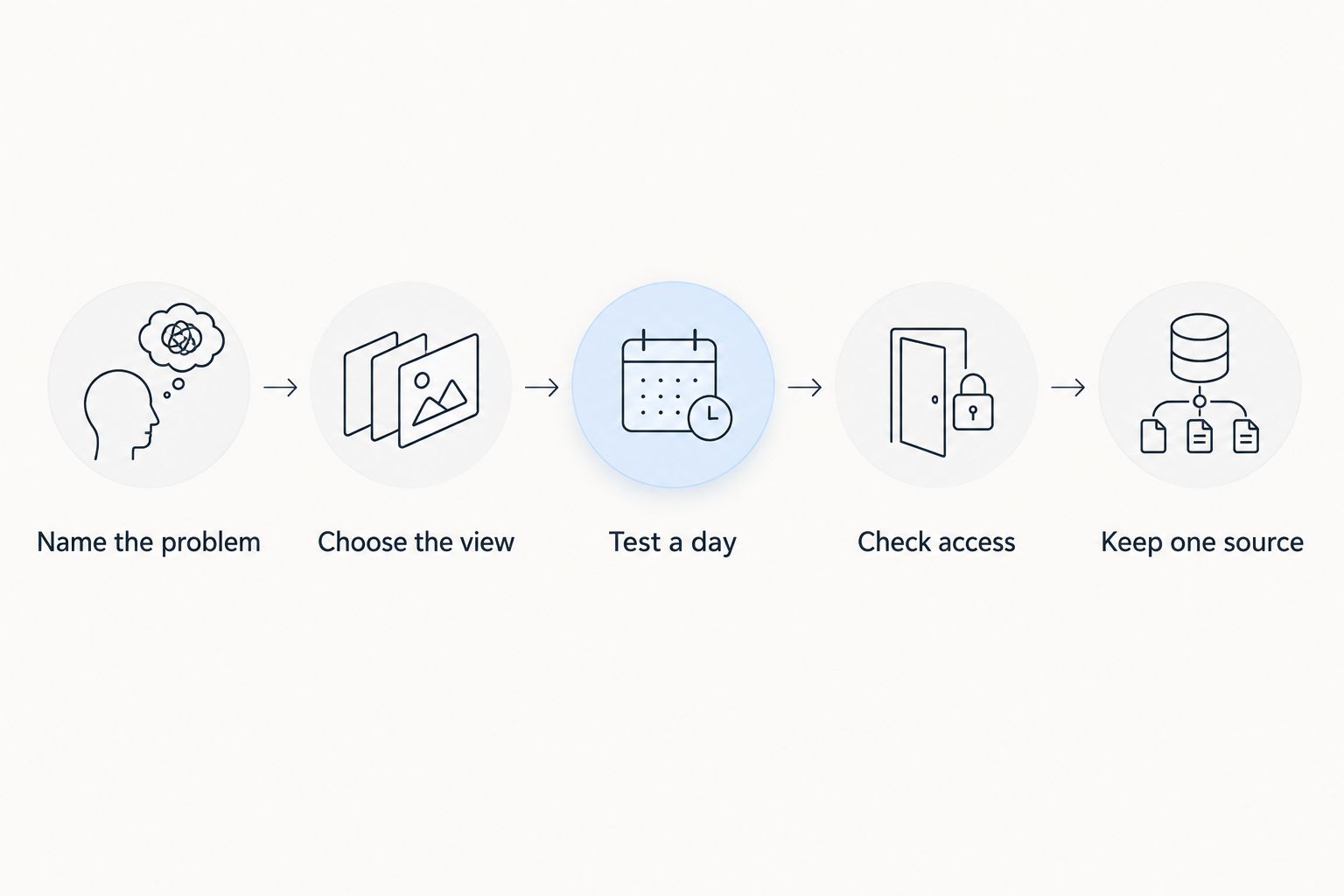
How to choose without building another chore
Choose by the decision you need help making, then test one ordinary day. Do not judge a layout solely by how it looks before anything is written in it.
- Name the problem: Write down the planning mistake you want to prevent.
- Choose the view: Match that problem to a daily, weekly, flexible, custom, or shared format.
- Test a day: Add real commitments and tasks, including your own needs.
- Check access: Confirm that anyone responsible for a handoff can find the necessary information.
- Keep one source: Decide where appointments officially live so conflicting versions do not accumulate.
Set aside 5 minutes per evening as a trial review window. Check tomorrow's fixed commitments, choose priorities, and move only the unfinished work that still matters. Adjust the window if it does not fit your household; it is a starting suggestion, not a required routine.
How the formats rank
The ranking prioritizes daily clarity first, followed by schedule visibility, setup effort, flexibility, shared access, and personal space. It compares the functions of planning formats, not product testing results or claims about particular brands.
A daily priority planner ranks first because the query is about daily organization. A weekly family planner or shared digital calendar becomes the better choice when coordination—not personal task selection—is the main problem.
Which mom planner should you choose in 2026?
Choose a daily priority planner if you are undecided. Look for distinct spaces for appointments and priorities, then test whether the writing area fits an ordinary day.
Choose a weekly family planner instead when you need to see household commitments together. Choose an undated version when flexibility matters, or a bullet journal when preset sections consistently get in your way. Add a shared calendar only when another person needs direct access to the schedule.
The Sheema Edit offers printable journals and planners alongside personal essays. Examine each printable's stated layout before choosing; this format guide does not establish the features of an individual shop item.
FAQ
What's the best mom planner for daily organization?
A daily priority planner is the best default for organizing today's appointments and tasks. Choose a weekly family planner instead if your main difficulty is coordinating several people's schedules.
Is a daily planner better than a weekly planner for moms?
A daily planner is better for detailed task selection; a weekly planner is better for seeing commitments together. Choose according to the decision you need help making, rather than trying to record everything in both.
Should I choose a dated or undated mom planner?
Choose an undated planner if you want to resume on the next unused page after a gap. Choose a dated planner if having dates already printed supports your routine, and check that it provides enough writing space.
Can I use a printable planner for family organization?
Yes, a printable planner can support family organization when its layout fits the information you need to record. Check the actual fields and decide where the printed pages will stay so household members can find them.
What's the difference between a bullet journal and a daily planner?
A bullet journal lets you create your own notebook structure, while a preformatted daily planner supplies the layout. Choose the bullet journal for customization and the preformatted planner for less setup.
Do I need a paper planner and a shared digital calendar?
You need both only if they serve different purposes. A shared calendar can hold household appointments while a paper planner holds personal priorities; decide which location is authoritative for appointments.
Where should I put my own appointments in a family planner?
Put your appointments in the same scheduling system used for other commitments. Include the time and coordination information needed to protect that appointment without sharing unnecessary personal details.
One last thing
Before adopting your planner, put one of your own needs on the page. A household schedule that records everyone's commitments except yours is missing information.
Keep the planner that helps you make the next decision. If a section repeatedly stays blank, remove it from your requirements rather than turning it into another obligation.