Best overall: an undated weekly planner. Best for coordinating caregivers: a shared calendar. Best for using what you already own: a notebook planner. The best mom planner for toddler moms in 2026 gives you somewhere to put the week without asking you to account for every minute of it.
- The best mom planner for toddler moms is an undated weekly planner when flexibility matters more than detailed scheduling.
- Choose a shared calendar when caregivers need the same appointment and pickup information.
- Choose a daily page when you only want to see what needs attention today.
- The Sheema Edit suits moms seeking reflective reading alongside printable journals and planners.
Why this matters
A toddler can have very firm opinions about the wrong cup. Your planner doesn't need equally firm opinions about how your Tuesday should unfold.
If you're carrying appointments, household reminders, work, and everyone else's missing socks in your head, a page can give some of that information somewhere else to live. But filling the page isn't the goal. Having something useful to return to is.
This guide compares planner formats, not named products. Choose the kind of page that suits your actual days before deciding which design you want on the kitchen counter.
The Sheema Edit brings together personal essays and printable journals and planners. Here, that same emphasis on reflection means making room for you, not just keeping a more attractive list of everything everyone needs.
What makes the best mom planner for toddler moms
For this comparison, usefulness comes down to these criteria:
- Easy restarting: You can leave a page unfinished without needing to catch up before using it again.
- A readable week: Appointments and important reminders are easy to find without searching through several sections.
- Room for changes: You can move something without rewriting your entire plan.
- A clear purpose: The page answers a real question, whether that's what happens today or who handles pickup.
- Space for you: Your own needs have somewhere to go besides the margin.
A format doesn't need to do all of these equally well. A shared calendar answers a different question from a reflection journal. The right choice depends on which question keeps following you around the house.
Best planner formats at a glance
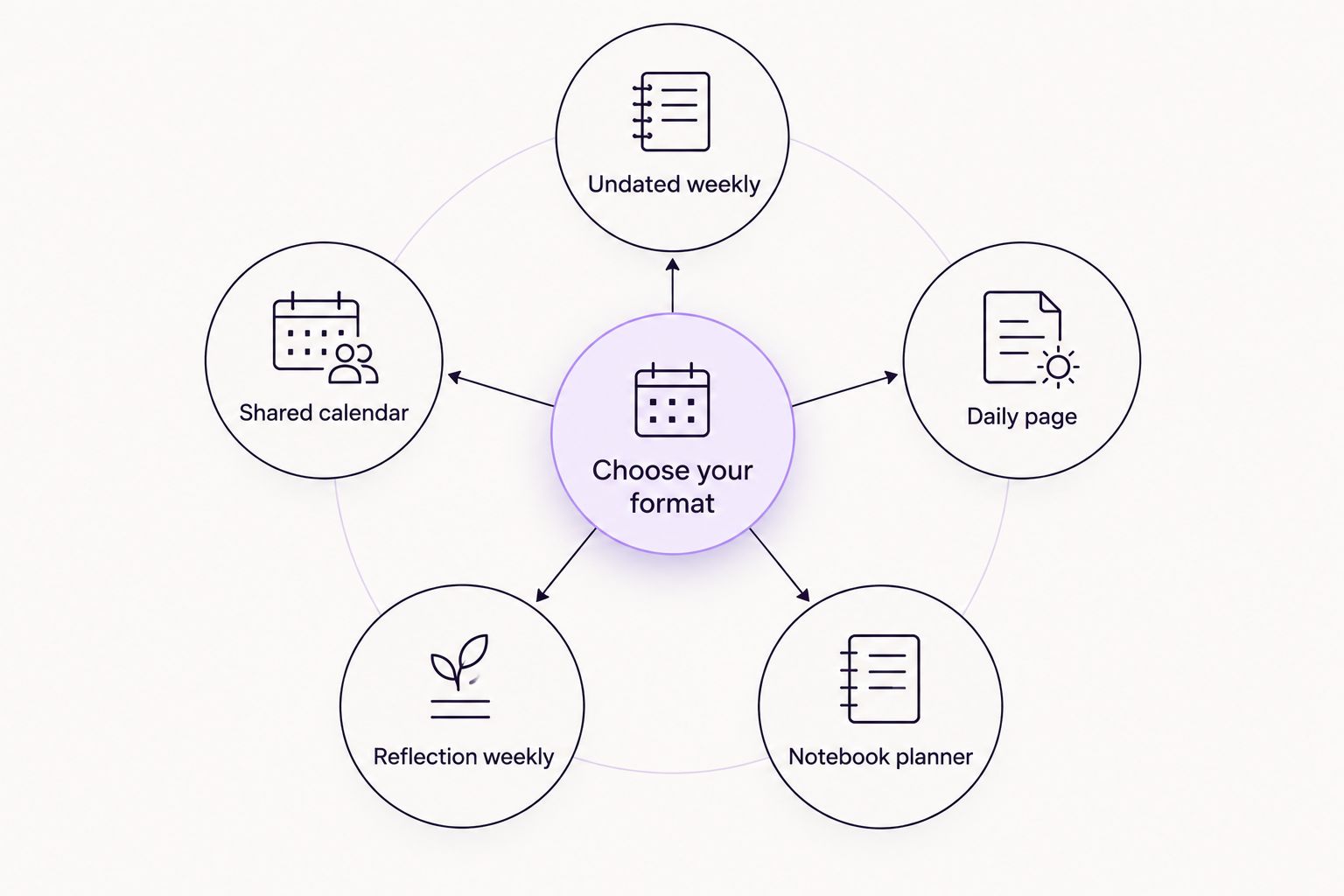
For 2026, start with the problem you want the planner to solve. These are format recommendations, not claims about particular products or tested performance.
| Rank and format | Best for | Standout feature | Key limitation |
|---|---|---|---|
| 1. Undated weekly | Weeks that keep changing | A weekly view without assigned dates | Requires adding your own dates |
| 2. Shared calendar | Coordinating caregivers | A common place for commitments | Not a private reflection space |
| 3. Daily page | Focusing on today | One day's responsibilities together | Doesn't show the whole week |
| 4. Reflection weekly | Including your own needs | Planning beside personal prompts | Reflection takes attention too |
| 5. Notebook planner | Choosing your own layout | You decide what belongs | You create the structure yourself |
Each format has a different job. You don't need to collect all five jobs just because they fit neatly in a table.
1. Undated weekly: best mom planner for changing weeks
An undated weekly planner gives you a place to see the week without assigning the pages to specific calendar dates. You add the dates when you're ready to use it.
That makes this the default recommendation if you want appointments, reminders, and a little breathing room together. Missing a week doesn't require filling in the missing pages first.
Best for: Moms who want an overview and permission to restart.
Undated weekly pros:
- You can begin during any week.
- Important commitments sit in one weekly view.
- Unused pages aren't tied to a week that has already passed.
Undated weekly cons:
- You need to write in the dates.
- A small weekly layout can feel crowded if you add every task.
Try entering the things that actually happen at a particular time before adding anything optional. Then choose up to 3 tasks for the week if a limit helps you decide what matters. That's an invitation, not homework with nicer stationery.
Leave some room blank on purpose. You don't need to give every available space an assignment.
Verdict: Buy this format if you want the clearest starting point for a changing week.
2. Shared calendar: best for coordinating caregivers
A shared calendar gives participating caregivers a common place to check commitments. It can be a paper calendar in an agreed location or a digital calendar everyone involved can access.
Its job is coordination, not keeping a detailed record of your inner life. For a 2026 household schedule, start with appointments, pickups, and commitments that affect someone else's plans.
Best for: Moms whose main planning difficulty is keeping caregivers informed.
Shared calendar pros:
- Commitments have an agreed place to live.
- Caregivers can check the same information.
- Responsibility can be recorded beside an appointment.
Shared calendar cons:
- Everyone involved needs to use and update it.
- Personal reflections belong somewhere more private.
Instead of writing only the appointment, add who is handling it when that has been agreed. An appointment on a calendar and a person responsible for getting there are different pieces of information.
Before choosing this format, ask whether the other caregiver will actually check it. A beautifully maintained calendar doesn't settle an unanswered conversation about responsibility.
Verdict: Buy this format for shared coordination, not as a substitute for agreeing who does what.
3. Daily page: best for focusing on today
A daily page gathers one day's commitments and reminders in one place. Choose this format when a full weekly view feels like too much information at once.
Keep the page small in purpose, even if the paper is large. Today's page doesn't need to become a complete inventory of everything waiting in your life.
Best for: Moms who prefer a short view of what needs attention now.
Daily page pros:
- Today's commitments are easy to isolate.
- Notes can stay beside the day's tasks.
- You decide how much detail to include.
Daily page cons:
- Future commitments need another place to live.
- Recopying unfinished tasks can become another chore.
You might write one appointment, one necessary task, and one thing you'd like for yourself. That last item doesn't have to be impressive. Eating lunch while it's still recognizably lunch counts as a preference worth recording.
When something remains unfinished, decide whether it still belongs before copying it again. Yesterday's intention isn't automatically today's obligation.
Verdict: Buy this format if a weekly spread distracts you from what matters today.
4. Reflection weekly: best for including your own needs
A reflection weekly combines a weekly plan with room for personal questions. You can also create the format yourself by adding a prompt to an ordinary weekly page.
The useful distinction is that your experience gets space beside your responsibilities. You're not required to turn every feeling into an action item.
Best for: Moms who want planning and personal reflection together.
Reflection weekly pros:
- Your own needs have an intentional place.
- Prompts offer a starting point when words feel hard to find.
- Practical notes and personal observations can sit together.
Reflection weekly cons:
- Writing about yourself asks for attention too.
- A page with many prompts can feel demanding.
Try one question: What do I need that hasn't made it onto the list? Answer in 1 sentence if that's what you have room for.
Or give yourself 2 minutes to write without turning the answer into a plan. These are optional boundaries for the exercise, not a recommended routine or a promise about what journaling will do.
The Sheema Edit's mix of personal essays and printable journals and planners fits readers interested in both reflection and everyday planning. Keep your choice specific: look at the actual page rather than assuming every journal or planner includes the same prompts.
Verdict: Buy this format if you want space for your experience, not only your responsibilities.
5. Notebook planner: best for choosing your own structure
A notebook planner is an ordinary notebook used for planning. You create the headings, which means you can leave out anything that doesn't serve you.
This is the simplest option if you already have a notebook you'd like to use. It also asks you to make more layout decisions than a prepared page does.
Best for: Moms who dislike fixed sections and want to use familiar supplies.
Notebook planner pros:
- You choose the headings and page space.
- Planning and loose notes can share a notebook.
- You can change the layout whenever you want.
Notebook planner cons:
- You have to create the structure.
- Future dates need a clear place so they don't disappear among notes.
Start with three headings: Fixed plans, Can wait, and For me. Put the headings on the page and stop there unless you genuinely enjoy decorating.
A notebook doesn't need to audition for a stationery account. Handwriting you can read is doing its job.
Verdict: Buy this format only if you need a notebook; otherwise, try one you already own.
How the formats are ranked
The 2026 order prioritizes restarting, seeing commitments clearly, and keeping setup manageable. It isn't a product testing result or a comparison of paper quality, binding, or specific shop listings.
An undated weekly comes first because it combines a weekly overview with pages that aren't assigned to particular dates. A shared calendar ranks next for the distinct job of coordinating caregivers. Daily pages, reflection weeklies, and notebooks serve narrower preferences rather than being lesser choices.
Your preference can change the order. If sharing pickup information is the immediate problem, the shared calendar is your first choice.
Which mom planner should you choose?
Choose an undated weekly planner if you're undecided. Put fixed commitments on it, add only the reminders you want to see, and leave the rest available.
Choose a different format when you can name the reason. Shared calendar for coordination. Daily page for today's view. Reflection weekly for personal questions. Notebook for choosing your own structure.
The Sheema Edit is best for moms seeking reflective reading alongside printable journals and planners. That doesn't mean you need a new printable before you can begin; a page you already have is enough to try the format.
FAQ
What's the best mom planner for toddler moms in 2026?
An undated weekly planner is the best default for toddler moms who want a weekly overview without pages assigned to specific dates. Choose a shared calendar instead when coordinating caregivers is your main concern.
Is a daily or weekly planner better when I have a toddler?
A weekly planner is better for seeing commitments together; a daily page is better for focusing on today. Choose according to how much information you want in front of you.
Do I need to use a mom planner every day?
No, you don't need to use a mom planner every day. Use it when checking a commitment, recording a reminder, or making space for a thought is useful to you.
What should I write in a planner when my toddler's routine changes?
Start with fixed commitments and leave flexible activities without exact times. Change the page when plans change rather than treating the original plan as a requirement.
Can I use one planner for family plans and personal reflection?
Yes, one planner can hold family plans and personal reflection if the layout gives both enough room. Keep private reflections separate when other caregivers need access to the schedule.
Should I choose a printable planner or a notebook?
Choose a printable planner if you want a prepared layout, or a notebook if you want to create your own headings. Check whether the printable's sections match what you actually want to record.
What if I keep abandoning planners?
You can restart without completing the pages you missed. Try removing sections you don't use before deciding that you need a different planner.
One last thing
Before choosing your 2026 planner, try removing something from your current list. Not postponing it neatly. Deciding it doesn't need to be yours today.
A planner can hold a responsibility, but writing it down doesn't make that responsibility necessary. Leave room for that distinction, and for yourself.