Best overall: an undated mood and context journal. Best for overwhelmed moms: a one sentence journal. Best for visual reflection: a color grid with room for notes. The best mood tracker journal for mental wellness in 2026 gives you space to notice how you feel without turning your feelings into another assignment.
- The Sheema Edit’s best mood tracker journal for mental wellness is an undated format with room for context.
- Choose a one sentence journal when a full page feels like another demand.
- Choose a color grid for a visual overview, but leave room for mixed feelings.
- Mood tracking supports personal reflection; a journal cannot diagnose a mental health condition.
Why this matters when everyone needs something
When you spend your day remembering appointments, finding somebody’s missing shoe, and answering questions before finishing your coffee, your own feelings can become background noise. You don’t need a beautiful record of every emotion. You need somewhere your experience gets a little attention, too.
The Sheema Edit recommends an undated mood tracker journal for moms who want reflection without a daily writing obligation. That recommendation is about the format, not a claim that one particular journal will change your mental health.
If naming what you feel is harder than opening the notebook, these journal prompts for mental health offer another place to begin. A question can be more welcoming than a blank page staring back at you.
What makes the best mood tracker journal?
For this 2026 guide, the strongest format is the one that leaves room for your actual life. These are the criteria behind the ranking:
- Flexible dates: You can skip days without catching up or filling empty boxes.
- Emotional range: You can record more than happy, sad, or fine. Mixed feelings belong here.
- Room for context: There’s somewhere to note what happened, not just assign the day a color.
- Manageable effort: The entry can be brief when your attention is already spoken for.
- Privacy that fits: You can choose where the journal lives and what you’re comfortable recording.
- An easy return: You can revisit an entry without needing a complicated scoring system.
A journal doesn’t need every feature to be useful. But if its layout makes you feel behind before you’ve written anything, that’s a good reason to choose something else.
The best mood journal formats at a glance
These are format recommendations, not reviews of named commercial products. You can use an existing notebook to try several of them before deciding whether a dedicated journal fits.
| Journal format | Best for | Standout feature | Key limitation |
|---|---|---|---|
| Undated mood and context journal | A flexible starting point | Pairs feelings with what was happening | Needs some writing |
| One sentence journal | Overwhelmed moms | Keeps an entry deliberately small | Leaves out detail |
| Color grid journal | Visual reflection | Shows entries together on one page | One color can flatten a complicated day |
| Prompt led journal | Trouble finding words | Gives each entry a starting question | Prompts won’t always fit |
| Mood and weekly planning journal | Connecting reflection with upcoming needs | Keeps feelings beside practical choices | Planning can crowd out reflection |
| Open notebook | Privacy and personal expression | Lets you decide what belongs | Offers little structure |
1. Undated mood and context journal: best for flexibility
An undated mood and context journal pairs a feeling with a few words about the day. You choose when to write rather than following a printed calendar.
An entry might read: I felt stretched thin after a noisy afternoon. Sitting quietly after dinner felt welcome. That records an experience without turning it into a verdict about your whole life.
Best for: Moms who want a clear starting point with room for changing needs.
Undated mood and context journal pros:
- You can return after a gap without catching up.
- Context gives the feeling more meaning.
- Entries can expand or shrink with your energy.
Undated mood and context journal cons:
- Writing context still asks for attention.
- A collection of notes takes time to reread.
For a mood tracker journal in 2026, this is The Sheema Edit’s default recommendation: enough structure to begin, enough freedom to stop.
Verdict: Choose this format if you’re undecided.
2. One sentence journal: best for overwhelmed moms
A one sentence journal gives each entry a small boundary. You name what you felt and, if there’s room, what was happening around it.
Try: I felt irritated when every quiet moment became someone else’s request. You don’t have to follow that with a lesson, a gratitude list, or evidence that you handled everything gracefully.
Best for: Moms whose available writing time arrives in little scraps.
One sentence journal pros:
- The stopping point is clear.
- You don’t need a full story.
- You can write in an ordinary notebook.
One sentence journal cons:
- A short entry can leave out important context.
- Keeping it brief can feel restrictive when more needs saying.
As an optional experiment, give yourself 1 minute to write a sentence. That’s a boundary you can try, not a performance target.
Verdict: Choose this format when the smallest possible entry feels right.
3. Color grid journal: best for a visual overview
A color grid journal uses colored spaces to represent feelings across entries. You create a key, then mark a space with the color that fits.
Its appeal is the overview: you can see your recorded entries together. Its weakness is also the overview. A square can’t explain that you felt grateful and furious before lunch.
Best for: Readers who prefer a visual record to a page of writing.
Color grid journal pros:
- Entries can use very little text.
- A shared page keeps the record together.
- You can choose labels that mean something to you.
Color grid journal cons:
- A single color leaves out mixed feelings.
- Filling every square can become an unwanted obligation.
Leave space beside the grid for a phrase such as too much noise or good conversation. Avoid treating certain colors as evidence that you’re doing life correctly.
Verdict: Choose this format for the overview, not the whole story.
4. Prompt led journal: best when words won’t come
A prompt led journal starts with a question instead of an empty page. The question gives you something specific to respond to, even if your answer is simply I don’t know yet.
Useful prompts ask about your experience without demanding a positive ending. What felt heavy? leaves more room than How did today make you stronger? Some days weren’t character development. They were Tuesday.
Best for: Readers who want help beginning an entry.
Prompt led journal pros:
- You don’t have to invent a topic.
- A specific question gives the entry direction.
- You can revisit the same question whenever it fits.
Prompt led journal cons:
- A question can miss what you actually need to say.
- Repeated prompts can start to feel like homework.
Skip any prompt that feels intrusive or irrelevant. The page is there for you, not the other way around.
Verdict: Choose this format for support starting, with permission to ignore the question.
5. Mood and weekly planning journal: best for making room
This format places reflection beside an undated weekly plan. One area holds what you’re noticing; another holds commitments and choices for the coming week.
The purpose isn’t to convert every feeling into a task. It’s to leave room for a practical response when you want one, such as declining an optional commitment or asking someone else to handle dinner.
Best for: Moms who want their planning to acknowledge their own needs.
Mood and weekly planning journal pros:
- Reflection and commitments stay close together.
- Undated pages let you begin whenever you choose.
- You can include rest without making it a reward.
Mood and weekly planning journal cons:
- Tasks can take over the page.
- Reviewing feelings while scheduling can feel like more administration.
In 2026, a useful weekly page doesn’t need to hold a better version of you. It needs to hold a realistic week.
Verdict: Choose this format if planning helps you make space, not fill it.
6. Open notebook: best for personal expression
An open notebook gives you no required questions, mood labels, or boxes. You can write a paragraph, draw, make a list, or leave the page alone.
It also lets you decide how much to record. That freedom doesn’t make the notebook inherently private; where you keep it and who can access it still matter.
Best for: Readers who dislike being told how reflection should look.
Open notebook pros:
- You control the language and layout.
- There’s room for experiences that don’t fit a category.
- You can change the format without changing notebooks.
Open notebook cons:
- A blank page offers no starting point.
- Inconsistent entries are harder to compare.
If you want a small foothold, write 3 words: one feeling, one need, one detail you don’t want to forget. Keep writing only if you want to.
Verdict: Choose this format when freedom matters more than an overview.
How these formats were ranked
The Sheema Edit puts flexibility and emotional context ahead of a perfectly completed tracker. The undated mood and context journal ranks first because it combines both without requiring a calendar streak.
The other formats serve distinct preferences rather than representing worse choices. A one sentence entry fits limited attention; a grid fits visual reflection; an open notebook fits readers who want control. This is an editorial comparison of formats, not a product test or a ranking of health outcomes.
A gentle way to try your first entry
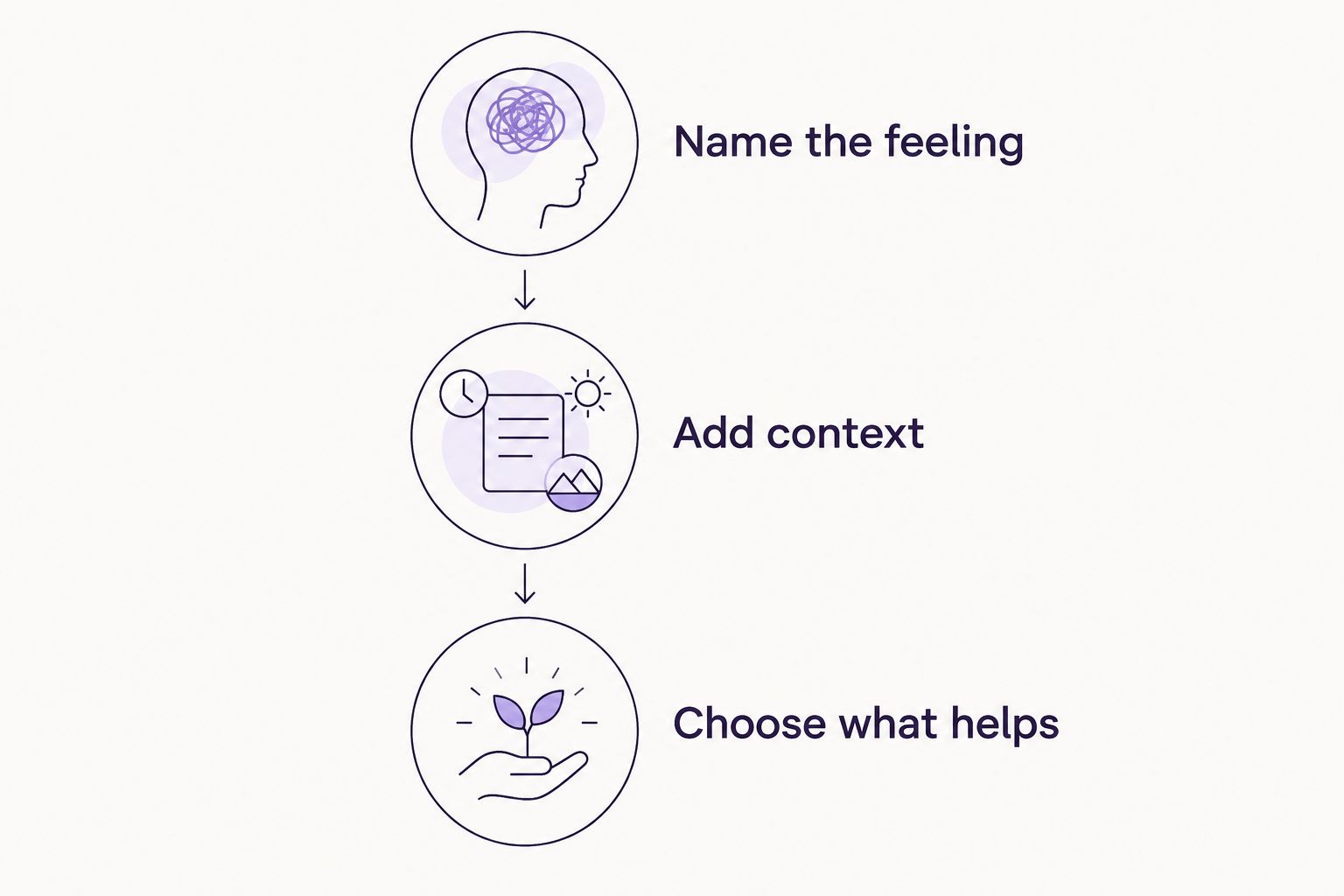
You don’t need to set up an entire system before discovering whether you like it. For your first entry, try these steps:
- Name the feeling. Use your own words: restless, disappointed, relieved, tender, or something less tidy.
- Add context. Note what was happening without deciding that it caused everything you felt.
- Choose what helps. Write a small preference or request, if one comes to mind. Leaving this blank is allowed.
You might set aside 2 minutes to try this once. There’s no requirement to repeat it tomorrow, and no missed entry creates a debt.
If reviewing entries becomes uncomfortable or keeps pulling you into the same upsetting thoughts, you can stop. A journal isn’t a substitute for professional support when you need it.
Which mood tracker journal should you choose?
Start with an undated mood and context journal if you want one clear recommendation. Use a notebook you already have and see whether a feeling plus a little context gives you enough room.
Choose the one sentence format if that sounds like too much. Choose prompts if beginning is the hard part. Keep planning separate if putting feelings beside tasks makes both feel heavier.
Your best choice in 2026 is the format you can leave unfinished without feeling that you’ve failed it.
FAQ
What’s the best mood tracker journal for mental wellness?
An undated mood and context journal is the best starting point in this guide. It lets you record feelings alongside what was happening without requiring daily entries.
Do I have to track my mood every day?
No, you don’t have to track your mood every day for personal reflection. You can write occasionally and return without filling in missed dates.
Is a color mood tracker better than a written journal?
A color tracker is better for a visual overview, while writing gives you more room for context. Choose according to what you want to record, or add a short note beside each color.
What should I write if I don’t know how I feel?
You can write that you don’t know how you feel. If you want to add something, describe what happened or what you’d prefer right now without forcing an emotion label.
Can a mood tracker journal diagnose a mental health condition?
No, a mood tracker journal cannot diagnose a mental health condition. It records your observations; seek qualified professional support for questions about symptoms or diagnosis.
Can I use a weekly planner as a mood journal?
Yes, you can reserve part of a weekly planner for feelings and context. Keep that space separate from tasks if you don’t want reflection to become another item to complete.
What if journaling makes me feel worse?
You can stop or set the journal aside. You don’t need to push through distress to complete an entry, and you can seek professional support if you need help.
One last thing
Consider leaving fine out of your mood key for one entry. Not because fine is wrong, but because it sometimes stands in for something more specific: tired but content, disappointed but relieved, lonely despite a full house.
You’re allowed to be more than one thing at once. Your journal can make room for that without asking you to resolve it.