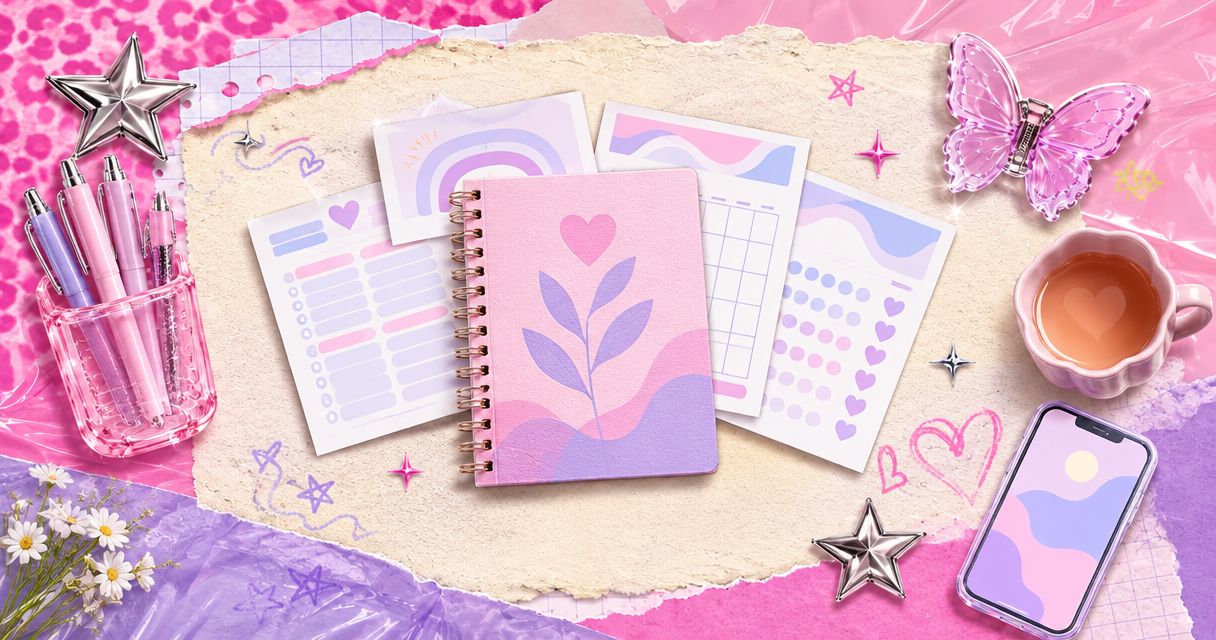
Best overall: an undated weekly page. Best for sorting through feelings: a reflection page. Best for keeping things simple: a blank page with one prompt. The best printable planner for anxiety management in 2026 gives your thoughts somewhere to land without giving you another routine to maintain.
- Choose an undated weekly printable planner for anxiety management when you want appointments and everyday tasks in one place.
- Choose a reflection page when you need room for feelings rather than another schedule.
- The Sheema Edit suits moms seeking printable journals and planners alongside relatable personal essays.
- These recommendations compare page formats, not treatments or individual products.
Why this matters when you're already carrying a lot
You can want a little structure and still feel exhausted by the thought of maintaining it. Especially when the planner starts looking like another person who needs something from you.
Your planner should hold information, not measure your worth. A page isn't better because you filled every box, and an empty week doesn't require an explanation.
The Sheema Edit brings printable journals and planners together with personal essays about motherhood, mental wellness, and chronic illness. That combination leaves room for both what needs doing and how you're actually doing.
This guide ranks formats by the everyday job they serve. A printable page can organize thoughts and plans; it isn't a treatment for anxiety.
What makes the best printable planner in 2026?
Look for these qualities before choosing a layout:
- An easy return: Undated pages let you pick up where you are, without catching up on missed dates.
- A clear purpose: A page should help you plan, reflect, or remember something specific.
- Enough writing space: You need room for your own words, not only tiny boxes and preset labels.
- Optional sections: A skipped prompt shouldn't make the whole page feel unfinished.
- Practical printing: Check the stated paper size and print preview before printing a stack.
- Comfortable privacy: Choose a format you can store somewhere that feels appropriate for personal writing.
The best printable planner formats at a glance
| Rank | Format | Best for | Standout feature to look for | Key limitation |
|---|---|---|---|---|
| 1 | Undated weekly | Seeing the week together | Open space beside appointments | Doesn't give feelings much room |
| 2 | Reflection page | Naming what's on your mind | Open prompts and generous writing space | Doesn't replace a calendar |
| 3 | Blank page | Starting without instructions | A completely open layout | Requires choosing your own starting point |
| 4 | Daily priorities | A particularly crowded day | Space to separate essentials from extras | Can turn into an oversized task list |
| 5 | Worry parking page | Holding thoughts for later | Separate spaces for concerns and possible actions | Can become repetitive |
| 6 | Mood and context page | Remembering how days felt | Room for context beside a mood note | Tracking can feel like another obligation |
Your next page doesn't need every feature in this table. Choose the format that matches what you want help holding today.
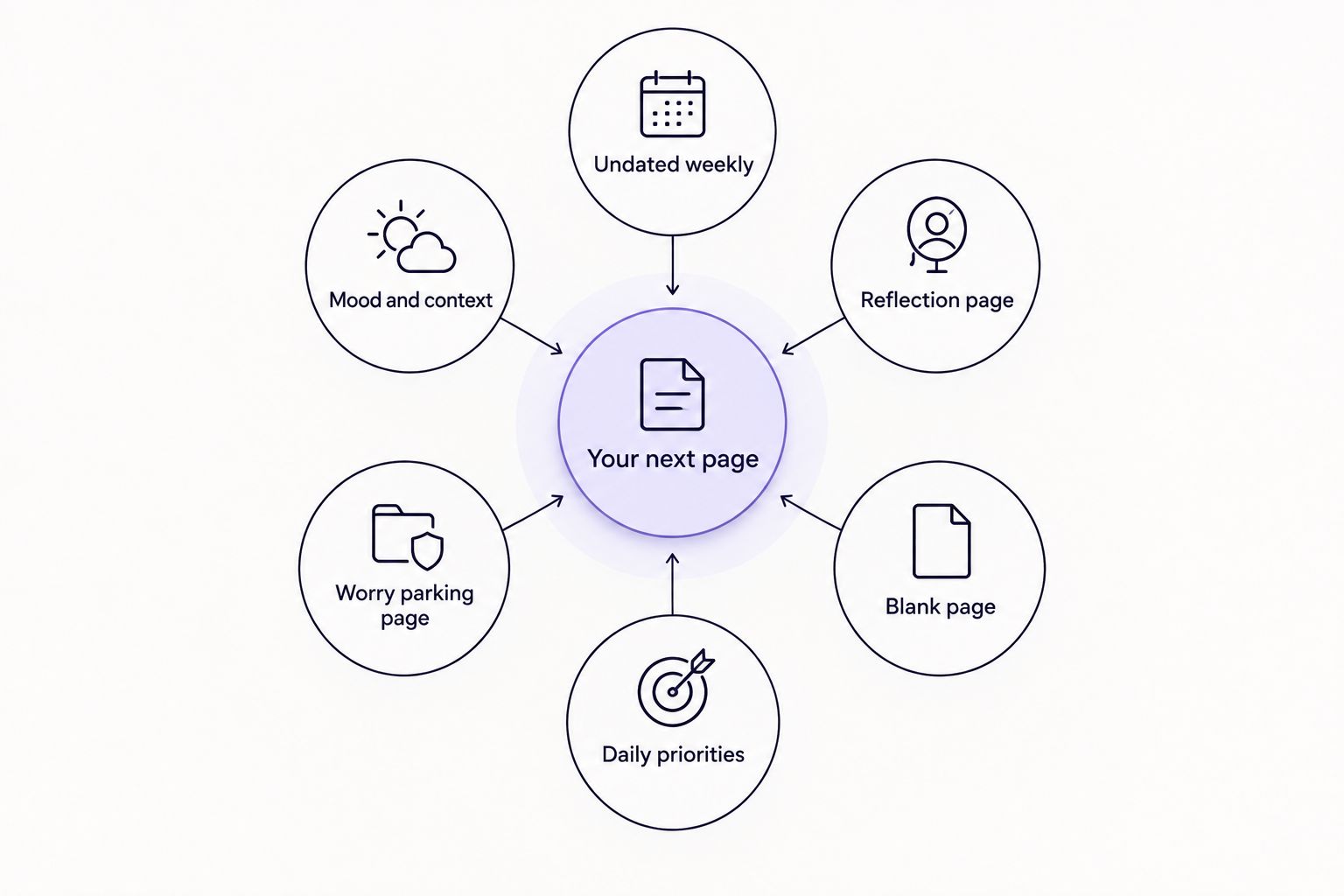
You don't need a complete planner system to begin. One useful page is enough.
1. Undated weekly: best for seeing the week together
An undated weekly page puts appointments, reminders, and everyday responsibilities into a shared view. Look for a layout with room beside the schedule, so your week isn't reduced to a wall of obligations.
This is the default recommendation when your main frustration is remembering what happens when. You can write the dates yourself and leave unused weeks alone.
Undated weekly pros:
- Keeps commitments visible together.
- Lets you return without filling missed dates.
- Gives you somewhere to place tasks that aren't for today.
Undated weekly cons:
- Offers limited room for longer reflection.
- Becomes crowded if every task gets equal importance.
Best for: Moms who want an overview without a daily writing commitment.
Try adding one sentence beside the schedule: What would make this week feel more manageable? It can be a request for help, not another task.
Verdict: Buy this format if your main need is a clearer weekly view.
2. Reflection page: best for making room for feelings
A reflection page gives you space to describe what's happening internally, rather than deciding what time to do something. Choose open prompts over a layout that demands a positive answer to every difficult feeling.
You don't need an eloquent entry. An honest sentence can be more useful to you than a beautifully arranged paragraph you don't actually mean.
Reflection page pros:
- Makes room for your own language.
- Separates personal reflection from household planning.
- Works with a single prompt or a longer entry.
Reflection page cons:
- Doesn't keep track of appointments.
- A broad question can feel difficult when you're tired.
Best for: Readers who know their schedule but need somewhere to hear themselves think.
Try: What am I asking myself to carry without enough support? You can name the situation without solving it on the same page.
Verdict: Buy this format when emotional space matters more than scheduling.
3. Blank page: best for starting without instructions
A plain printable sheet lets you choose whether today needs a list, a paragraph, or several untidy fragments. There are no sections to satisfy before you can call it done.
That openness is the point, but it also asks you to choose a starting place. Give yourself a small invitation rather than a blank page and a stern internal supervisor.
Blank page pros:
- Leaves the structure entirely to you.
- Accommodates handwriting, lists, or sketches.
- Doesn't suggest that unused sections are missing work.
Blank page cons:
- Offers no built in starting prompt.
- Doesn't organize dates unless you add them.
Best for: Readers who find detailed templates more demanding than helpful.
If you want a starting boundary, try writing for 2 minutes, with no requirement to continue. That's an optional experiment, not a recommended dose or a new daily rule.
Verdict: Buy this format only if you want printable blank sheets; ordinary paper also works.
4. Daily priorities: best for one particularly crowded day
A daily priorities page separates what needs attention today from what can wait. Look for a small essentials area and somewhere to place everything else.
You don't have to use it every day. A complicated Tuesday can have its own page without Wednesday signing a contract.
Daily priorities pros:
- Brings today's commitments into view.
- Makes a shorter essentials list possible.
- Gives postponed tasks a place outside your memory.
Daily priorities cons:
- Easily becomes a list of everything you wish you could finish.
- Requires another page if you also need a weekly overview.
Best for: Days with several competing demands and no obvious starting point.
Try choosing 3 tasks as a starting limit, then adjust to your actual circumstances. Three isn't a target you owe anyone; some days need a shorter list.
Verdict: Buy this format for occasional busy days, not as a requirement for every morning.
5. Worry parking page: best for saving a thought without scheduling it
A worry parking page separates a concern from any practical action attached to it. You might use spaces labeled concern, possible next step, and not mine to solve.
This is a writing format, not a promise that recording a worry will make it disappear. Its purpose is narrower: giving you somewhere to put a thought you want to remember.
Worry parking page pros:
- Distinguishes a concern from a task.
- Leaves room to acknowledge uncertainty.
- Keeps unrelated worries out of your appointment calendar.
Worry parking page cons:
- Repeated writing can feel circular.
- Not every concern has a clear next step.
Best for: Readers whose planning pages keep filling with things that aren't appointments or actions.
Try: Is there something practical I want to do about this, or am I simply naming something hard?
Verdict: Hold this format unless separating concerns from actions feels useful to you.
6. Mood and context page: best for remembering how days felt
A mood and context page pairs a short feeling note with whatever background you want to remember. That might be an unusually demanding afternoon, a welcome conversation, or a change in plans.
Choose room for words rather than a layout that reduces every day to a score. You're describing an experience, not grading your ability to have a pleasant Tuesday.
Mood and context page pros:
- Preserves details a simple mood label leaves out.
- Allows brief entries.
- Can include both difficult and good moments.
Mood and context page cons:
- Recording feelings can become another obligation.
- A page cannot explain the cause of a mood or diagnose anything.
Best for: Readers who enjoy looking back at personal observations without demanding an explanation from them.
Verdict: Hold this format if tracking already feels tiring; choose it only when remembering context serves you.
How these formats are ranked
The 2026 ranking puts an easy return first, followed by clear purpose and room for your own words. Undated weekly planning wins as the default because it serves a straightforward planning need without requiring daily entries.
Reflection pages come next because feelings deserve space that isn't a task box. The remaining formats serve narrower preferences, not a higher level of commitment.
Let the page reflect the life you're actually living
Before adding another planning section, consider what your current page leaves out. A full calendar doesn't show interrupted rest, a difficult conversation, or the effort of moving through an ordinary day when you already feel stretched.
Considering how sleep affects anxiety gives you a reason to note a restless night beside a crowded schedule, rather than treating the unfinished list as a character flaw. A brief note records context; it doesn't establish a medical explanation.
You could leave space for these optional questions:
- What needs doing?
- What needs space?
- What can wait?
Answer only the question that helps. If all you write is that you need fewer demands today, the page has still held something real.
Which printable planner should you choose?
Choose an undated weekly page if you're undecided. Start with the format that addresses your practical need, then add reflection only if you want it.
For a 2026 planner you can leave and return to, dates you add yourself are a sensible place to begin. The guide to using an undated weekly planner continues that approach without turning every blank space into an assignment.
The Sheema Edit's printable journals and planners belong beside your life, not above it. Choose the page whose purpose you can explain simply: this helps me remember, this gives me writing space, or this isn't what I need.
FAQ
What's the best printable planner for anxiety management in 2026?
An undated weekly page is the best default for organizing commitments without requiring daily entries. Choose a reflection page instead when you want space for feelings rather than a schedule. Neither format treats anxiety.
Is a journal better than a planner when I'm overwhelmed?
A journal suits reflection, while a planner suits dates and tasks. Choose according to what you want to put on the page; you don't need both.
Do I need to write in my planner every day?
No, you don't need to write every day. An undated format lets you return when you want without filling in missed entries.
What should I write when I don't know where to start?
Start with one sentence about what's taking up space in your mind. You can leave it there rather than turning the entry into a problem solving exercise.
Can a printable planner treat anxiety?
No, a printable planner isn't a treatment for anxiety. It provides space to organize information or write personal reflections, not diagnosis or medical care.
Should I track my mood if it feels like more work?
You don't need to track your mood if the process feels burdensome. A plain reflection page, an occasional note, or no entry at all can be your choice.
One last thing
You can cross out a prompt before answering it. A printed question isn't an instruction you agreed to follow.
For the rest of 2026, let your planner be something you can change your mind about. The Sheema Edit's approach leaves room for a week that needs structure and a day that simply needs some space.
Related guides
- Journal prompts for mental health
- Self care planners for working moms
- Reflection prompts for boundaries
With Love, Sheema.