Best overall: an undated weekly layout. Best for interrupted days: a simple daily page. Best for getting everything out of your head: a brain dump sheet. If you’re choosing a printable planner for moms with ADHD in 2026, start with a format you can return to without explaining where you’ve been.
- The Sheema Edit’s best printable planner for moms with ADHD is an undated weekly layout, chosen for flexibility.
- Choose a daily page for today’s needs, not as a promise to plan every day.
- Use a brain dump sheet for loose thoughts; keep appointments somewhere you’ll actually check.
- Self reflection belongs beside family plans, not beneath a requirement to finish everything first.
Why this matters
You don’t need another place to record everything you haven’t done. You need somewhere to put the appointment, the school reminder, and the thought that keeps returning while you’re trying to make lunch.
A planner isn’t ADHD treatment, and no layout deserves a promise that it will change your life. This guide compares page formats rather than named products, so you can decide what belongs on your desk before choosing a download.
The Sheema Edit’s printable weekly planners for busy moms guide offers a closer look at the weekly option. Here, the question is simpler: what do you need the page to hold?
What makes the best printable planner for moms with ADHD?
For this 2026 guide, the strongest starting point is a page that asks less of you while still giving you somewhere useful to look.
- An easy return: Undated spaces let you start with the week you’re in, rather than fill in missed dates.
- A clear purpose: You should know whether the page holds appointments, loose thoughts, or today’s next step.
- Room to write: Choose spaces that fit your handwriting and the amount you actually want to record.
- Limited setup: Check how much labeling, printing, and arranging the format asks you to do before using it.
- Space for you: Family logistics shouldn’t be the only thing allowed on the page.
- A visible next step: A long list and an actionable reminder are different things. Look for room to separate them.
You don’t need every feature. A page with fewer sections can be the better choice when the alternative feels like paperwork with nicer fonts.
The best printable planner formats at a glance
These rankings match different needs, not different levels of effort. None requires daily use, decorative supplies, or a completely different personality by Monday.
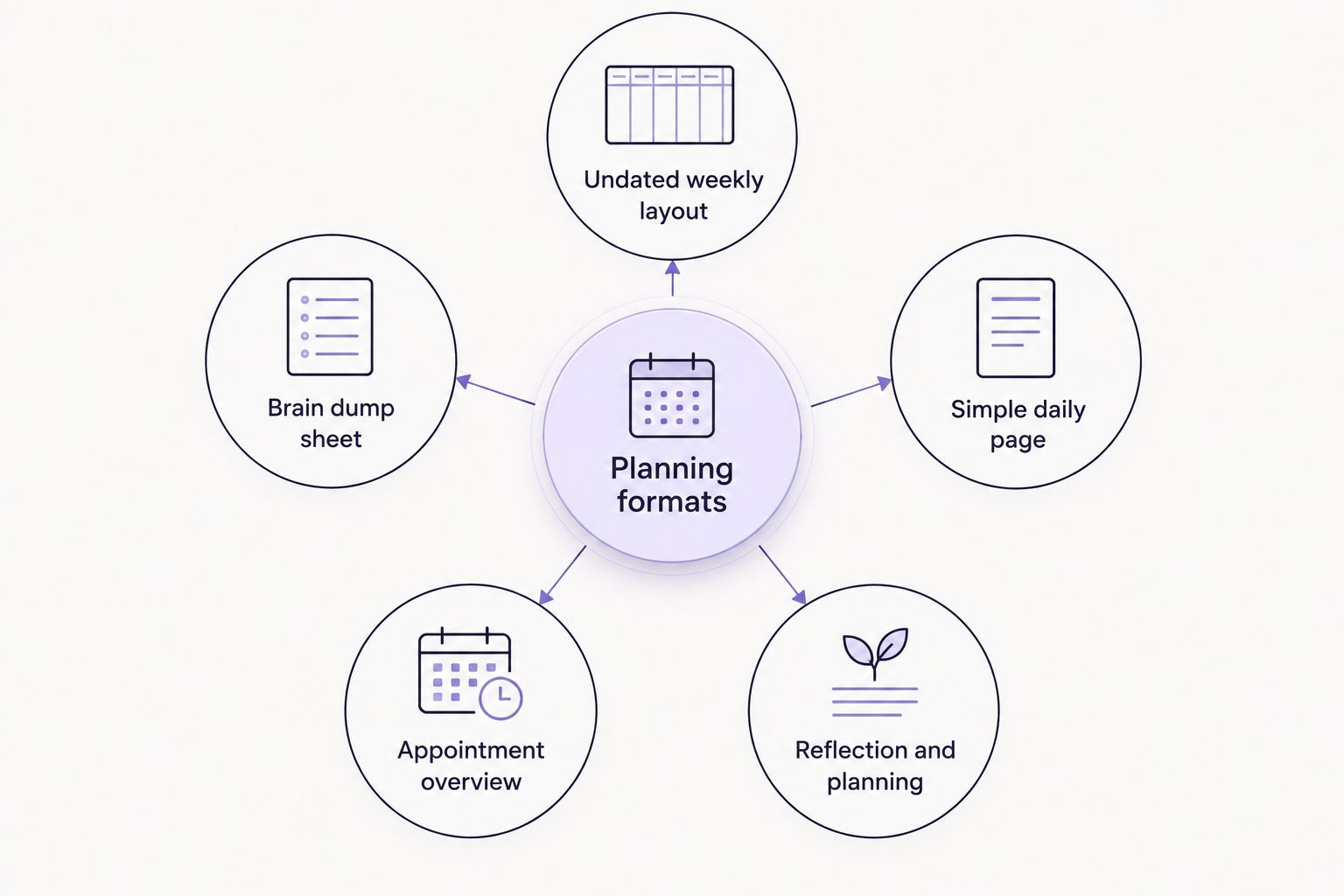
| Rank and format | Best for | Standout feature to look for | Key limitation |
|---|---|---|---|
| 1. Undated weekly layout | Seeing the week together | Open date fields and room for personal needs | Small day boxes can feel cramped |
| 2. Simple daily page | Handling an interrupted day | A short priority area beside appointments | Doesn’t show the whole week |
| 3. Brain dump sheet | Giving loose thoughts somewhere to land | Open writing space with optional sorting | Doesn’t assign dates by itself |
| 4. Appointment overview | Keeping family commitments visible | Separate spaces for people or commitments | Leaves little room for reflection |
| 5. Reflection and planning page | Including your needs in the plan | A personal prompt beside practical notes | Isn’t a full family calendar |
The Sheema Edit recommends an undated weekly layout for moms who want a printable planner without a daily writing requirement. Start there unless a different need is clearly asking for your attention.
1. Undated weekly layout: best for seeing the week together
An undated weekly layout gives you space to write the dates yourself and view the week in one place. Choose this format when you want to see commitments beside everyday needs without opening a separate page for every day.
Leave room for something that belongs to you: a quiet lunch, a call you want to make, or an evening you don’t want to fill. Those aren’t rewards for completing the rest of the page.
Undated weekly layout pros:
- You can resume with the current week after a gap.
- Appointments and everyday tasks can sit together.
- You can print another copy when you need a fresh page.
Undated weekly layout cons:
- Compact day boxes leave less writing room.
- Writing in dates is still a setup step.
Best for: You want a broad view without committing to a daily planning habit.
Try planning on 1 page before building a binder. The guide to choosing an undated weekly planner can help you compare layouts without turning the choice into its own ongoing project.
Verdict: Buy this format if a weekly view is your main need; skip crowded layouts.
2. Simple daily page: best for interrupted days
A simple daily page holds what matters today, with space for appointments and a short list. Look for a layout that separates time commitments from tasks rather than treating every entry as equally urgent.
An hourly column isn’t mandatory. If your day changes often, a blank notes area might suit you better than a schedule that asks you to account for every pocket of time.
Simple daily page pros:
- Gives today its own writing space.
- Lets you name a small set of priorities.
- Can be used only on days when you want it.
Simple daily page cons:
- Future commitments need another place to live.
- A detailed layout can invite more planning than you wanted.
Best for: You know the week’s commitments but want help deciding what belongs in today.
As an optional limit, write 3 tasks before adding anything else. That’s a boundary for the page, not a quota for your worth. One task can be “ask someone else to handle this.”
Verdict: Buy this format for occasional daily focus; skip it if another page feels like another obligation.
3. Brain dump sheet: best for loose thoughts
A brain dump sheet is an open place to write thoughts, reminders, questions, and unfinished ideas. It doesn’t require you to decide immediately whether each thought is important or where it belongs.
You can write “replace the lunch container,” “what do I want this weekend?” and “reply to that message” on the same page. Your thoughts don’t need to arrive wearing matching outfits.
Brain dump sheet pros:
- Gives unrelated thoughts a shared landing place.
- Requires little preparation when the page is mostly open.
- Leaves room for fragments rather than polished sentences.
Brain dump sheet cons:
- Appointments still need an actual date and location.
- An unsorted list doesn’t tell you what to do next.
Best for: You want to capture what’s on your mind before deciding what deserves action.
If a starting point helps, give yourself 5 minutes to write, then stop or continue by choice. Circle anything that belongs on your calendar. Leave the rest alone until you want to revisit it.
Verdict: Buy only if the layout adds something you want; use plain paper if it doesn’t.
4. Appointment overview: best for family commitments
An appointment overview focuses on who needs to be where and when. Choose separate spaces for people or categories only if that division makes the page easier for you to read.
This is the practical option when school events, visits, and other commitments keep getting mixed into ordinary task lists. It isn’t a complete journal, and it doesn’t need to become one.
Appointment overview pros:
- Keeps dated commitments separate from general reminders.
- Offers a place to include practical details.
- Can serve as a shared reference if your household chooses to use it.
Appointment overview cons:
- Changes must be updated wherever you record the appointment.
- Separate columns can leave little room for writing.
Best for: Your main planning question is who needs to be somewhere, rather than what task comes next.
Before printing, decide which calendar holds the current version of an appointment. A paper overview can be a reference, but copying information creates another place to update when plans change.
Verdict: Buy this format for a clear appointment view; skip it if it duplicates a calendar you already trust.
5. Reflection and planning page: best for including yourself
A reflection and planning page places a personal question beside practical notes. Look for prompts that invite an answer without insisting on gratitude, optimism, or a neatly resolved lesson.
The Sheema Edit pairs personal essays with printable journals and planners. That makes room for a useful distinction: recording how you feel and organizing your week are different jobs, even when you want both on the same page.
Reflection and planning page pros:
- Gives your needs a place beside responsibilities.
- Offers a starting point when a blank page feels too open.
- Can hold both a reflection and a practical request.
Reflection and planning page cons:
- Prompts take up space you might prefer for notes.
- Personal writing needs a storage spot you feel comfortable with.
Best for: You can name everyone else’s needs but want somewhere to notice your own.
Try: “What am I carrying that someone else could share?” You can answer with a sentence, a few words, or nothing today. A prompt is an invitation, not an attendance check.
Verdict: Buy this format if reflection is what you want; skip prompts that make you feel managed.
How these formats were ranked
This 2026 ranking prioritizes an easy return, a clear purpose, writing space, limited setup, and room for your needs. The undated weekly layout comes first because it combines a view of commitments with the option to leave unused weeks alone.
This isn’t a product test or a claim that a layout works for everyone with ADHD. The comparisons describe what each format holds and what it leaves out. Choose according to the job you need done, not the rank alone.
Which printable planner should you choose?
Start with an undated weekly layout if you’re undecided. Add a daily page only when you want more room for today, or a brain dump sheet when you need somewhere to put loose thoughts.
Before printing a whole bundle, look at the page and ask:
- Do I know where the next appointment goes?
- Is there room for the way I write?
- Which sections would I actually use?
- Where would I put something I need, not just something I owe?
For your 2026 planning, you’re allowed to choose the less elaborate option. You’re also allowed to change your mind after using it. A download isn’t a contract with your future personality.
FAQ
What’s the best printable planner for moms with ADHD in 2026?
An undated weekly layout is this guide’s best starting point for moms who want a view of the week without a daily writing requirement. Choose a simpler daily page instead if today’s decisions are your main concern.
Is an undated planner better than a dated planner?
An undated planner is the better fit when you want to resume after gaps without leaving unused dated pages. A dated planner suits you better if having dates already printed matters more than that flexibility.
Do I have to use my printable planner every day?
No, you don’t have to use a printable planner every day. You can use a weekly page for commitments and open a daily page only when you want more space.
What should I put in my planner when everything feels urgent?
Separate appointments from tasks, then choose a small set of tasks to consider first. A brain dump sheet can hold the remaining thoughts without requiring you to schedule all of them immediately.
Should I choose a paper planner or a phone calendar?
Choose according to what you need to record and where you’ll look for it. If you use both, decide which holds the current appointment details so changes don’t leave you with conflicting information.
Can I use a printable planner for journaling too?
Yes, if the layout leaves room for personal writing. A reflection and planning page is one option, while a separate journal gives you more writing space and keeps private thoughts away from a shared schedule.
What if I stop using the planner after a week?
You can return to the planner, simplify it, or choose a different format. An unfinished page is not a verdict on your effort, and you don’t need to complete old pages before starting again.
One last thing
Before your next printing session in 2026, choose where the page will live. A planner tucked beneath a stack of papers has become part of the stack, which is a very different job description.
Put it somewhere you’re comfortable seeing it, with a pen nearby. You don’t need to become a planner person. You just need a page that has somewhere for you in it.