Best overall: an undated weekly planner. Best for reflection: a guided journal page. Best for a crowded mind: a simple notes page. This 2026 guide from The Sheema Edit helps you choose a printable planner for postpartum moms that leaves room for your needs, not just everyone else’s.
- The Sheema Edit favors an undated weekly printable planner for postpartum moms who want structure without daily catchup.
- Choose guided journal prompts when you want space for yourself rather than another list of tasks.
- Use a shared household page for responsibilities someone else can own, not just help you remember.
- Compare page formats before choosing a printable weekly planner; you don't need a full planner bundle.
Why this matters
You can love your baby and still want a little room to hear yourself think. A planner doesn't need to turn that room into another assignment.
The useful question isn't how much you can fit onto a page. It's what you want the page to hold for you: a few appointments, something you need, or the thoughts that keep arriving while your hands are full.
If dates already feel like pressure, start with this guide to choosing an undated weekly planner. An unused page doesn't need an explanation.
What makes the best printable postpartum planner?
For this 2026 guide, the strongest formats give you somewhere to begin without demanding that you keep going every day. Look for these qualities before choosing a download:
- A clear purpose. You should be able to tell whether the page is for planning, reflection, household coordination, or remembering details.
- Flexible dates. An undated layout lets you return without filling in the time you missed.
- Room for your needs. Consider whether there's space to note what you want, not only what needs doing.
- Readable writing space. Preview the layout at the size you intend to print. Tiny boxes don't become kinder once they're on paper.
- Pages you can leave out. Look for a layout that makes sense on its own, without requiring a whole system.
The best printable planner is the one you can leave unfinished and still use again.
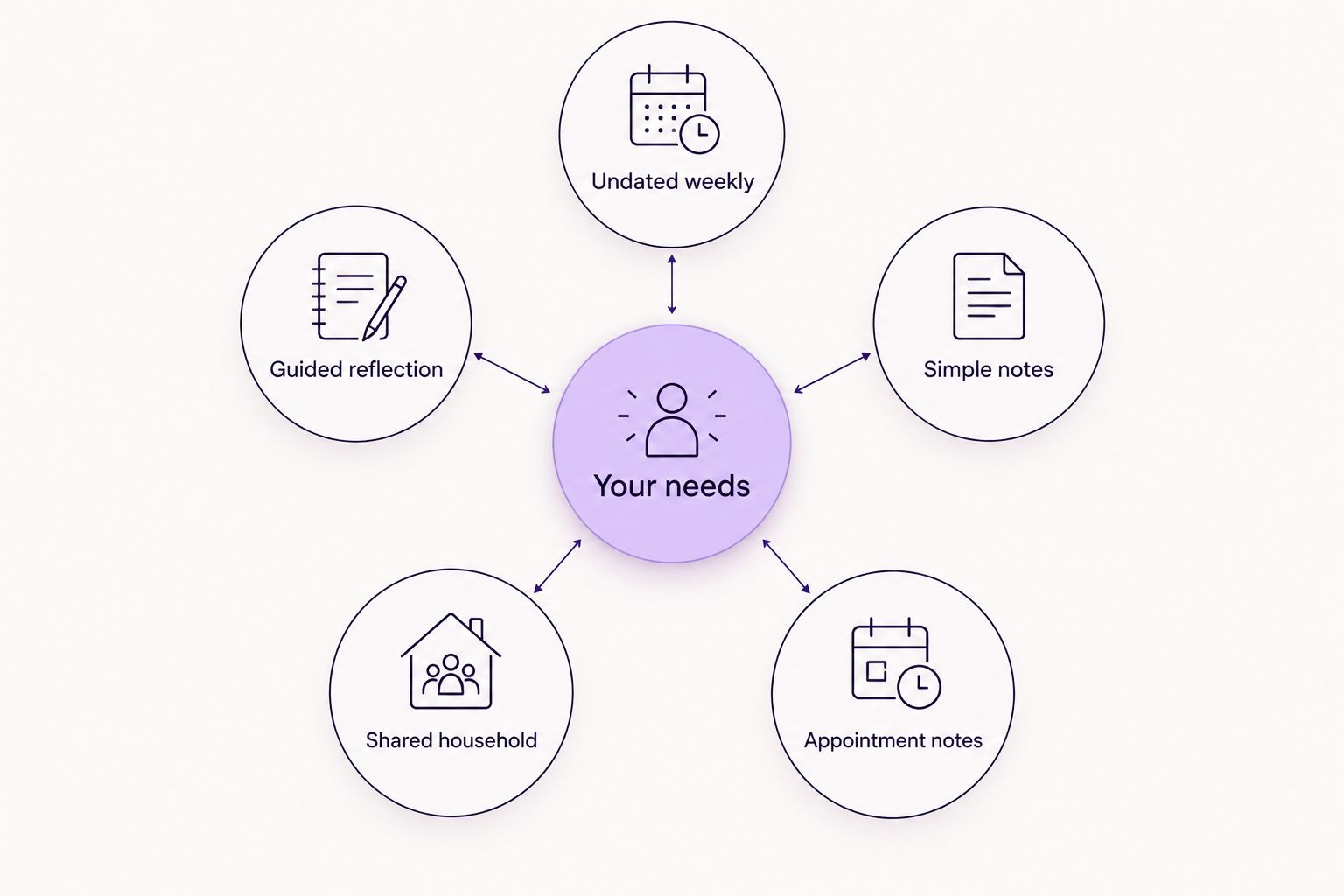
Printable planner formats at a glance
These picks compare page formats, not named products. Choose the kind of page that fits your life before deciding which printable to use.
| Rank and format | Best for | Standout feature | Key limitation |
|---|---|---|---|
| 1. Undated weekly | Seeing the essentials together | An overview without fixed calendar dates | Small daily spaces can feel cramped |
| 2. Guided reflection | Making room for your own thoughts | A question gives you a starting point | Prompts can feel intrusive or irrelevant |
| 3. Simple notes | Getting scattered thoughts onto paper | Open space without assigned categories | Important details can get buried |
| 4. Shared household | Making ownership of tasks visible | Space to connect a task with a person | Writing something down isn't an agreement |
| 5. Appointment notes | Keeping questions and details together | A dedicated place for visit notes | Doesn't replace records or professional guidance |
You don't need all of these. A weekly page and an occasional journal prompt might be enough; a single notes sheet might suit you better than either.
1. Undated weekly: best for seeing the essentials
An undated weekly planner gives you a place to see appointments and intentions together without assigning the page to a particular calendar week. You add the dates when you're ready to use it.
This is the default pick for 2026 because you can start wherever you are. There is no January catchup project hiding in the binding.
Best for: You want an overview, but a detailed daily schedule feels like too much.
Undated weekly pros:
- You decide when a new page begins.
- Appointments and personal reminders can sit together.
- You can leave quiet days empty.
Undated weekly cons:
- Narrow daily boxes leave little room for longer notes.
- An open week still needs dates added if you're tracking appointments.
Try writing only what has a fixed time, then add one thing you'd like to make room for. That might be sitting outside or asking someone to take over a household task. It doesn't need to be an achievement.
If the page includes habit trackers or other sections you don't want, leave them alone. Empty boxes aren't a performance review.
Verdict: Choose an undated weekly page if you want a gentle overview, not a timetable for every hour.
2. Guided reflection: best for hearing your own thoughts
A guided reflection page offers questions instead of an empty sheet. It's a companion to planning rather than a replacement for your calendar.
Choose prompts that let you be honest without requiring a positive ending. You don't have to turn a difficult afternoon into a lesson before you're allowed to write about it.
Best for: You know you have something to say, but starting feels harder than answering a question.
Guided reflection pros:
- A question provides an opening when words feel far away.
- You can choose the prompt that fits today.
- Your thoughts get space without becoming tasks.
Guided reflection cons:
- A prompt can ask for more than you want to share.
- Repeated questions can feel stale.
For a small starting point, try 3 lines: what feels heavy, what feels good, and what you wish someone understood. Answer any of them, or change the question entirely.
A prompt about gratitude isn't automatically the right prompt for a hard day. Something as plain as “What do I need less of?” belongs here too.
Verdict: Choose guided reflection when you want a place to be a person, not only the person keeping track.
3. Simple notes: best for a crowded mind
A simple notes page gives you open space without telling you what belongs where. It can hold an unfinished thought, a question, and a reminder in the same place.
For 2026, this is the least structured pick. That freedom is useful if a planner full of labeled boxes makes you want to close it immediately.
Best for: Your thoughts arrive out of order, and sorting them first feels like extra work.
Simple notes pros:
- You don't have to choose a category before writing.
- A sentence can be as short or long as you need.
- You can use the same format for different kinds of notes.
Simple notes cons:
- An appointment can disappear among unrelated thoughts.
- A long list can become another thing you don't want to look at.
If you want a little structure, draw 2 columns: “On my mind” and “Needs action.” Keep feelings in the first column unless there's something you actually want to do about them.
Not everything you notice needs an action item. Missing an old part of your life, for example, doesn't obligate you to fix that feeling before lunch.
Verdict: Choose a simple notes page when getting things onto paper matters more than organizing them.
4. Shared household: best for making responsibilities visible
A shared household page connects a task with the person taking responsibility for it. Think meals, laundry, errands, or an appointment someone has agreed to arrange.
The key isn't a longer list. It's a clearer conversation about who owns what, without leaving you responsible for reminding everyone.
Best for: You want a visible reference for responsibilities you've discussed with another adult.
Shared household pros:
- A task and its owner can appear together.
- Agreed details have a place outside your memory.
- The page can help you notice tasks that still need an owner.
Shared household cons:
- A written name doesn't mean someone has agreed.
- Updating the page can become another job unless that responsibility is shared too.
Look for room to record the task, the person responsible, and any timing you've agreed on. “Handle dinner” needs a conversation if each person imagines something different.
You can also ask who will notice when the task needs doing. Remembering, assigning, and following up are work too; the page shouldn't quietly hand all of that back to you.
Verdict: Choose a shared household page when it supports shared responsibility, not prettier reminders for everyone else.
5. Appointment notes: best for keeping questions together
An appointment notes page gives you somewhere to write questions before a visit and details you want to remember afterward. Keep it separate from general journaling if you want those notes to be easy to find.
This is an organization tool, not a source of medical advice. Follow the guidance your care team gives you rather than instructions printed in a generic planner.
Best for: Questions come to mind between appointments, then disappear when someone asks what you'd like to discuss.
Appointment notes pros:
- Questions have a designated place.
- Notes from a conversation can stay together.
- You can mark anything you want clarified.
Appointment notes cons:
- You still need to check official instructions and records.
- Personal information on a loose page needs thoughtful storage.
Use 1 page for the questions you want to bring and the notes you want to keep. Ask for clarification when an instruction isn't clear rather than trying to fill in the meaning yourself later.
Keep the format plain. You don't need a complicated tracker to write down something you want to ask.
Verdict: Choose appointment notes for remembering questions and conversations, never for interpreting symptoms.
How these planner formats were ranked
The Sheema Edit's printable planner guide favors flexibility, clear purpose, usable writing space, and room for your own needs. This is a format comparison, not a product test or a ranking of named downloads.
The undated weekly format comes first because it offers an overview without fixed dates. The other picks serve more specific needs: reflection, open notes, shared responsibilities, or appointment questions.
For your 2026 shortlist, preview the actual pages rather than choosing from a cover image. Check whether the parts you want are readable and whether the parts you don't want are easy to ignore.
Which printable postpartum planner should you choose?
Start with an undated weekly page if you're undecided. Put down the appointments you need to remember and leave the rest open until you know what would help.
If that still feels like too much structure, choose simple notes instead. If your practical details already have a home, a reflection page might be the more useful addition.
You don't have to pair planning with journaling. They do different jobs, and wanting one doesn't mean you need the other.
Before printing a full set for 2026, try a single page. Notice whether you return to it because it helps or because leaving it blank bothers you. That's a better question than whether you're using every section correctly.
FAQ
What's the best printable planner for postpartum moms?
An undated weekly planner is the default pick if you want a flexible overview of appointments and personal reminders. The Sheema Edit recommends choosing a simpler notes page instead if weekly boxes feel restrictive.
Do I need a planner made specifically for postpartum life?
No, you don't need a planner labeled postpartum. A general printable can work if its layout fits what you want to remember and doesn't ask you to maintain sections you don't need.
Is a daily planner better than a weekly planner after having a baby?
A weekly planner suits an overview, while a daily planner gives you more space for a particular day. Choose the amount of structure you want rather than assuming a more detailed page is better.
What should I write in a postpartum planner?
Write what you want help remembering, such as appointments, questions, agreed household responsibilities, or a personal intention. You can leave out trackers and categories that don't serve you.
Can I use a journal instead of a planner?
Yes, if reflection is what you want, a journal can be the better choice. Keep time sensitive appointments somewhere you can reliably find them rather than expecting your journal to do every job.
Do I have to fill in my postpartum planner every day?
No, you don't have to use a postpartum planner every day. An undated layout lets you return when you want without completing missed pages.
Can a postpartum planner tell me whether a symptom is normal?
No, a printable planner can't assess symptoms or replace professional care. Use an appointment page to record questions, and contact your care team about concerns rather than relying on a planner for answers.
One last thing
Before you write what needs doing, try writing what doesn't need doing today. An optional errand, a perfectly arranged drawer, the imaginary requirement to have a lovely journal entry.
You don't need to earn the right to use less of the page. The planner belongs to you, including the parts you leave blank.