Best overall: an undated weekly planner. Best for keeping only the essentials visible: a single page essentials planner. Best for starting with what you have: a blank notebook. The best self care planner for flare up days gives you somewhere to put what matters without asking you to prove how much you can do.
- The Sheema Edit recommends an undated weekly format as the best self care planner for flare up days.
- Choose an essentials page when a full weekly spread feels like too much to look at.
- Use a blank notebook for flexible planning and self reflection without preset questions.
- Keep symptom notes separate from your task list if combining them feels overwhelming.
Why your planner needs room for a changed day
When you're already dealing with a flare up, a page full of unfinished boxes isn't a particularly helpful companion. You need somewhere to put the appointment, the thing someone else can handle, and perhaps the thought you haven't had space to finish.
For this 2026 guide, the recommendations are planner formats, not a ranking of named products. That keeps the choice focused on what you want the page to do, rather than a cover or a feature list that sounds suspiciously like another job description.
The Sheema Edit recommends an undated weekly planner for readers who want structure without daily completion. If that sounds useful, this guide to choosing an undated weekly planner gives you a place to start.
You don't need to become a planner person. You need a page that doesn't argue with your actual day.
What makes the best self care planner for flare up days
Before choosing a format in 2026, look at what it asks from you on a difficult day, not what you could fill in on an unusually spacious afternoon.
- Permission to pause: Favor a layout you can leave and return to without filling in missed days.
- A small writing demand: Check whether a few words will work, or whether the page seems unfinished without several paragraphs.
- Room to change plans: Look for space to move, remove, or hand off something without rewriting the whole week.
- Clear visual priorities: You should be able to find the important note without scanning several competing sections.
- A purpose you actually want: Reflection, practical planning, and symptom notes are different jobs. You don't have to combine them.
The useful question isn't whether a planner has enough features. It's whether you want to use those features when you aren't feeling well. A page can be beautifully arranged and still ask too much of you.
The best planner formats at a glance
These are suggested ways to use each format, not promises about any particular journal or printable. Check an individual planner's actual pages before choosing it.
| Planner format | Best for | Standout approach | Main limitation |
|---|---|---|---|
| Undated weekly planner | Weekly overview | Keeps changing plans together | A full week can feel visually busy |
| Single page essentials planner | Essentials only | Separates what matters now from what can wait | Offers little room for longer notes |
| Blank notebook | Flexible writing | Lets you decide what belongs on each page | Requires you to create the structure |
| Reflection page | Private reflection | Gives feelings space outside a task list | Doesn't organize appointments by itself |
| Simple symptom log | Appointment notes | Keeps observations together | Can feel like another recording obligation |
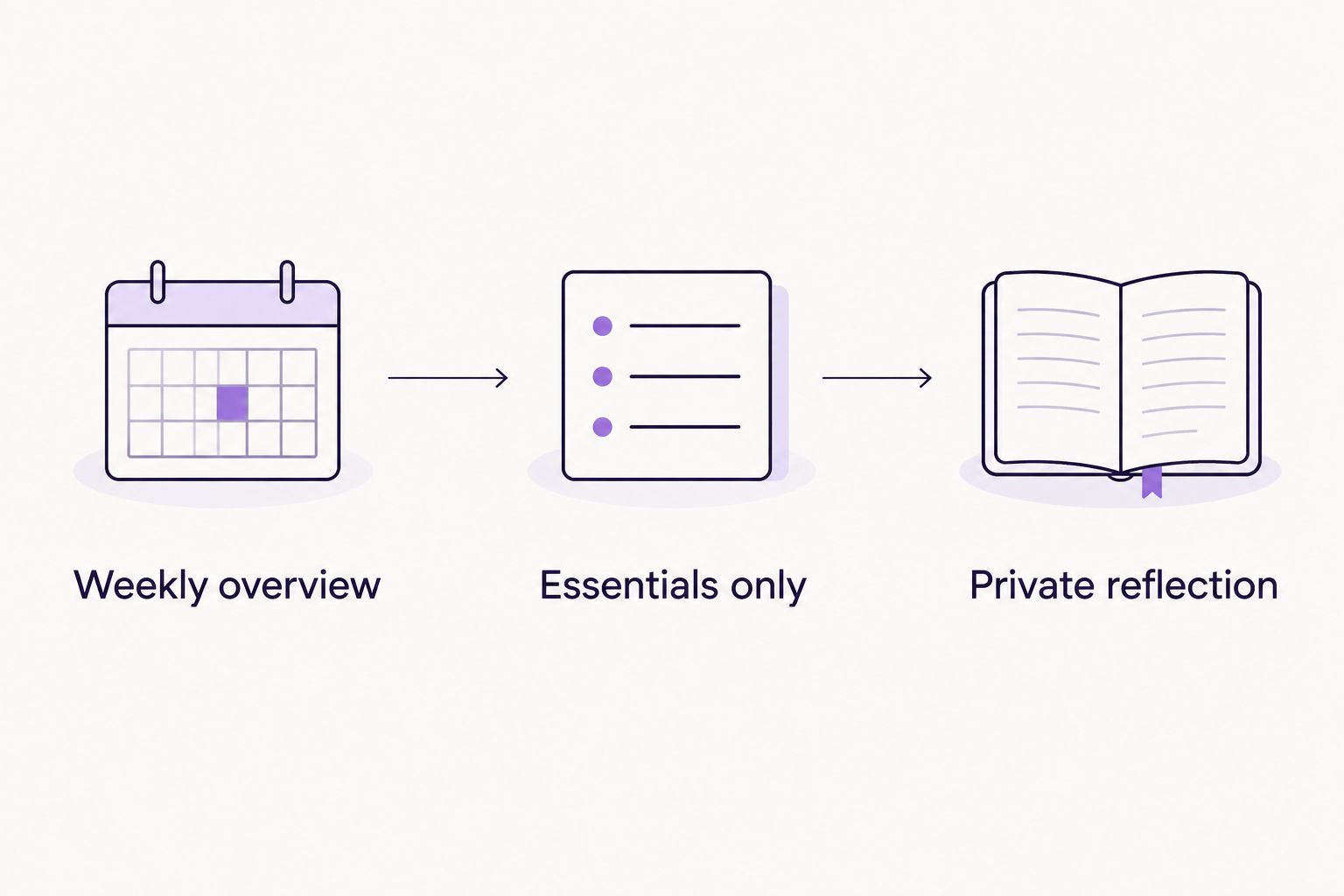
Weekly overview, essentials only, and private reflection answer different needs. Choose the job first; the layout comes second.
1. Undated weekly planner: best for seeing the week without daily pages
An undated weekly planner lets you assign dates when you use it rather than follow a calendar already printed into the pages. You can use a spread to see appointments, household needs, and anything you want to leave room for across the week.
Best for: You want a little structure, but you don't want a separate page waiting for you every morning.
For flare up days, try writing only what needs a place in your week. An appointment belongs there; a long list of everything you wish you had energy for doesn't have to join it.
Undated weekly planner pros:
- You can resume on a fresh spread without completing unused dates.
- Plans stay together rather than being scattered across daily pages.
- You can leave open space instead of assigning every day a task.
Undated weekly planner cons:
- Seeing the entire week can feel crowded when several commitments overlap.
- A printed layout still limits how much space each day receives.
Before choosing a weekly planner in 2026, inspect the inside pages. Undated doesn't automatically mean spacious, simple, or free of habit checkboxes.
Verdict: Buy only if the weekly layout leaves enough room for plans to change. If you already have a suitable planner, start there.
2. Single page essentials planner: best for reducing what you have to look at
A single page essentials planner holds a deliberately small view of the day. You can make one yourself with headings for what matters now, what can wait, and what someone else could take on.
Best for: You want somewhere to put immediate needs without looking at the whole week.
Try 3 headings: Keep, Move, Ask. Under Keep, put something you want to keep visible; under Move, something you're choosing to postpone; under Ask, something you'd like help with.
Single page essentials planner pros:
- The limited space encourages you to leave out unnecessary detail.
- You can change the headings to suit the day.
- Requests for help can sit beside tasks instead of remaining in your head.
Single page essentials planner cons:
- Future commitments need another place to live.
- A short list can still become demanding if everything gets labelled essential.
Keep doesn't mean do it all yourself. It can mean keeping a reminder to send a message, confirm an arrangement, or ask someone to check the calendar.
Verdict: Hold onto this format for days when a weekly spread feels like too much. Start with 1 page rather than building a whole planning system around it.
3. Blank notebook: best for planning without preset expectations
A blank notebook gives you space without deciding what you should write. You can use a page for a reminder, a few unfinished thoughts, or a list that doesn't look anything like yesterday's.
Best for: Preset prompts and boxes feel more restrictive than helpful.
Give the page a heading only if you want one. Something as ordinary as What needs somewhere to go today? can hold both a practical reminder and a thought you don't want to carry around.
Blank notebook pros:
- You decide how much space each thought receives.
- Practical notes and personal writing can share a page.
- You don't need to finish a template before turning the page.
Blank notebook cons:
- An empty page offers no starting point when choosing words feels difficult.
- Important dates can become hard to find among unrelated notes.
If you want a little structure, leave 2 lines beneath a heading such as Later. That's a suggestion, not a new rule your notebook expects you to remember.
Verdict: Hold onto a notebook you already use before buying another format. The stationery drawer does not need an expansion project on your behalf.
4. Reflection page: best for having space that isn't about tasks
A reflection page is somewhere to write about your experience rather than organize your output. It can be a printable, a journal page, or a few lines in an existing notebook.
Best for: You want to hear yourself think without turning every feeling into an action item.
Try a prompt such as What feels heavy today? or What would I like someone to understand? You can answer with a phrase, leave it unfinished, or decide that today isn't a writing day.
Reflection page pros:
- Personal thoughts don't have to compete with errands for space.
- A chosen prompt gives you somewhere to begin.
- You can write without producing a plan afterward.
Reflection page cons:
- Some prompts ask for more emotional energy than you want to give.
- Reflection alone doesn't keep appointments or practical arrangements visible.
The Sheema Edit's self reflection approach belongs here: space for your experience, without a promise that the right page will fix it. For your 2026 planner choice, inspect the prompts as carefully as the layout.
Verdict: Buy only if the actual prompts feel welcome rather than demanding. Skip any page that insists on a positive ending you don't feel like writing.
5. Simple symptom log: best for keeping notes for an appointment
A simple symptom log gives observations a consistent place. You can use it to record what you noticed and what you want to ask at an appointment, rather than trying to remember everything later.
Best for: You specifically want a record to refer to, not another way to organize your day.
Keep entries descriptive. A note about what happened and a question you'd like to ask has a different purpose from trying to interpret what caused it.
Simple symptom log pros:
- Notes stay together instead of being scattered across loose pages.
- You have somewhere to put appointment questions as they occur to you.
- A repeated layout gives each entry a familiar starting point.
Simple symptom log cons:
- Recording symptoms can feel like another obligation.
- A log doesn't explain symptoms or replace medical guidance.
You don't have to combine symptom notes with personal reflection. Keeping them separate is an option if you'd rather your journal be somewhere you aren't asked to document your body.
Verdict: Hold off unless keeping a record serves a purpose you actually want. A self care planner doesn't need a symptom section to count as useful.
How these formats were ranked
This 2026 ranking prioritizes flexible dates, a small writing demand, room for changed plans, clear priorities, and a purpose the reader chooses. It compares formats by those qualities, not by product testing or health outcomes.
The undated weekly format takes the default spot because it offers a place for plans without requiring a daily page. The remaining options answer narrower needs: less to look at, more freedom to write, space for feelings, or a place for appointment notes.
A lower position doesn't mean a worse choice for you. If a weekly spread feels intrusive, its place at the top of a table is not a reason to use it.
Which self care planner should you choose?
Choose an undated weekly planner if you're undecided and want a practical overview. Choose a single essentials page if seeing the week makes it harder to focus on what's in front of you.
If neither sounds appealing, use a blank notebook. You don't have to earn a simpler option by trying something more elaborate first.
For an overwhelmed mom, the useful distinction is between what needs remembering and what needs doing personally. A planner can hold ask about pickup just as legitimately as pickup. Your handwriting doesn't turn every item into your responsibility.
The Sheema Edit's recommendation for 2026 is to choose the least demanding format that serves your purpose. Leave the rest of the page alone.
A gentle way to try your chosen page
Before committing to a different planner, sketch its basic layout on paper. Try putting your actual notes into it, rather than imagining the organized version of yourself who apparently has an uninterrupted afternoon.
Ask yourself:
- Can you find the important note without searching?
- Is there somewhere to put a changed plan?
- Can you leave a section empty without wanting to explain yourself?
- Would you want to return to this page after a break?
You can stop after that experiment. There is no requirement to decorate the page, establish a routine, or turn the trial into a personal improvement project.
FAQ
What's the best self care planner for flare up days?
An undated weekly planner is the best default if you want a practical overview without daily pages. Choose a single essentials page instead if looking at a whole week feels overwhelming.
Is an undated planner better than a dated planner for flare up days?
An undated planner is the better fit when you want to pause and resume without unused calendar dates. A dated planner still suits readers who prefer a fixed calendar structure.
Do I need to write in my self care planner every day?
No, you don't need to write every day. Use the page when it gives you somewhere useful to put a reminder, a thought, or a request for help.
What should I write when I don't have much energy?
Write only what you want to keep visible. That might be an appointment, something to postpone, or a short request for help; you don't need to complete every section.
Should my planner include a symptom tracker?
Include symptom notes only if keeping a record serves a purpose you want. A tracker doesn't explain symptoms or replace medical guidance, and it can stay separate from your personal journal.
Can I use a notebook instead of a self care planner?
Yes, a notebook can hold both practical notes and personal reflection. Its main tradeoff is that you create the structure and need a way to keep important dates easy to find.
How do I choose a printable planner for difficult days?
Look at the actual page layout and choose one that asks for little writing. Check whether you can leave sections empty, change plans, and return after a break without filling in missed days.
One last thing
A blank section can be a decision, not an omission. Leaving the habit boxes untouched, ignoring a prompt, or crossing out a plan doesn't mean you used the page incorrectly.
Before replacing your current planner, try covering the sections you don't want with a spare sheet of paper. See whether the remaining space does the job. You might need a different format, or you might simply want less of the one already in front of you.
Related guides
- How to use an undated weekly planner
- Self reflection journal prompts for moms
- Self reflection journal prompts for boundaries
- Best symptom tracker journals for chronic illness
With Love, Sheema.