Best overall: an undated weekly planner. Best for understanding what you need: a reflection focused planner. Best for starting with what you have: a blank notebook. The best undated planner for self care routines in 2026 leaves room for your actual life, including the weeks when writing anything feels like another job.
- Choose an undated weekly planner for self care routines when you want a little structure without daily homework.
- A reflection focused planner suits readers who need space to notice feelings before making plans.
- A blank notebook works when you want to try a layout before committing to a dedicated planner.
- The Sheema Edit is best for moms seeking self reflection and flexible planning without making productivity their worth.
Why this matters
You can want more space for yourself and still dislike the idea of managing that space in little boxes. There are already appointments, school messages, laundry, and that mysterious household task that apparently belongs to nobody but you.
Your planner should help you notice your needs, not grade how consistently you meet them. That is the starting point for this guide to planner formats, rather than a ranking of specific products with unconfirmed features.
The Sheema Edit brings self reflection and everyday planning into the same conversation. You don't have to become a different person before either one belongs in your life.
What makes the best undated planner for self care routines?
Look at the page itself before getting attached to the cover. For your 2026 planner, these are the criteria that matter here:
- Easy reentry: You can return after a gap without filling in missed days.
- Usable space: There is enough room for your handwriting and your actual thoughts.
- Flexible structure: You can change what you record instead of obeying a fixed list of habits.
- Room for reflection: You can name a need, not just assign yourself another task.
- Reasonable upkeep: Using the planner doesn't require more preparation than you want to give it.
A page can be beautiful and still be wrong for you. If the layout makes an ordinary week look like a personal shortcoming, choose something else.
Undated planner formats at a glance
These recommendations compare ways of planning. Check any specific planner's sample pages before choosing it; an undated label alone doesn't tell you what is inside.
| Rank and format | Best for | Standout approach | Key limitation |
|---|---|---|---|
| 1. Undated weekly planner | Seeing care alongside everyday commitments | Keeps the week together | Small spaces can crowd longer thoughts |
| 2. Reflection focused planner | Understanding what you need | Starts with a question rather than a task | Less useful for appointment details |
| 3. Undated daily page | Giving a demanding day its own space | Focuses on the day in front of you | Can feel like daily homework |
| 4. Rolling list planner | Keeping care separate from calendar dates | Carries unfinished ideas forward | Doesn't show time commitments clearly |
| 5. Blank notebook | Trying planning without a preset layout | Lets you decide what belongs | Requires you to create the structure |
Each format has a different job. The first is the default recommendation, not a declaration that everybody needs the same page.
1. Undated weekly planner: best for seeing the whole week
An undated weekly planner gives your commitments and personal needs a shared place. You add the dates when you use it, so you can begin with this week instead of making a project out of catching up.
For an overwhelmed mom choosing a planner in 2026, this is the simplest place to start. You can see where the week is crowded before adding anything else to it.
Best for: You want a view of the week without maintaining a separate page every day.
Undated weekly planner pros:
- Shows appointments and personal time together.
- Lets you begin with the current week.
- Gives you a place to notice an overloaded stretch.
Undated weekly planner cons:
- Small daily boxes leave little room for reflection.
- A busy page can turn into another task list.
Try adding one sentence outside the schedule: What would make this week feel a little less tight? The answer doesn't need to be an activity. It might be canceling something, asking for help, or leaving an evening alone.
Verdict: Buy a weekly format if seeing the whole week helps you make room for yourself. Choose one with space you can leave empty.
2. Reflection focused planner: best for noticing your needs
A reflection focused planner puts questions and writing space ahead of scheduling. Choose this format when you can list everything you need to do but struggle to say what you need.
Self care planning doesn't always need to begin with an action. Sometimes the useful first sentence is simply: I'm tired of being the person who remembers everything.
Best for: You want to understand your experience before deciding what belongs on the calendar.
Reflection focused planner pros:
- Gives feelings and needs somewhere to land.
- Offers a starting point when a blank page feels too open.
- Keeps reflection separate from finishing tasks.
Reflection focused planner cons:
- Longer prompts can feel demanding when you're tired.
- Reflection space doesn't replace a clear appointment calendar.
Try these 3 prompts, answering only the one that fits:
- What has been taking more out of me than I've admitted?
- What do I keep postponing because someone else needs something?
- What would support look like this week?
The Sheema Edit pairs self reflection with planning for readers who want both practical space and honest words. That doesn't mean every journal entry needs to become a plan. Some thoughts deserve to be heard without being assigned a deadline.
Verdict: Buy a reflection focused format if understanding yourself matters more than organizing each hour. Skip layouts that demand more disclosure than you want to give.
3. Undated daily page: best for a day that needs extra room
An undated daily page gives one day its own space. You can use it for a complicated day without making daily planning a permanent commitment.
This format suits the days when appointments, reminders, and your own needs won't comfortably share a small weekly box. It also lets you stop at today rather than mentally carrying the rest of the month.
Best for: You occasionally need more detail than a weekly layout allows.
Undated daily page pros:
- Provides space for a fuller day's notes.
- Keeps attention on what is relevant today.
- Can sit alongside an existing calendar.
Undated daily page cons:
- Separate pages make the whole week harder to scan.
- A detailed layout can invite unnecessary tracking.
Keep a daily page to 3 headings if that feels useful: Must happen, Could help, and Can wait. A school pickup belongs in a different category from reorganizing the cupboard, even if your brain has given them equal billing.
You don't need to finish every section. An undated page is an option you can reach for, not attendance you owe.
Verdict: Buy a daily format if you need occasional breathing room for a complicated day. Don't choose it because you think serious planning requires daily entries.
4. Rolling list planner: best for care without calendar pressure
A rolling list holds ideas and reminders without assigning each one a date. You review what still matters, remove what doesn't, and carry useful items into your next planning session.
For self care routines, this can be a place to keep things you'd like to return to: calling a friend, sitting outside, or making space for a quiet meal. Those are possibilities, not instructions for being a better person.
Best for: You want to remember what supports you without scheduling every supportive thing.
Rolling list planner pros:
- Keeps useful ideas from disappearing between weeks.
- Doesn't require you to predict when you'll have energy.
- Makes it easy to remove an idea that no longer fits.
Rolling list planner cons:
- Doesn't show whether the calendar has room.
- An unchecked list can become its own source of pressure.
Give the list a heading such as Things I might appreciate, rather than Things I should do. When you review it, delete freely. Wanting something once doesn't create a lifelong obligation to want it.
Verdict: Buy a rolling list format if dates make optional care feel like another deadline. Keep appointments somewhere that shows their actual times.
5. Blank notebook: best for finding your own layout
A blank notebook lets you try planning without accepting somebody else's categories. Begin with 1 page, write the current week at the top, and decide what you need underneath it.
If you already have an unused notebook, start there. Your first experiment doesn't need a shopping trip or an elaborate stationery personality.
Best for: You don't yet know which structure feels useful.
Blank notebook pros:
- Lets you change the layout whenever you want.
- Leaves room for both lists and longer thoughts.
- Can begin with a notebook you already own.
Blank notebook cons:
- You have to decide how to arrange the page.
- Too much freedom can make starting harder.
A simple page might contain This week, What I need, and Room to leave open. You don't need decorative borders unless drawing them is genuinely enjoyable. The notebook is not auditioning for a desk photograph.
Verdict: Hold off on a dedicated planner if you're still discovering what you want. Try the notebook first, then choose a format based on what you actually use.
A gentle way to start using your planner
When you open your planner, you can follow this short sequence: Notice, Choose, Leave room. These are invitations, not another routine to maintain perfectly.
Notice: Write what feels crowded, tiring, or absent. A few words are enough.
Choose: Pick one thing you want the page to help you remember. That might be a commitment, a request for support, or a need you've kept pushing aside.
Leave room: Keep some space unassigned. You don't have to decide in advance what every available moment is for.
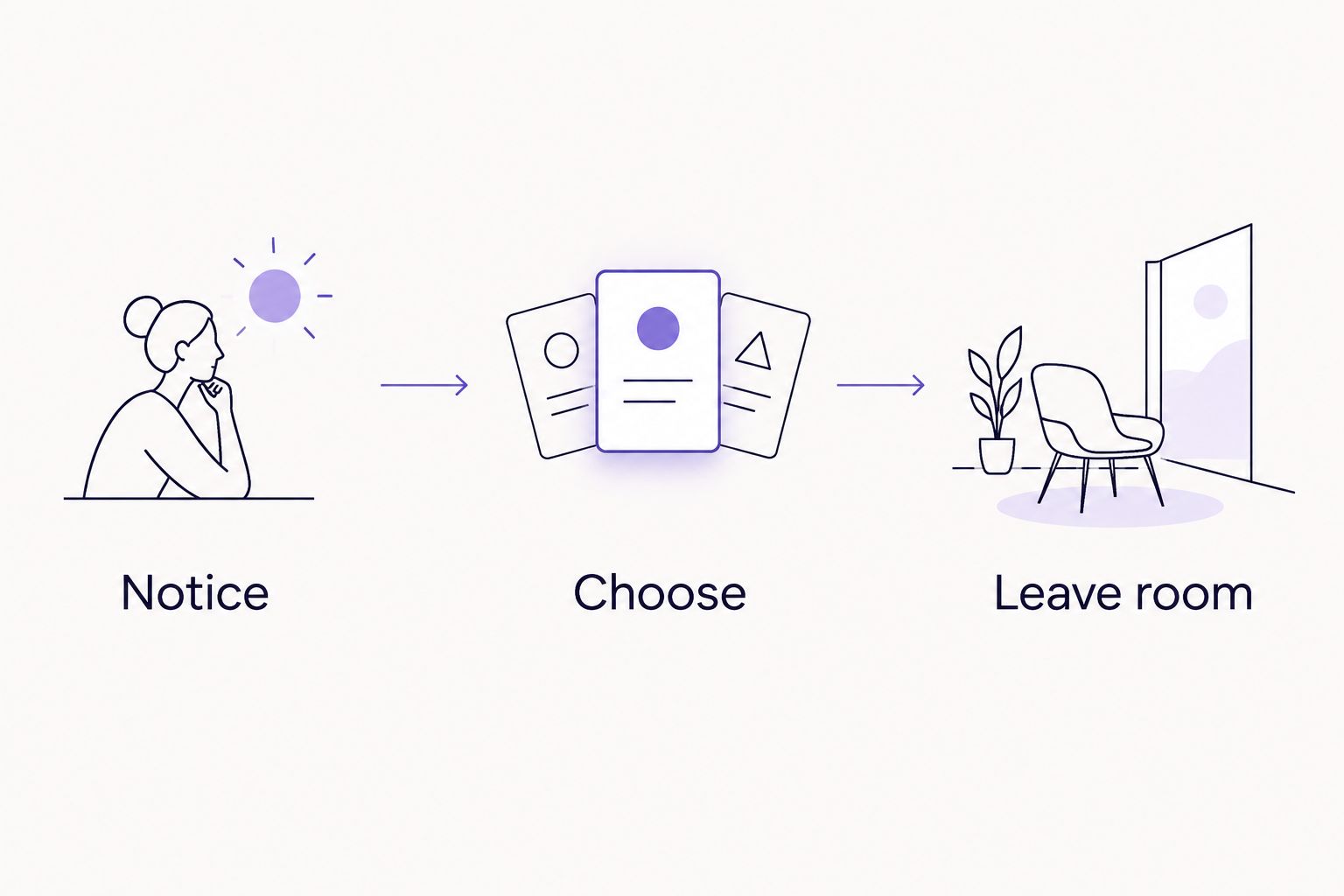
You could give this 5 minutes, or stop after a sentence. If you want a fuller walkthrough, how to use an undated weekly planner is the next place to look.
How the formats are ranked
This 2026 guide ranks planner formats by easy reentry, usable space, flexibility, reflection, and upkeep. It isn't a product testing review, and the ranking doesn't depend on unverified product claims.
The weekly format comes first because it puts everyday commitments and personal needs on the same page. The other formats earn their place by serving a distinct need, not by offering more boxes to complete.
Which undated planner should you choose?
Choose an undated weekly planner if you're undecided. Look for readable spaces, room for a personal note, and a layout that doesn't require you to account for every hour.
Choose reflection first if your question is What do I need? rather than When will I do it? Choose the notebook if you're not ready to choose anything at all.
The Sheema Edit's approach to an undated planner for self care routines starts with the person using it. Your 2026 planner can hold a quieter week without asking you to turn that quiet into an achievement.
FAQ
What's the best undated planner for self care routines?
An undated weekly planner is the best default in this guide because it shows personal needs alongside everyday commitments. Choose a reflection focused format instead if you mainly want space to understand how you're feeling.
Is an undated planner better than a dated planner?
An undated planner is the better fit if you want to pause and return without unused printed dates. A dated planner suits you better if having the calendar already filled in matters more than that flexibility.
Do I have to use a self care planner every day?
No, you don't have to use a self care planner every day. You can open it weekly, occasionally, or whenever you want somewhere to put a thought.
What should I write in a self care planner when I'm overwhelmed?
Start with one sentence about what you need or what feels too full. You don't need to turn the answer into a goal or write a complete account of your day.
Can I use a notebook instead of buying an undated planner?
Yes, a notebook can serve as your undated planner. Add the current week and a few headings, then change the layout when you discover what you actually use.
How do I restart a planner after missing several weeks?
Restart with the current week and leave the missed weeks alone. Bring forward only the reminders that still matter; catching up isn't a requirement.
Should I combine self care planning with family planning?
Combine them if seeing everything together helps you protect space for yourself. Keep reflection separate if you want privacy or find that household tasks crowd out your own notes.
One last thing
Before adding a new habit, try writing down something you no longer want to carry. A planner can make room through subtraction, too.
The Sheema Edit leaves space for that kind of answer. You are allowed to open a planner, decide something can wait, and close it again.
With Love, Sheema.