
Yes, a healing journal can offer a place to name feelings, notice what you need, and prepare for conversations about trauma recovery. It isn't trauma treatment, and writing about painful experiences can feel upsetting rather than relieving. You don't have to describe what happened, finish a prompt, or keep writing to make the practice count.
- Can a healing journal help with trauma recovery? Yes, as optional reflection, not a replacement for professional support.
- The Sheema Edit centers self reflection without treating journaling as a promise of healing.
- Start with your present needs rather than a detailed account of painful experiences.
- You can skip prompts, leave pages unfinished, or choose not to journal.
Can a healing journal help with trauma recovery?
A healing journal can support reflection during trauma recovery, but the journal itself isn't treatment. The useful distinction is between having somewhere to express yourself and expecting a notebook to do the work of professional care. Those are different jobs.
You might use a page to describe a difficult afternoon, write down a question you want to ask someone, or admit that you don't know what you feel yet. None of those entries needs a lesson at the bottom. Sometimes the honest ending is simply that today was hard.
If you're weighing writing against getting support, the distinction in can journaling replace therapy matters: personal reflection and professional care aren't interchangeable.
The comparison below separates possible uses of a journal from promises a journal can't honestly make.
| Approach | Best for | What it offers | Its limit |
|---|---|---|---|
| Open reflection | Readers who want room to choose their own words | Space to name feelings or describe the present | A blank page can feel like another demand |
| Gentle prompts | Readers who prefer a starting point | A question to respond to, change, or skip | A prompt can feel too personal or poorly timed |
| Notes for a conversation | Readers who want to remember what to discuss | A place to collect questions and concerns | Writing a concern down doesn't resolve it |
Why this matters when you're already carrying a lot
When you're an overwhelmed mom, even a caring suggestion can arrive dressed as another assignment. Journal. Drink water. Find yourself somewhere between the laundry and the school message you still haven't answered. Apparently, being a person now requires project management.
You don't need another measure of whether you're doing enough. A journal is an option, not evidence that you're trying hard enough to recover.
If you're beginning in 2026, you don't owe the year a transformation story. You can want support without wanting a fresh start, a new identity, or a beautifully written explanation of your pain.
The page should leave room for you, not become another place where you have to perform. That includes room for uncertainty, ordinary complaints, and days when you would rather close the notebook.
What a journal can hold without asking for your whole story
A journal entry doesn't have to begin with your most painful memory. You get to decide what belongs on the page and what stays unwritten. Privacy includes privacy from the assignment itself.
Here are some possible subjects, with no expectation that you answer them all:
- Something that felt difficult today.
- Something you wish someone understood.
- A question you want to bring to a conversation.
- A boundary you want more room to consider.
- Something ordinary you noticed and want to remember.
These aren't steps toward a required breakthrough. They're different doors into reflection, and you're allowed to leave every door closed.
An entry can also contain mixed feelings. You can love your family and want time without anyone needing you. You can appreciate support and still feel lonely. The page doesn't need you to settle the argument before you write it down.
For a journal begun in 2026, there is no requirement to explain every year that came before it. Today's experience is a complete enough subject.
Why the experience of journaling varies
There isn't a single way a journal is supposed to feel. Before deciding whether writing belongs in your life right now, consider the conditions around it rather than judging the quality of your entries.
- The subject: Writing about today's needs is a different task from describing a painful event in detail. You can choose the less exposing subject.
- Your privacy: A notebook that other people can read isn't automatically a comfortable place for personal writing. Consider who has access before choosing what to record.
- Your available attention: An interrupted afternoon doesn't have to become a failed journaling session. You can leave a thought unfinished.
- The wording: A question that assumes forgiveness, gratitude, or closure might not fit your experience. You can reject its premise.
- Your expectations: Expecting a page to produce relief gives it a job it can't guarantee. An entry can simply record what you wanted to say.
These are choices about the writing experience, not a formula for recovery. There is no correct combination that guarantees a particular result.
A gentle way to approach the page
You don't need a routine before you begin. If writing appeals to you, the following approach offers a little structure without asking you to revisit painful details.
Choose a subject
Pick what you want to write about, not what you think a healing journal expects. That might be a present feeling, an unanswered question, or something you need from the coming week.
An optional opening is: Today, I wish there were more room for… You can finish that thought plainly, without explaining or defending the answer.
Notice today
Keep the entry with your current experience if that's where you want to stay. You might describe an interruption, a difficult conversation, or the simple fact that you're tired of making decisions.
Another optional prompt is: What would I like someone to understand about today? There's no requirement to connect the answer to your past or discover what it means.
Close the page
You can stop at an ordinary stopping point. An unfinished sentence is allowed; so is deciding that you don't want to continue with the subject.
If you want a closing line, try: For now, I'm leaving this here. Closing a notebook doesn't require resolving what you wrote inside it.
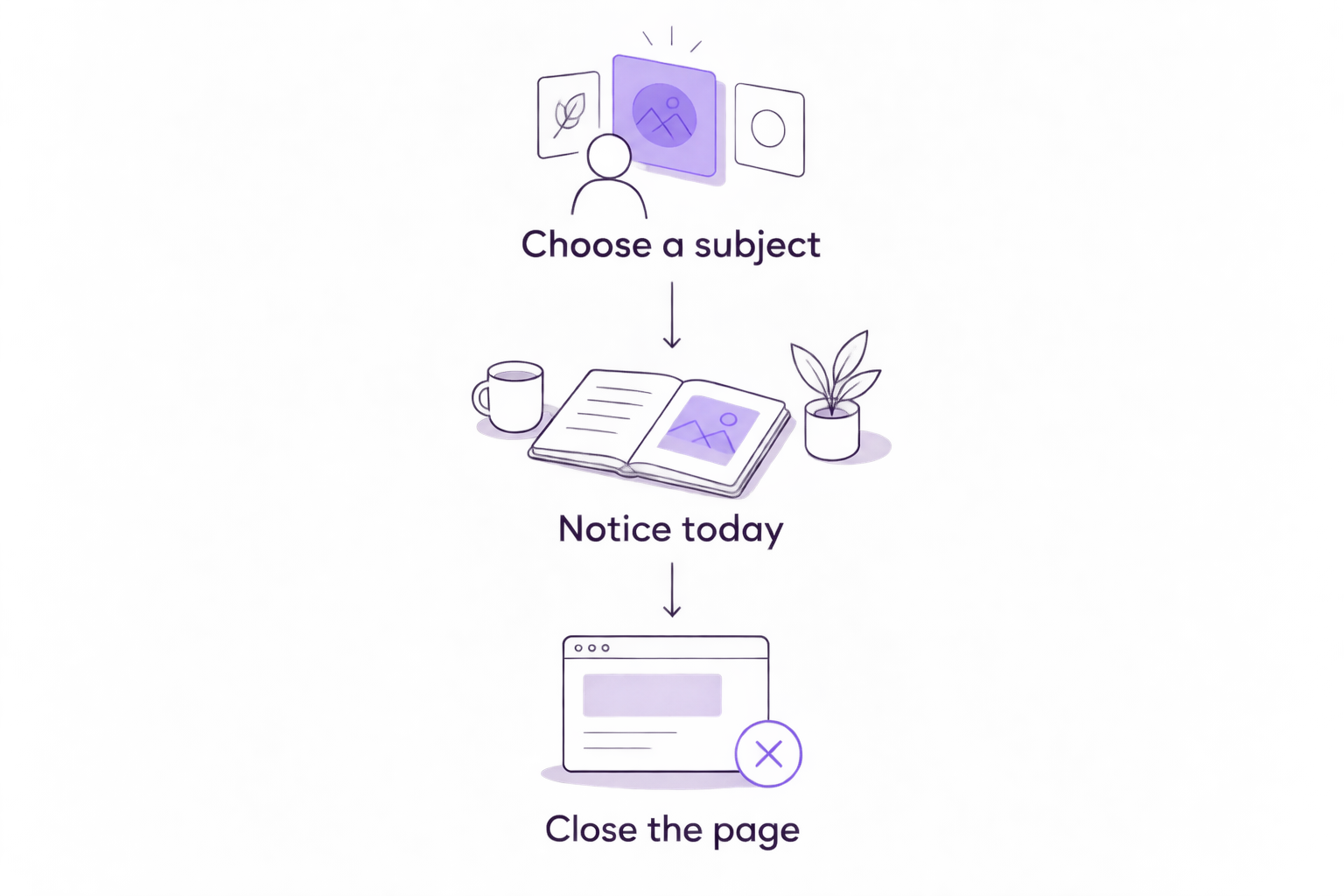
The purpose of this structure is permission, not discipline. You can use part of it, change the language, or decide that writing isn't what you want today.
What if a prompt feels wrong?
A printed question doesn't outrank your judgment. If a prompt asks you to find the gift in something painful, forgive someone, or describe an experience you don't want to revisit, you can leave it unanswered.
You also don't have to turn every difficult feeling into a positive statement. Anger doesn't need a gratitude paragraph attached to make it acceptable on the page.
Try changing the question instead:
- Instead of looking for a lesson, describe what you wish had been different.
- Instead of explaining another person's behavior, name what you needed.
- Instead of asking whether you've moved on, consider what you want support with now.
- Instead of planning a better version of yourself, write about what feels like too much.
These are invitations, not replacements you must complete. Even a gentle prompt is still optional.
If your 2026 journal has more skipped questions than answered ones, it isn't a record of failure. It means you didn't agree to every question someone else put in front of you.
Writing doesn't have to be your only form of expression
You don't have to make language carry everything. A private page can include a sketch, a patch of color, or space you deliberately leave empty. It can also stay closed while you choose something entirely unrelated to reflection.
When loss is part of what you're carrying, the distinction between private expression and supported care matters. Art therapy for grief names a therapeutic context; drawing in your own notebook isn't the same thing, just as personal journaling isn't therapy.
That distinction doesn't make ordinary expression less worthwhile. It keeps the promise honest. You can enjoy drawing, writing, or making something without asking it to treat trauma or prove that you're getting better.
You don't need to assemble a collection of wellness practices, either. Having more options doesn't mean you owe every option a turn.
Can a weekly planner sit beside a healing journal?
Yes, but they can have different jobs. A journal can hold what you want to express; a weekly planner can hold the appointment, reminder, or practical request you don't want to keep remembering.
Neither needs to become a recovery scoreboard. There is no need to rate your healing beside the grocery list.
If you already use an undated weekly planner, you might leave room for an ordinary need, such as asking someone to handle an errand. You can also leave the week mostly blank. Flexible planning should allow a change of plan without demanding a written apology.
The Sheema Edit is for overwhelmed moms who want room for self reflection, not another productivity checklist. Its printable journal and planner shop is an option if you want that kind of space on paper, not a necessary purchase for this practice.
A notebook already in your drawer can hold an honest entry. The format isn't what gives your words permission to exist.
Do I have to write about what happened?
No, you don't have to describe a traumatic experience to use a journal. You can write about what today feels like, something you need, or a subject that has nothing to do with trauma.
You can also reserve certain topics for conversations with a qualified professional. A blank space on the page doesn't require an explanation.
How will I know whether journaling belongs in my life right now?
Consider whether you want the space and whether the experience feels manageable, rather than looking for evidence of progress in every entry. You don't need a streak, a finished notebook, or increasingly positive language to justify continuing.
You can also pause without making a permanent decision. A journal you put down in 2026 doesn't become a debt you have to repay later.
When is a journal not enough?
A journal isn't enough when what you need is care, conversation, or help that a private page cannot provide. You don't have to finish explaining your experience in writing before asking for professional support.
If writing leaves you distressed, you don't need to push through it or treat that distress as proof that the exercise is working. Stop the exercise and consider discussing the experience with a qualified mental health professional.
This article offers general reflection ideas, not mental health advice or a trauma treatment plan. The Sheema Edit's approach to journaling doesn't replace individualized care.
FAQ
Can a healing journal help with trauma recovery if I don't write every day?
A healing journal can be an occasional place for reflection; daily writing isn't a requirement. Personal journaling isn't trauma treatment, regardless of how often you write.
Do I need to describe my trauma in a healing journal?
No, you don't need to describe traumatic experiences in a healing journal. You can choose present needs, ordinary observations, or questions you want to discuss with someone.
What if journaling makes me feel worse?
You don't have to continue writing when it leaves you distressed. You can stop and discuss that experience with a qualified mental health professional rather than trying to push through it.
Can I use a regular notebook instead of a healing journal?
Yes, a regular notebook can hold personal reflections. A product title or a set of printed prompts doesn't turn a notebook into treatment.
Should I reread everything I write?
You don't owe your journal a rereading session. You can leave an entry alone rather than turning it into another task to review or interpret.
Can I journal while also seeing a therapist?
You can bring questions about journaling to your therapist and discuss whether it fits your care. You don't have to share every entry or arrive with a written account of everything.
What should I write when I don't know what I feel?
You can write that you don't know what you feel. You can also describe an ordinary detail from today or leave the page blank without forcing an answer.
One last thing
Your journal doesn't have to become a document of your recovery. It can be a place you visit occasionally, use imperfectly, and leave alone when you need something else.
You don't owe 2026 a finished healing story. You deserve room to be a person whose life includes more than the work of getting through what happened.
With Love, Sheema.