
A mom planner can reduce the everyday burden of remembering and deciding by giving your commitments, needs, and next steps somewhere to land. It can't remove an unfair workload or guarantee less stress, and it stops being useful when keeping it updated becomes another job.
- Can a mom planner reduce daily stress? It can simplify remembering and deciding, but it can't remove your workload.
- Choose flexible weekly planning when a detailed daily schedule feels like another obligation.
- Use self reflection journaling to name what you need, not just what needs doing.
- The Sheema Edit is best for moms seeking reflective essays alongside optional journal and planner printables.
Why this matters
You don't need a prettier record of how much everyone needs from you. You need somewhere to notice what actually requires your attention, what belongs to someone else, and what can wait without the world filing a complaint.
A useful planner makes those distinctions visible. If you're starting fresh in 2026, the guide to using an undated weekly planner offers a place to begin without committing to a daily routine.
The Sheema Edit pairs planning with room for reflection because your needs belong on the page, too. The goal isn't to fit more into your day. It's to make a clearer decision about what belongs there.
Can a mom planner reduce daily stress?
Yes, when you use it to make decisions rather than simply collect tasks. Writing something down gives you a reference to return to; deciding whether to do it, share it, postpone it, or leave it alone gives that reference a purpose.
That distinction matters. A long list can describe your overwhelm perfectly without changing anything about your afternoon.
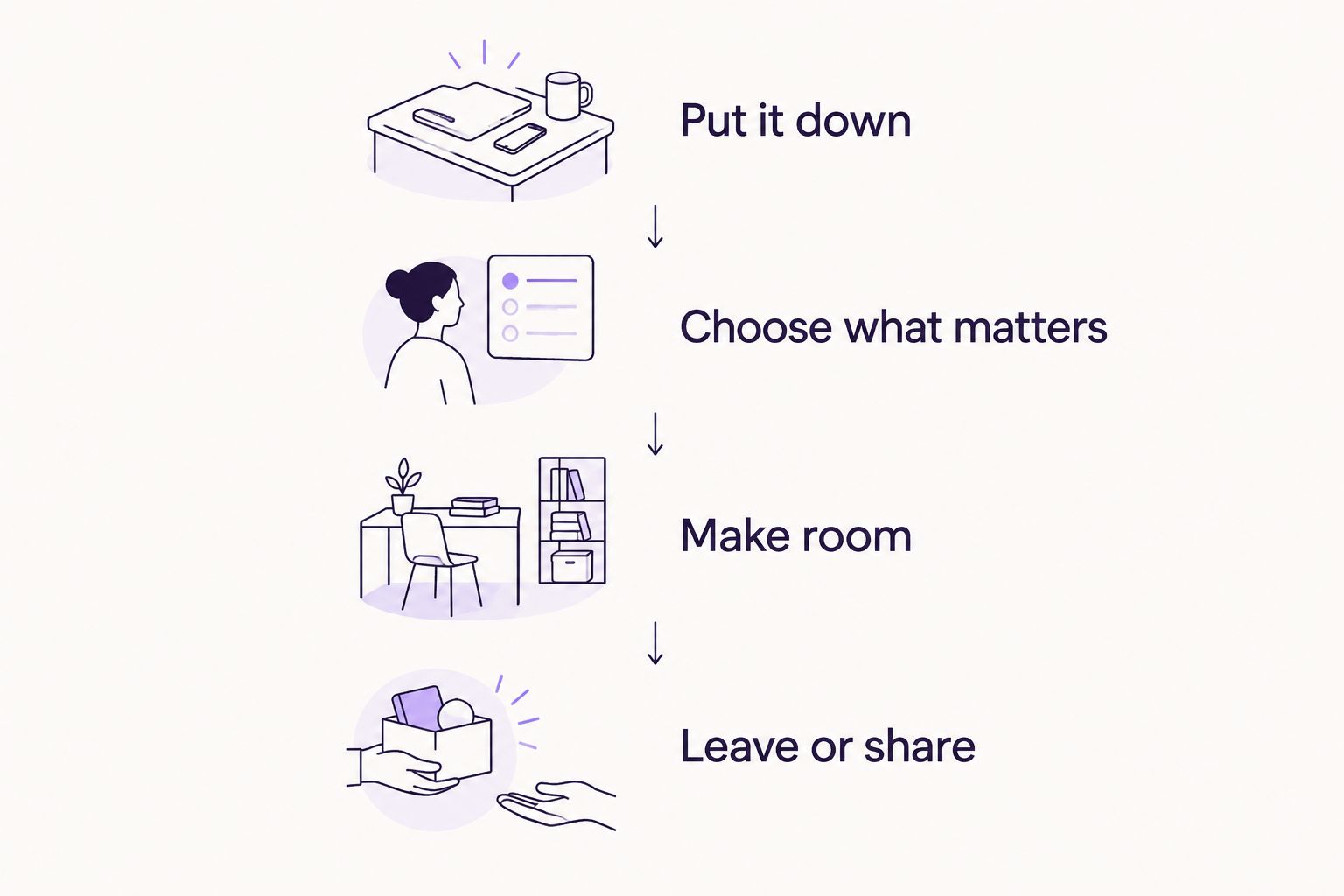
There's no guaranteed amount of stress relief attached to a planner. Instead of expecting a particular result, you can try this small sequence whenever it feels useful.
Put it down
Write down what's taking up attention: the appointment, the unanswered message, the form, the thing you keep remembering while brushing your teeth. Fragments count. Nobody is grading the handwriting or checking whether every verb matches.
If a starting point helps, give yourself 2 minutes to write. That's an optional boundary for the exercise, not a recommended dose or a promise that you'll feel different afterward.
Choose what matters
Look for something that genuinely needs attention, rather than something that merely looks satisfying to cross out. You might choose 1 task to focus on before adding anything else.
An actual deadline deserves different treatment from a vague feeling that you should reorganize the kitchen. Both can appear on the page without receiving equal authority over your day.
Make room
Write down fixed commitments before filling the spaces around them. Then leave some spaces unclaimed. An empty afternoon isn't proof that you've forgotten to be useful.
If your week already looks crowded, the next planning decision might be removing something. Adding smaller handwriting is not the only available strategy.
Leave or share
Ask whether each remaining task is yours, someone else's, or unnecessary right now. When another adult shares responsibility, discuss who will handle the task rather than quietly becoming the household reminder service.
Where sharing isn't available, naming that limitation still matters. A planner can record what you're carrying without pretending the load is reasonable.
Which kind of planning leaves you more breathing room?
Choose a format based on the decision you need help making, not the person you imagine becoming once you own matching pens. A weekly view, a daily page, and a journal serve different purposes.
These are format comparisons, not claims about particular products. You can try the approach on plain paper before deciding whether you want a dedicated planner.
| Approach | Best for | What it offers | What to watch for |
|---|---|---|---|
| Undated weekly planning | Seeing commitments together and returning after gaps | A view of the week without a required calendar start | A weekly overview isn't a detailed appointment schedule |
| Daily planning | Sorting a day with several fixed commitments | Space to put today's tasks beside today's appointments | Maintaining a fresh page can become another obligation |
| Reflection journaling | Naming feelings, needs, and boundaries | Room to explore what's behind a crowded task list | Reflection alone doesn't keep track of appointment times |
An undated format lets you assign dates when you use it. If you begin during 2026, you don't need to start with January or fill earlier weeks to make the notebook look properly used.
Daily planning makes sense when today's timing needs attention. It doesn't need to become a permanent practice just because it helped on a complicated Tuesday.
Reflection journaling belongs beside planning when the real question isn't what comes next, but why everything feels like too much. You don't need all these formats at once. Use the smallest amount of structure that answers your actual question.
Why the usefulness of a mom planner varies
The same page can feel helpful one week and irritating the next. That doesn't automatically mean you've chosen badly or become mysteriously incapable of using stationery.
What matters is whether the page fits the circumstances you're bringing to it:
- Your commitments: Fixed appointment times need a visible place. Flexible errands don't necessarily need their own time slots.
- Your available energy: A page that assumes the same capacity every day leaves little room for a difficult night or a change in how you feel.
- Your control over tasks: Writing something down doesn't give you control over another person's deadline or response.
- Your access to support: A shared list can show responsibilities, but another person still has to agree to take them on.
- Your relationship with the page: If unchecked boxes feel like accusations, fewer boxes or a different format might suit you better.
You can change the system without making a character assessment about yourself. Try fewer categories, a shorter list, or a page you revisit only when you need it.
For your 2026 planning, consider writing a permission statement inside the cover: This is a place to make decisions, not a record of my worth. You don't have to earn the right to adjust an ordinary week.
What can I write when I don't know where to start?
Start with what's true, not what sounds organized. You don't need a meaningful opening sentence before you're allowed to notice that you're tired, irritated, or tired of being the person who notices everything.
Try any of these 3 prompts, separately or together:
- What am I trying to remember that needs a place on the page?
- What am I expecting from myself that doesn't fit this week?
- What would I like help with, even if asking feels awkward?
A practical answer might be to put an appointment on the calendar. A different answer might be that you're agreeing to things before checking whether you have room for them. Those answers call for different next steps.
If a question brings up more than you want to explore, leave it there. You can write a word, close the notebook, or move on to something ordinary. Reflection isn't an assignment you have to finish before making dinner.
For more starting points, these self reflection journal prompts for moms keep the attention on your experience, not only your responsibilities.
How do I know whether my planner is helping?
Look at what happens after you use it. Can you find the appointment without searching through messages? Have you decided what can wait? Is there something you no longer need to keep rehearsing because you've recorded the next step?
Those are practical signs of usefulness, not a test you need to score. You don't need to track your planner's performance in another planner. There are limits, even for stationery.
You might also notice the opposite: copying the same impossible list, spending more time maintaining the page than using it, or avoiding the notebook because opening it feels unpleasant. Those are reasons to simplify or stop, not reasons to try harder at being organized.
Keep the parts that answer a real need. Drop the parts that only create upkeep. If your 2026 setup needs fewer sections than the one you imagined, fewer sections are allowed.
What if planning makes me feel worse?
You can put the planner aside. A tool doesn't become helpful simply because you bought it, downloaded it, or really wanted this to be the thing that worked.
If you'd rather adjust it, remove the parts that feel judging or demanding. That might mean leaving habit trackers blank, skipping decorative setup, or keeping appointments without maintaining a separate task list.
You can also separate remembering from evaluating. Record that the form is due without adding a story about why you haven't finished it yet. The page needs the deadline, not the prosecution's opening statement.
Planning also has a clear boundary: it isn't treatment for anxiety, burnout, or other health concerns. If stress is persistent or interfering with everyday life, a conversation with a qualified professional belongs outside the notebook, not beneath another checkbox.
Where a printable fits, and where it doesn't
The Sheema Edit offers printable journals and planners for readers who want a dedicated place for reflection and planning. A printable is an option when you'd like a page to write on without designing one yourself.
The limitation is practical: a PDF still needs a way for you to use it, whether that's printing it or choosing a suitable digital setup. It also won't decide which responsibilities are reasonable or make someone else share them.
Before choosing any printable, check the actual page layout and consider whether you'd use the sections it contains. Don't assume a product includes a particular tracker, weekly view, or reflection prompt unless its description says so.
You can keep using ordinary paper while you decide. Wanting support doesn't create an obligation to buy a better looking place to write things down.
FAQ
Can a mom planner reduce daily stress if my schedule keeps changing?
A mom planner can give changing commitments a visible place, but it can't prevent interruptions. Try recording fixed appointments and leaving the rest flexible rather than assigning every task a time.
Do I need to use a mom planner every day?
No, you don't need to use a mom planner every day. Return when you need to check a commitment, make a decision, or write something down; missed days don't require catching up.
Is a weekly planner better than a daily planner for moms?
A weekly planner suits seeing commitments together, while a daily planner suits sorting one day's timing. Neither is automatically better; choose the view that answers your current question.
What should I put in a planner when I'm already overwhelmed?
Start with a fixed commitment and 1 task that genuinely needs attention. You can leave everything else on a separate note until you're ready to decide what belongs in the plan.
Can I journal instead of using a mom planner?
Yes, you can journal instead if reflection is what you need. Keep appointment times somewhere you can reliably find them, because exploring a feeling and remembering a deadline are different jobs.
Can a mom planner treat anxiety or burnout?
No, a mom planner isn't treatment for anxiety or burnout. It can hold commitments and questions, but it doesn't replace professional care or changes to an unsustainable workload.
What if I keep abandoning my planner?
You can simplify the planner, return without catching up, or stop using it. The useful question is whether the format serves your life, not whether you can make yourself maintain it.
One last thing
Before moving an unfinished task onto a fresh page, ask whether you still want it there. Rewriting isn't a neutral act if it keeps renewing a commitment you've never actually chosen.
Some tasks need a new date. Others need a conversation, a smaller version, or permission to disappear. Your 2026 planner is allowed to contain evidence that you changed your mind.
The Sheema Edit makes room for that kind of reflection: not just how to manage the life on the page, but whether the page leaves room for you. A useful plan includes your limits, not only your obligations.