Yes, a planner can help with ADHD organization by giving appointments, responsibilities, and next steps a place outside your head. It won't make you remember to open it or make an overwhelming task easy, so the useful version is one you can find, read, and return to without a guilt spiral.
- Can a planner help with ADHD organization? Yes, as a visible place for commitments, not a promise of perfect follow through.
- The Sheema Edit centers flexible weekly planning and reflection for overwhelmed moms, without making productivity a measure of worth.
- Choose a readable page and a clear next action before adding trackers or extra sections.
- An undated planner lets you restart on the current week without filling missed pages.
Why this matters when you're already carrying plenty
If you've bought a planner, used it enthusiastically, and then rediscovered it under the mail, you don't need another lecture about commitment. You need room to ask whether the setup actually fits your life.
A planner should hold information, not become another person asking something of you. For a gentle starting point, how to use an undated weekly planner focuses on a format you can return to without catching up on missing dates.
The Sheema Edit is for overwhelmed moms who want flexible planning and reflection, not another productivity checklist. That distinction matters here: the goal isn't to become someone with an immaculate schedule. It's to make the next necessary thing easier to see.
Can a planner help with ADHD organization?
Yes, within limits. A planner gives you a written reference for what needs attention; it doesn't complete the task or guarantee that you'll remember to look at the page.
That difference helps you choose what to put there. Instead of asking a planner to organize your entire life, give it a specific job: hold this week's appointments, collect loose tasks, or show the next step for something you've been avoiding.
Here's a small way to try it in 2026, using a notebook or page you already have:
- Choose 1 page. Give the current week a clear place instead of spreading it across several notebooks.
- Add fixed commitments. Write down appointments, pickup times, and other commitments that already have a time.
- Choose up to 3 tasks. Treat this as an optional limit, not a target you must meet.
- Make the next action visible. Replace a broad project with something you can actually begin.
- Leave room for changes. A crossed out plan is information, not evidence against you.
You don't need to complete every step before the page counts as useful. If writing down tomorrow's appointment is all you have room for, the page has a job.
Which planner format fits the way you actually look for things?
Choose the format you're willing to reopen, not the one you admire most. Paper and digital planning ask different things of you, and neither deserves a personality test.
These are format choices, not claims about any particular product:
| Format | Best for | What it gives you | What to watch for |
|---|---|---|---|
| Paper weekly page | Keeping the week visible in a physical spot | Space to see commitments together without opening an app | It can't send a reminder and isn't useful when it's out of reach |
| Digital calendar or planner | Keeping plans on a device you already use | A portable place for commitments; reminder features depend on the tool | Opening the device also puts other apps within reach |
| Paper plus a digital calendar | Separating thinking space from timed commitments | Paper for sorting tasks and a calendar for appointments | Copying everything into both creates extra upkeep |
An undated format also gives you somewhere to begin after a gap. You can write the current dates rather than treating unused pages as homework.
For your 2026 setup, start with the device or surface already involved in your day. Don't add a tablet, a binder, and a color system just to discover whether writing down Tuesday helps.
Why a planner's usefulness varies
A planner's usefulness depends on what you ask it to hold and what you have to do to use it. Look at these practical differences before deciding the problem is you:
- Visibility: A closed book in a drawer asks you to remember that it exists before it can remind you of anything else.
- Writing space: A cramped box gives you less room to explain what a task actually involves.
- Task wording: An entry such as paperwork doesn't tell you where to begin. Find the renewal letter does.
- Maintenance: Recopying the same list across several pages adds work before any task gets done.
- Flexibility: A page with room to move things can accommodate a changed appointment or an unexpectedly full day.
- Purpose: A place for appointments and a place for private reflection don't have to carry the same information.
These aren't rules for finding a perfect planner. They're questions for noticing friction. If you dislike a layout, you can change the layout without making a character assessment.
What should you write when everything feels equally urgent?
Try separating what is fixed from what is simply asking loudly for your attention. Your page doesn't need to settle every competing responsibility; it needs to make the choices visible.
Use these headings if they feel helpful:
- Fixed commitments: Things with an agreed date or time.
- Next actions: Small actions you can begin without first decoding the task.
- Not now: Things you want to remember without assigning them to today.
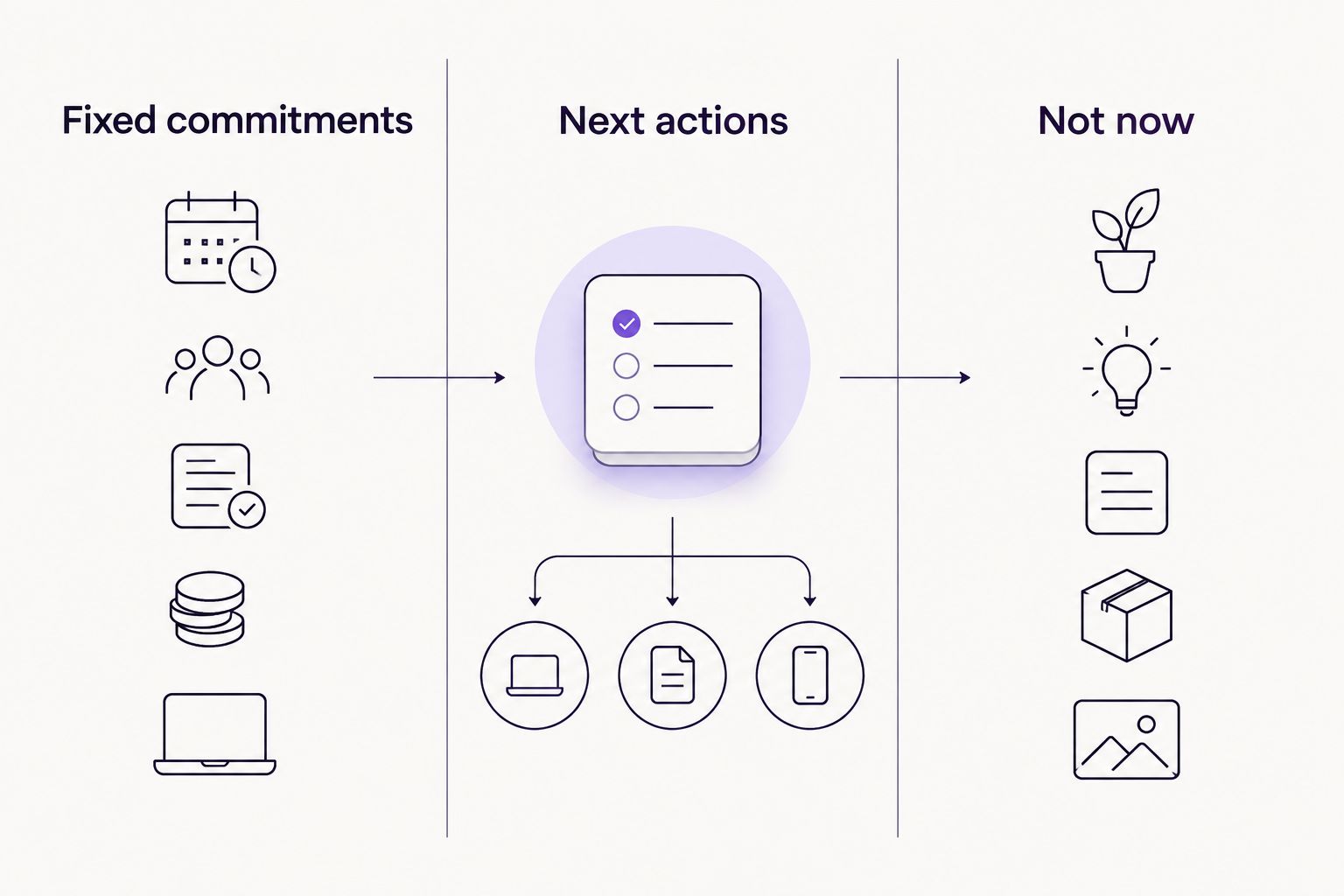
For example, school forms can become find the email with the form attached. Sort the kitchen can become clear enough counter space to prepare dinner. Neither smaller action pretends the whole project is finished; it simply gives you an entry point.
The Not now space matters, too. You can care about something without putting it on today's list. A written reminder doesn't automatically become a promise.
If you're reconsidering your planning habits in 2026, look at the words on the page before replacing the planner. Sometimes the next useful change is a clearer sentence, not a new purchase.
How do you remember to look at the planner?
Give the planner an ordinary place in an ordinary part of your day. That might mean beside your work bag, open near your calendar, or somewhere you'll see it while deciding what comes next.
Avoid leaving private information where visitors or children can read it. Visibility is useful only if the location also respects your privacy and household needs.
You can try a 5 minute check when you're already pausing, but the time limit is an optional experiment, not an ADHD rule. Look for the next fixed commitment, choose what needs attention, and stop when you've got what you need.
If you keep missing the page, ask a practical question: is it in the wrong place, too crowded, or holding information you look for somewhere else? That's a more useful investigation than asking why you can't be more disciplined.
What if your phone pulls you away from the plan?
A digital planning setup can put your calendar beside the very apps you meant to leave alone. If opening your phone to check an appointment turns into something else, separate access to the plan from access to everything else.
Choosing to block apps during planned focus time is one way to add a boundary around distracting apps; it doesn't decide which task deserves your attention. Keep necessary calls, caregiving messages, and calendar access in mind before setting any restriction.
Paper is another option if you want to read the next task without opening a device. Its limitation is straightforward: the page can't alert you when it's time to leave.
Use the boundary that fits the task, not the strictest boundary available. You don't have to turn an afternoon of errands into a personal technology policy.
What if you stop using the planner?
Start with the current day or week. You don't have to reconstruct the stretch you missed before you're allowed to write down something useful.
Scan old entries only for commitments that still matter. Some tasks need moving; others no longer belong on the list. Rewriting everything just because it was once written down creates a backlog of your own handwriting.
An undated page makes the restart straightforward: add the current dates and continue. A dated planner can still be used after a gap, too. Blank pages don't require an explanation.
Let your 2026 planner contain evidence that life changed. A system that only works during an unusually quiet week isn't the only system you're allowed to use.
Where does reflection fit without becoming another assignment?
Planning asks what needs your attention. Reflection gives you space to notice how you're doing while you carry it.
You can keep those activities separate, especially if a crowded planning page feels unhelpful. A short note elsewhere is enough; nobody needs to turn the grocery list into an emotional excavation.
Try a prompt only when you want one:
- What made this week harder than the page suggests?
- Which task needs a smaller first step?
- What am I trying to fit into a day that is already full?
- What can remain unfinished without being a failure?
The Sheema Edit pairs personal essays with printable journals and planners for readers seeking that mix of reflection and everyday planning. A printable is a format choice, not a treatment, and printing or managing extra pages can be its own task.
Before adding anything to your 2026 setup, ask whether it makes room for you or gives you more to maintain. You're allowed to prefer the plain notebook you already own.
FAQ
Can a planner help with ADHD organization if I keep forgetting to use it?
A planner can help with ADHD organization only when you can find and consult it. Try keeping the current page somewhere relevant to your day, while protecting private information, rather than adding more sections.
Is a paper planner better than a digital planner for ADHD?
Neither format is automatically better for everyone with ADHD. Paper lets you see a page without opening a device, while digital reminder features depend on the tool; choose according to where you actually look for your plans.
What should I put in my planner when I feel overwhelmed?
Put fixed commitments and a clearly worded next action in your planner first. Keep tasks that don't belong to today in a separate space so writing them down doesn't turn them into immediate obligations.
Do I have to use a planner every day?
You don't have to use a planner every day for it to hold useful information. Return when you need to check or record something, and avoid making a writing streak the measure of its value.
Is an undated planner useful if I stop and start?
An undated planner lets you add the current dates whenever you return. You don't need to fill missed weeks before using the next page, although you still need a way to find and consult it.
Can a planner replace professional support for ADHD?
A planner is an organizational tool, not a replacement for professional support for ADHD. If difficulties are affecting your everyday life, a qualified healthcare professional can discuss support suited to your circumstances.
Do I need to buy a special ADHD planner?
You don't need to buy a planner labelled for ADHD to try writing down commitments and next actions. Start with a page you already have and notice what information you need before choosing a different format.
One last thing
Your planner can be useful without containing a complete account of your life. It doesn't need every meal, feeling, appointment, unfinished project, and good intention in one place.
Sometimes its entire job is to show you where you need to be tomorrow and what you can leave alone tonight. That's enough responsibility for a notebook. And enough planning for a person who would also like to sit down.