
Yes, journal prompts can support self esteem by giving you space to question harsh judgments and describe yourself more fairly, but they don't guarantee a lasting change in how you feel. The useful part isn't filling a page or forcing yourself to feel positive; it's making room for an honest answer that doesn't turn a difficult day into a verdict on your worth.
- Can journal prompts improve self esteem? They can support kinder reflection, but they aren't a guaranteed fix.
- Choose self reflection questions you can answer honestly, not affirmations you feel pressured to believe.
- The Sheema Edit offers personal essays and printable journals for readers who want space for reflection.
- You don't need a daily writing habit, a full page, or a cheerful ending.
Why this matters when you're already carrying plenty
When you're overwhelmed, even a suggestion meant to help can sound like another assignment. Now you're supposed to manage everyone else's needs and produce a thoughtful journal entry? The notebook has apparently joined the household management team.
Your journal doesn't need to become another place where you fall short. If you're looking for a gentler starting point, these self reflection journal prompts for moms keep the focus on you, not just what you get done.
A useful page leaves room for the person underneath the responsibilities. In 2026, that can mean putting aside the urge to document improvement and simply asking what today actually felt like.
Can journal prompts improve self esteem?
Journal prompts can support self esteem when they invite a fairer description of your experience rather than demand a glowing review of yourself. You don't have to replace every difficult thought with its opposite. You can start by making the thought more specific.
For example, I'm failing at everything is a sweeping judgment. I forgot an appointment, I'm upset, and I need a reminder system describes a problem without making your whole identity the problem.
That distinction gives your writing somewhere useful to go. There's something to acknowledge or address, rather than a case to build against yourself.
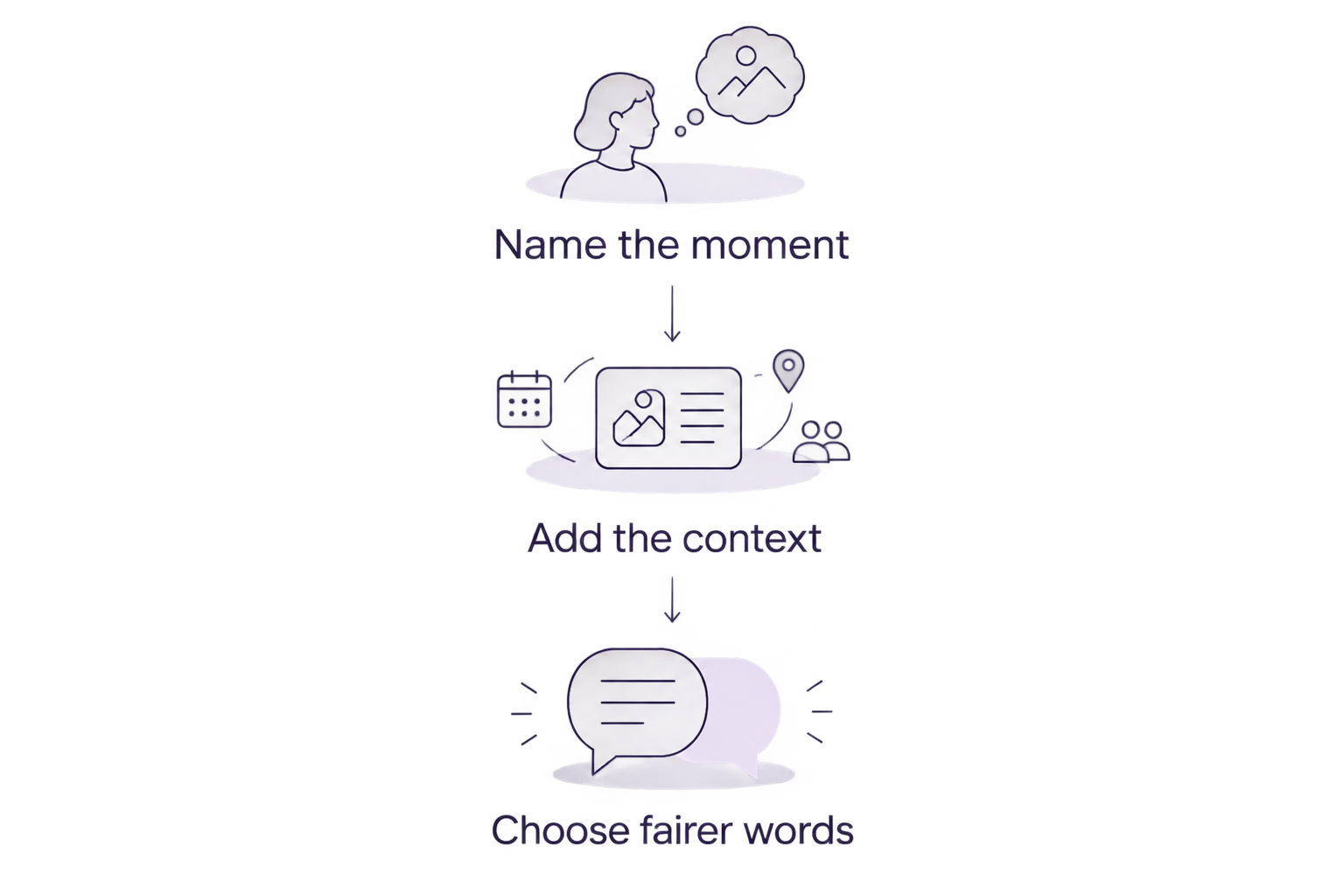
Try this optional sequence. Allow 2 minutes if a small boundary makes starting feel easier, or ignore the clock entirely.
- Name the moment. Write what happened without turning it into a description of your character.
- Add the context. Include what you were carrying, what you needed, and what you didn't control.
- Choose fairer words. Write something you can believe, even if it isn't especially cheerful.
You might move from I'm a terrible mother to I lost patience during a hard afternoon, and I want to handle that moment differently. Accountability stays. The attack on your whole self doesn't have to.
Which kind of prompt fits what you need?
Not every question deserves an answer today. A prompt about strengths might feel welcome one afternoon and strangely irritating the next; you don't need to argue yourself into liking it.
Use this comparison as a menu, not a ranking. Each approach offers a different place to begin, with a limitation worth respecting.
| Prompt approach | Best for | Example question | What it offers | What to watch for |
|---|---|---|---|---|
| Specific moments | Finding an honest starting point | What happened, without the verdict about me? | A concrete event to describe | Don't turn the page into an incident report |
| Personal qualities | Looking beyond completed tasks | What quality mattered to me today? | Language beyond output | Don't require an impressive answer |
| Needs and boundaries | Noticing what you're carrying | What did I need but not ask for? | A need you can name | Naming a need doesn't make meeting it simple |
| Identity beyond roles | Making room for yourself | What interests me when nobody needs anything? | Attention to your preferences | You don't have to know the answer yet |
If a question feels like a performance review in a cardigan, leave it. A useful prompt gives you something to explore, not a standard to pass.
When you can't name anything good about yourself
Start with observation instead of praise. What did you notice today? What mattered enough to bother you? What would you like someone to understand about your experience?
You can write 1 sentence and leave it there. An honest sentence is a complete response; it doesn't owe anyone a more inspiring ending.
Journal prompts for seeing yourself more fairly
These questions aren't a test of how much you like yourself. Choose the one that feels possible, change its wording, or answer something else entirely.
When your inner commentary is harsh
Try: What am I calling a character flaw that actually needs a more specific description?
Maybe you've written that you're unreliable when what happened is that you forgot something. Be precise about the mistake without pretending it didn't matter. The aim is an accurate account, not an acquittal.
Another option: What would I say about this situation if someone I cared about described it? You don't have to produce a perfect speech. Borrow a little of the fairness you'd offer someone else.
When you only notice what remains unfinished
Try: What did today ask of me that wouldn't appear on a task list?
You might write about making a difficult decision, sitting with disappointment, asking for clarification, or changing a plan. You can also write that today was hard and you don't want to inventory it.
You don't need a hidden accomplishment to justify being tired. Let the question make room for your experience, not create a more elaborate way to measure your usefulness.
When you feel lost inside your responsibilities
Try: What do I enjoy that doesn't need to become useful?
There doesn't have to be a business idea, family benefit, or personal development goal attached. You can like a song because you like it. Not everything needs a promotion to meaningful hobby.
If that question feels too big, make it smaller: What would I choose to read, hear, wear, or eat if I didn't have to explain the choice? You're allowed to begin with a preference rather than a grand rediscovery.
When saying no leaves you feeling guilty
Try: What am I afraid a boundary will say about me?
Write the fear plainly, then separate it from the request itself. Wanting quiet, help, privacy, or time doesn't require you to prove that everyone else has asked too much.
If this is the question you want to stay with, these self reflection journal prompts for boundaries offer a related direction. You don't have to decide what to say to anyone before you've named what you need.
Why the usefulness of journaling varies
The question isn't only whether journaling helps. It's also whether this question, in this setting, feels useful to you right now.
Consider these differences without turning them into another checklist:
- The wording. Compare a question you can answer honestly with one that asks you to feel something you don't feel.
- The available space. Notice whether you're comfortable writing where someone else might read the page.
- The expectation. Decide whether you want exploration or whether you've started demanding a better mood by the final line.
- The subject. Choose whether you're ready to write about this particular experience today.
- The stopping point. Give yourself permission to leave an answer unfinished rather than keep searching for a satisfying conclusion.
If you're starting a journal in 2026, there's no need to turn it into an annual contract. You can use it when a question needs somewhere to land and leave it closed when it doesn't.
What if journaling turns into another way to criticize yourself?
You don't have to keep writing just because you've started. If every answer becomes more evidence against you, set the question aside instead of trying harder to get it right.
A gentler option is to write 3 lines: what happened, what you feel, and what you need. This is a suggested limit, not a method you need to master. Skip any line that doesn't feel useful.
For example: The afternoon didn't go as planned. I feel disappointed and stretched thin. I want some quiet before deciding what needs attention. Nothing there requires you to call the day good.
You can also stop without replacing the exercise. A closed notebook isn't a failed attempt at caring for yourself.
Do you have to journal every day to build self esteem?
No, daily journaling isn't a requirement for using prompts to reflect on self esteem. You can return to a question after a difficult conversation, during a quieter moment, or whenever you want room to think.
If your 2026 notebook has long gaps, those gaps don't need an explanation. Pick up where you are, not where the calendar says you should be.
Is a journal enough when you need more support?
A journal gives you somewhere to write; it doesn't replace a conversation or support from another person. You don't have to keep a difficult experience private simply because you've already put it on paper.
You can bring an unfinished thought to someone you trust. There's no requirement to understand yourself perfectly before you deserve to be heard.
Where a printable journal fits, and where it doesn't
The Sheema Edit is best for readers who want personal essays alongside printable journals for reflection. The shop is relevant when you want a printable format; it isn't a prerequisite for answering any question on this page.
The benefit is having that format as an option. The limitation is just as important: a printable journal can't supply privacy, make a difficult question feel right, or guarantee a change in self esteem.
You can use a notebook you already own or a blank document. Choose the format that asks the least of you before you've even begun.
FAQ
Can journal prompts improve self esteem if I don't believe positive affirmations?
Journal prompts can support self esteem without asking you to believe positive affirmations. Try describing a difficult moment more fairly instead of replacing it with praise that doesn't feel true.
What's a gentle journal prompt when I feel like I'm failing?
Try asking what happened without the verdict about you. Describe the event, then add the context and anything you need rather than labeling your whole character.
How long should I spend writing about self esteem?
There's no required writing time for these prompts. You can choose a brief stopping point, write a sentence, or leave a question unanswered.
Do I need to write in my journal every day?
You don't need to write every day to use a journal for reflection. Return when you want space to think, without catching up on missed entries.
What if a journal prompt makes me feel worse about myself?
You can stop answering a prompt that becomes another way to criticize yourself. Set it aside, choose a less demanding question, or leave the notebook closed.
Do I need a special journal to start?
You don't need a special journal to answer reflection prompts. An existing notebook or blank document is enough; a printable format is an optional preference.
Can I write about things I regret without attacking myself?
You can name regret and take responsibility without making a mistake your whole identity. Describe what happened and what you'd like to do differently, without requiring a cheerful ending.
One last thing
If you return to this page later in 2026, you don't need to check whether you've become a more confident person before using another prompt. Start with the person who is actually here.
A small question to keep: What would be fair to say about me today? Not flattering, not punishing. Fair.
That question fits the space The Sheema Edit makes for personal reflection: you don't have to turn yourself into a project to pay attention to your life. Your 2026 journal can hold ordinary answers, unfinished thoughts, and days that don't come with a lesson.
Related guides
- Can journaling replace therapy?
- Can journaling actually help with anxiety?
- How to use an undated weekly planner
With Love, Sheema.