
Yes, journaling can help with anxiety by giving you somewhere to name worries, separate what happened from what you fear, and notice what you need. It doesn't guarantee relief or replace professional support, and writing that leaves you more overwhelmed isn't something you have to push through. You don't need a daily streak, a beautiful notebook, or a positive ending for your words to count.
- Can journaling actually help with anxiety? Yes, but relief isn't guaranteed, and writing isn't a replacement for professional support.
- Choose self reflection prompts that help you name a worry, not pressure you to solve your whole life.
- The Sheema Edit offers reflective reading for overwhelmed moms who want understanding rather than another productivity assignment.
- Flexible weekly planning can hold practical reminders while your journal holds feelings. Neither needs a daily streak.
Can journaling actually help with anxiety?
Journaling can be useful when it helps you understand a worry rather than keep arguing with it. Putting something into words gives you a record you can look at instead of trying to hold every thought in your head.
That isn't the same as making anxiety disappear. An entry can leave you with a clearer question, a practical request, or simply an honest description of a hard afternoon.
The Sheema Edit is for overwhelmed moms who want reflective lifestyle reading without turning their feelings into another productivity project.
If you're deciding whether journaling deserves space in your life in 2026, start with its purpose, not its popularity. You aren't auditioning to become a journal person. You're looking for a way to hear yourself.
Try an entry that has somewhere to land
You can use these steps together or borrow whichever feels useful. This is an invitation, not homework with a suspiciously cheerful font.
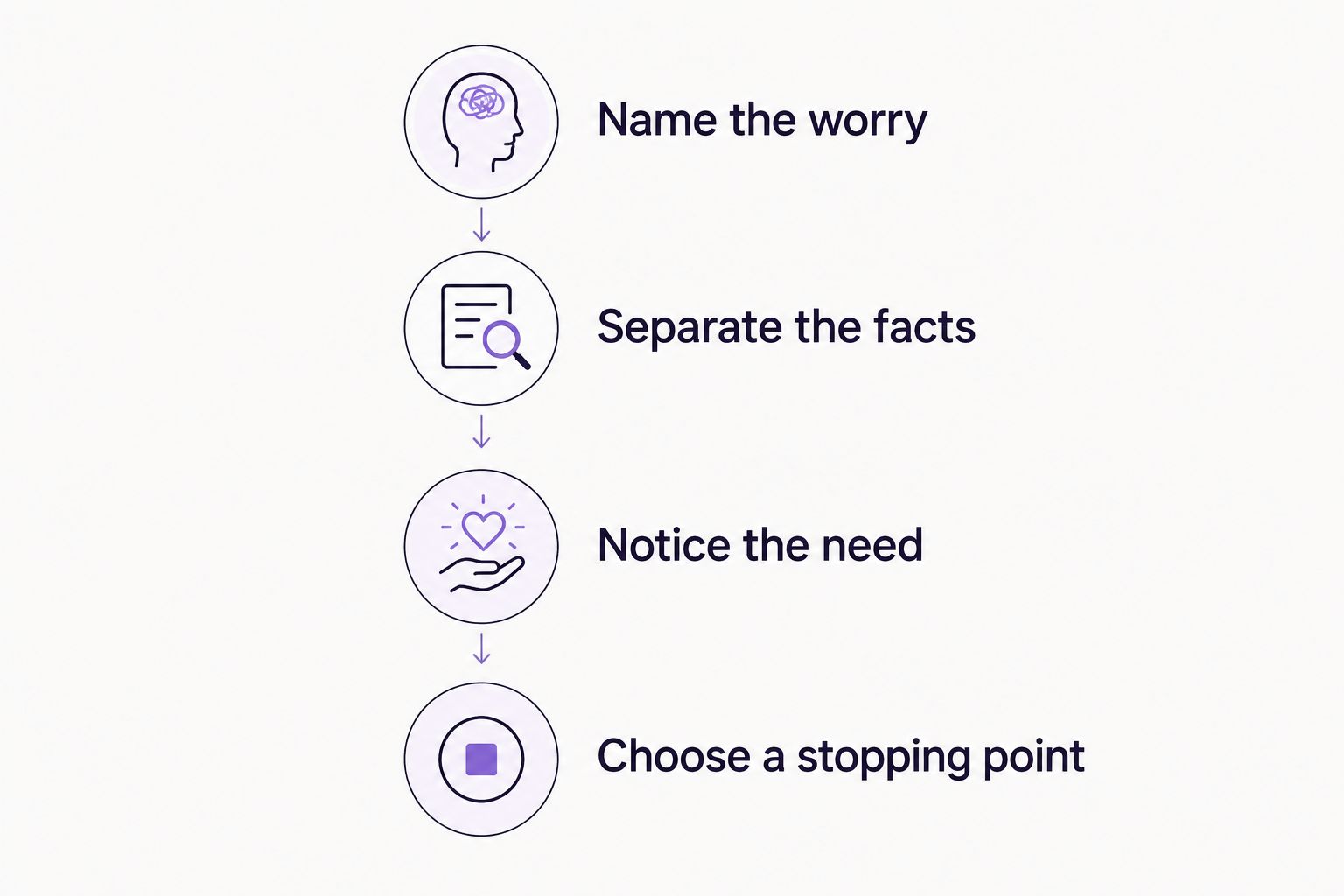
- Name the worry. Write what is taking up space, without requiring yourself to explain it perfectly. For example: I'm worried I'll disappoint someone if I say I can't do this.
- Separate the facts. Describe what has actually happened. Someone asked for help; you haven't answered yet. Their disappointment is something you fear, not something you already know.
- Notice the need. Ask what you want to acknowledge or request. Perhaps you need more time to answer, a clearer boundary, or permission to leave the decision alone tonight.
- Choose a stopping point. End when you've said what you wanted to say. You don't owe the page a solution, a lesson, or an uplifting final paragraph.
The point isn't to correct every uncomfortable thought. It's to give the worry a shape without making it responsible for narrating your entire life.
Why this matters when you're already carrying a lot
When you're managing meals, messages, appointments, and everyone else's missing things, an invitation to start another habit can sound remarkably like more work. Even a lovely notebook can become an object you feel guilty beside.
Your journal doesn't need to become another place where you're behind. You can write between ordinary interruptions, return after a long gap, or decide that today isn't a writing day.
A useful distinction for 2026: making room for yourself isn't the same as making yourself more efficient. You don't have to turn a difficult feeling into a better morning routine before it deserves attention.
Which kind of journaling fits what you need?
Different approaches ask different things of you. Choose by what you want from the page, not by which format looks most impressive when someone photographs it beside coffee.
| Approach | Best for | What it gives you | What to watch for |
|---|---|---|---|
| Open writing | Saying what you haven't had room to say | Space without a prescribed topic | A blank page can feel demanding or invite repetition |
| Prompted reflection | Finding a place to begin | A specific question to respond to | A prompt can feel too personal or miss what matters today |
| A worry and next step | Separating a concern from a practical task | A place to name an action, if one exists | Not every feeling has an action attached |
| Gratitude writing | Noticing something welcome alongside difficulty | Space for an experience you want to remember | It can feel dismissive if you use it to silence harder feelings |
Open writing: room without a script
Open writing fits when you know what you want to say but haven't had somewhere to put it. You can start halfway through the story, repeat a word, or leave a sentence unfinished.
The limitation is the lack of direction. If you keep returning to the same frightening question without learning anything new, you don't need to keep filling pages to prove you're trying.
Prompted reflection: a smaller doorway
A prompt fits when the blank page feels like someone asking you to explain your entire personality on demand. A narrower question gives you something specific to answer.
Try: What am I expecting myself to carry without help? Skip any question that feels intrusive, irrelevant, or simply irritating. A printed prompt is not an authority figure.
A worry and next step: feelings beside logistics
This approach fits a concern with a practical piece attached. You might write that an upcoming appointment worries you, then separately note the question you want to bring.
The limit matters: a practical step doesn't cancel a feeling. Sending the message or adding the reminder doesn't mean you're required to feel settled afterward.
Gratitude writing: addition, not replacement
Gratitude writing fits when you want to remember something welcome without pretending the rest of the day was easy. You can appreciate a kind conversation and still feel worried about tomorrow.
It stops being useful when gratitude becomes a command to stop being upset. Nothing good has to serve as evidence against your own difficulty.
Why the experience varies
A journal isn't a standard experience. What you write about, how you approach the page, and what you expect from it all change what the activity asks of you.
- The question you choose. What do I need today? opens a different conversation from Why can't I handle anything?
- The room you have for privacy. If you're worried someone will read your words, honest writing can feel exposed rather than welcome.
- The expectation you bring. Looking for a little clarity is different from requiring yourself to feel calm before you close the notebook.
- The kind of worry involved. A practical concern offers different writing possibilities from an uncertainty you cannot resolve on the page.
- Your willingness to stop. Finishing a page isn't more important than noticing that you don't want to continue.
None of these factors grades your effort. If a format doesn't suit you, that's information about the format, not a verdict on how committed you are to yourself.
What can I write when my mind feels crowded?
You don't need an interesting insight to begin. Ordinary, unfinished language belongs here too.
Choose a sentence opening that asks less of you:
- The thought taking up the most room is…
- What I know happened is…
- What I'm afraid will happen is…
- Something I haven't had space to say is…
- What I wish someone would understand is…
- Something that can wait is…
You can answer with a phrase rather than a paragraph. If all you write is that you want someone else to make dinner decisions, you've still named something real.
For a small experiment, you could choose 1 sentence, 2 minutes, or 3 lines as an optional boundary. These aren't targets or a formula for relief. They're ways to make the invitation smaller, and you can stop sooner.
What if journaling makes me feel more anxious?
You don't have to keep writing through increasing distress. Set the entry aside rather than treating discomfort as proof that you need to go deeper.
There's a difference between acknowledging a difficult feeling and repeatedly demanding an answer you cannot obtain. A page full of increasingly urgent what if questions doesn't need another page just because there's paper left.
You can leave the entry unfinished, choose an ordinary activity instead, or speak with someone you trust. If anxiety is affecting your everyday life, a journal isn't a substitute for qualified support.
This is also a useful boundary for online wellness advice in 2026: a practice doesn't become right for you because someone presents it as essential. You're allowed to decline it without writing a defense.
Do I need to journal every day for it to count?
No. You can use a journal when you want somewhere to think, then leave it alone when you don't.
A gap doesn't create a backlog. You don't need to summarize every missed day or begin with an apology to an inanimate object that has, frankly, been resting comfortably on a shelf.
If consistency starts to matter more than what you want to say, loosen the arrangement. The page can be available without becoming compulsory.
Can a weekly planner sit alongside a journal?
Yes. A journal can hold what you're feeling while a weekly planner holds what you want to remember. Keeping those purposes separate is an option, not a requirement.
For example, your journal might hold your worry about an overloaded week. Your planner might hold a reminder to ask for help with a pickup. The reminder doesn't solve the feeling; it simply gives the practical detail somewhere to live.
The Sheema Edit offers printable journals and planners for readers who want a place for reflection or planning. A prepared format offers a starting point, but it isn't necessary for journaling and doesn't promise anxiety relief.
If you're choosing a setup in 2026, consider whether you enjoy writing on paper, want a reusable format, and have somewhere private to keep your entries. Those questions matter more than whether the finished page looks coordinated.
FAQ
Can journaling actually help with anxiety if I don't know what to write?
Yes, journaling can still offer a place to name a worry without requiring a polished entry. Start with something specific, such as what is taking up the most room in your thoughts, and leave it there if that feels sufficient.
What's the best kind of journaling for an overwhelmed mom?
The best fit is a format you can use without turning it into another obligation. A short prompt offers direction, while open writing gives you more freedom; neither requires a daily commitment.
Is writing in my phone as valid as using a notebook?
Yes, writing in your phone counts as journaling. Choose a place that feels usable and private, and consider whether notifications interrupt the space you want for yourself.
Do I have to write about the thing that worries me most?
No, you don't have to write about your hardest worry. You can choose an everyday frustration, something you need, or a moment you want to remember.
Should I reread journal entries about anxiety?
You don't have to reread your entries. Return to them only if you want to, rather than treating review as another requirement or searching for proof that you should feel better.
Can a journal replace talking to someone about anxiety?
No, a journal doesn't replace professional support. Writing can hold thoughts you want to discuss, but you don't need to organize them perfectly before asking for help.
What if I stop journaling after a few entries?
Stopping doesn't make the entries you wrote less valid. You can return whenever you want, change formats, or decide that writing isn't what you need right now.
One last thing
Before you choose a notebook or download anything in 2026, choose what happens when you're interrupted. Let the answer be simple: you can close the page without finishing the thought.
You don't need a closing insight to make the interruption acceptable. An unfinished entry isn't unfinished work. It's a place you were allowed to spend a little time with yourself.