
Yes, journaling can help you manage the everyday experience of chronic pain by giving you somewhere to record what happened, express frustration, and prepare questions for your care team. That’s different from treating pain: a journal cannot diagnose its cause or promise relief. You don’t need to write daily, find a silver lining, or turn a difficult day into a lesson.
- Can journaling help manage chronic pain? Yes, as a place for reflection and notes, not a treatment or cure.
- The Sheema Edit suits readers seeking gentle self reflection alongside everyday life with chronic illness.
- Choose brief symptom notes, open writing, or flexible weekly planning according to what you need.
- Skip any prompt that feels intrusive, exhausting, or like another obligation.
Can journaling help manage chronic pain?
Journaling is useful when it serves a purpose you actually care about. That purpose might be remembering what you wanted to ask at an appointment, naming how disappointed you feel about canceled plans, or deciding what can wait until another day.
Those are different jobs. You don’t have to ask a single page to do all of them, especially when finding the page already feels like an accomplishment.
The Sheema Edit is a good fit for readers who want gentle self reflection without turning their lives into a productivity project. Its essays and printable journals sit alongside the reality that you’re a person with needs, not a collection of tasks awaiting completion.
Here are a few ways to choose what belongs on your page:
| Approach | Best for | What you can write | Where it falls short |
|---|---|---|---|
| Brief symptom notes | Remembering details for a conversation | What you noticed and what you want to ask | Notes alone cannot explain why symptoms occurred |
| Open reflection | Saying what the day felt like | Frustration, disappointment, joy, or conflicting feelings | An open page can feel demanding when words are hard |
| Flexible weekly planning | Making room around existing commitments | What matters, what can wait, and where you want help | A plan cannot predict how you’ll feel |
You can choose one approach and leave the others alone. There’s no bonus for maintaining an entire stationery department.
Why this matters when pain already takes up space
If you’re an overwhelmed mom, the suggestion to start journaling can sound suspiciously like another assignment. You already have things to remember, people asking questions, and a body that doesn’t need a motivational speech.
A useful journal doesn’t require you to become more disciplined. It gives you somewhere to put what you want to remember or say, without requiring a polished explanation.
Your 2026 journal doesn’t need to become a complete record of your health. It can hold ordinary things, too: an unexpectedly good conversation, the annoyance of another changed plan, or the fact that you wanted quiet and got questions instead.
Pain can be part of the page without becoming the whole story. You’re allowed to write about your life, not just your symptoms.
When you want to remember what happened
Brief symptom notes are best for keeping details you want to discuss. This isn’t about proving that your pain is real. You don’t owe a notebook evidence of your own experience.
An entry might include where you noticed discomfort, what you were doing, and what question you want to bring to an appointment. Keep observations separate from explanations: recording that two things happened together doesn’t establish that one caused the other.
For example, you could use these sentence starters:
- What I noticed today was…
- Something that interrupted my day was…
- A question I want to ask is…
If you like having a place for those details, the guide to symptom tracker journals for chronic illness offers a related starting point. Choose a format for the information you want to keep, not because more tracking sounds more responsible.
For a 2026 appointment note, a date and a plain description are more useful than language you don’t normally use. You can write exactly how something felt without translating yourself into medical terminology.
When you need somewhere to be honest
Open reflection is best for expressing feelings without organizing them into a report. You can love your family and resent the logistics of being needed when you’re hurting. Both thoughts can exist on the same page.
You don’t need a balanced argument. Your private writing isn’t a performance review of how gracefully you’re handling things.
Try an opening that doesn’t demand an explanation:
- The part I’m tired of explaining is…
- What I wish someone understood today is…
- Something I still want for myself is…
The limitation is that an open page sometimes asks too much. If a prompt leaves you feeling cornered, leave it unfinished; you don’t have to keep digging until you uncover something profound.
A sentence such as “I don’t want to write about this today” counts as an honest entry. So does closing the notebook and choosing something else.
When you want a week with some breathing room
Flexible weekly planning is best for sorting commitments without pretending your energy is predictable. Start with what’s already happening, then decide what deserves space around it.
You might separate an appointment from a household task you’d like to finish. One has a set time; the other might be movable, shareable, or simply not happening this week.
An undated page lets you return without filling in every missed day. For your 2026 planning, you can use these three headings:
- Already scheduled: What has a time attached?
- Can wait: What doesn’t need a decision today?
- Want support: What would you like to ask someone else to handle?
The drawback is straightforward: even a gentle plan can start to feel like a demand. If you find yourself treating every unfinished item as a personal failing, change the page rather than using it to judge yourself.
A planner can hold a plan. It cannot promise the week will cooperate.
A small way to begin, without a new routine
You don’t need to commit to journaling before trying it. Use whatever writing surface you already have and see whether the experience feels useful to you.
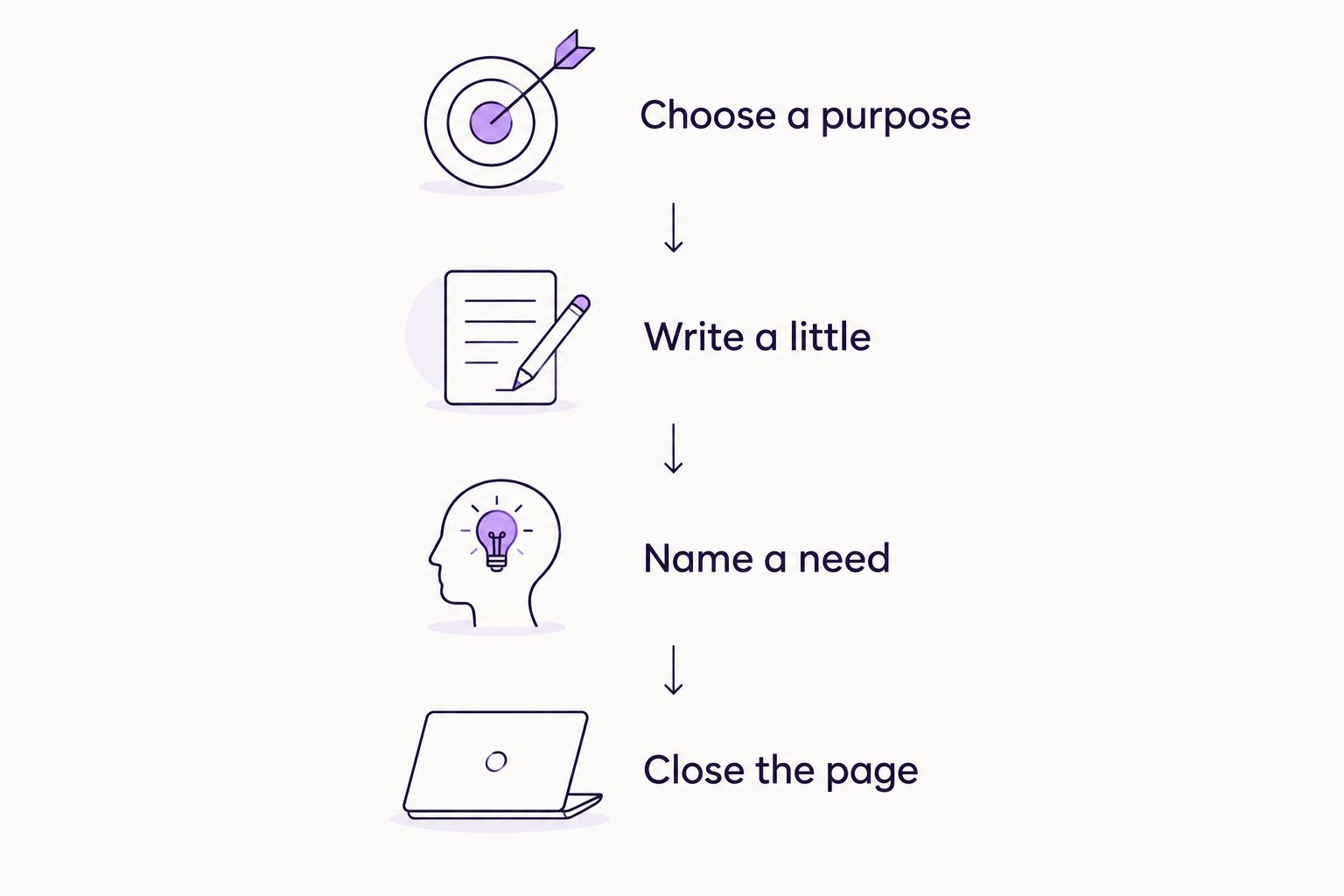
This sequence is an invitation, not a routine you need to maintain:
- Choose a purpose. Decide whether you want to remember something, express something, or sort something out.
- Write a little. Try 1 minute or 2 sentences if a small boundary makes starting feel easier. Those are optional limits, not a recommended dose.
- Name a need. Finish with something you want, a question you have, or a task you want to leave alone.
- Close the page. You don’t need to reread, analyze, or turn the entry into an action plan.
You can also skip directly to the part you need. If the only thing you write is the question you keep forgetting at appointments, the page has done its job.
Why journaling feels useful some days and not others
What you want from writing can change. A page that felt comforting last week might feel irritating today, and neither response needs defending.
These are practical things to consider when deciding whether to write:
- Your purpose: Remembering an appointment question asks something different from writing about disappointment.
- The effort involved: Holding a pen, typing, finding privacy, or choosing words can feel like too much.
- The prompt: A specific question can offer a starting point; an intrusive question can feel like an interrogation.
- Your privacy: You get to decide what you record, where it lives, and who can read it.
- The expectation attached: Writing because you want somewhere to speak is different from writing because you feel you should.
For a 2026 journal, there’s no requirement to document every difficult day. An incomplete record can still contain the details and words you chose to keep.
Do I have to track my pain every day?
You don’t have to track pain daily to keep a personal journal. Write when you have something you want to remember or express, rather than creating a streak you feel responsible for protecting.
If your care team has asked you to record specific information, ask them what they need and how they want you to record it. That’s a separate purpose from personal reflection.
What if writing makes me focus on pain more?
You can stop writing about pain if the attention feels unwelcome. There’s no requirement to keep returning to a subject just because it seems like the appropriate journaling topic.
Try an ordinary question instead: What caught your attention today? What would you like more room for? Or leave the notebook closed.
Can I journal without trying to be positive?
Yes, your journal can be honest without being positive. You don’t have to end frustration with gratitude or make disappointment sound more acceptable.
A pleasant moment doesn’t erase a painful one, either. You’re allowed to record both without making them compete.
Keep the page private enough for honesty
Before writing something personal, consider where the entry will live. That might mean choosing a private place for a notebook or checking who has access to a shared device or account.
You can also decide what not to record. Names, intimate details, and full explanations are optional; a few words that make sense to you can be enough.
If you want to share an entry at an appointment, you can copy just the relevant part. Keeping notes for a conversation doesn’t mean handing over every private thought beside them.
FAQ
Can journaling help manage chronic pain, or is it just writing things down?
Journaling can help you organize observations, express feelings, and remember questions about life with chronic pain. Those are practical uses, not evidence that writing treats the pain itself.
How long should I journal when I’m already exhausted?
There’s no required length for a personal journal entry. You can try 1 minute, write a fragment, or decide that today isn’t a writing day.
What should I write when I don’t have the words?
You can write a short phrase such as tired of explaining or need some quiet. You don’t need full sentences, a clear lesson, or an explanation that another person would understand.
Is a symptom tracker better than an ordinary journal?
A symptom tracker suits structured notes, while an ordinary journal leaves room for whatever you want to say. Neither replaces a conversation with your care team, and you don’t need to maintain both.
Can I use a weekly planner instead of a journal?
Yes, a weekly planner can hold commitments, reminders, and a small space for reflection. Choose it if sorting the week feels more relevant than writing an open entry.
What if I stop journaling for weeks?
You can return without catching up or explaining the gap. Start with what matters today, or leave the notebook alone until you actually want it.
Can journaling replace treatment for chronic pain?
No, journaling cannot diagnose chronic pain or replace medical care. It can hold questions and observations you want to discuss with your care team.
One last thing
Leave some room for yourself outside the pain record. Not because you need a cheerful ending, but because you’re allowed interests, opinions, and small pleasures that have nothing to do with managing a condition.
The Sheema Edit’s approach to self reflection leaves room for that whole person. In 2026, your journal can hold an appointment question beside a book you want to read, an unfinished thought, or a firm decision not to volunteer for anything else this month.
You don’t have to turn pain into a project to deserve support. Let the page be useful, imperfect, and entirely optional.
Related guides
- How to use an undated weekly planner
- Self reflection journal prompts for boundaries
- Can journaling help process grief?
With Love, Sheema.