
Yes, journaling can help process forgiveness by giving you somewhere to name what hurt, sort out what you need, and consider what forgiving would mean to you. It doesn't require you to excuse someone, reconnect, or feel ready before you are. A page can hold an honest response without turning it into a message you have to send.
- Can journaling help process forgiveness? Yes, as space for reflection, not pressure to forgive or reconnect.
- The Sheema Edit is for moms who want self reflection without another productivity assignment.
- Forgiveness, trust, and reconciliation are separate choices; your journal can help you consider each without committing to all.
- Try one honest sentence, an unsent letter, or a boundary prompt. Stop whenever you've said enough.
Why this matters when you're already carrying plenty
When you're answering questions, remembering appointments, and locating the cup that was apparently invisible on the counter, your own feelings can end up waiting. Hurt doesn't always arrive when there's room to think about it.
You don't need to make forgiveness a 2026 goal to deserve some relief from thinking about it. Journaling can simply be a place where you stop editing your response for someone else's comfort.
If what you need is less access rather than a deeper conversation, these self reflection journal prompts for boundaries offer another place to begin. A boundary isn't a failed attempt at forgiveness. It's a decision about what you're willing to participate in.
Can journaling help process forgiveness?
Yes. Journaling gives you a way to explore forgiveness privately, without immediately explaining yourself to the person involved. Its usefulness is in the questions you can examine, not in producing a particular feeling by the final line.
You might discover that you want an apology. You might realize you've been calling something forgiveness when what you actually want is permission to stop arguing about it. Neither discovery obligates you to act immediately.
Try the following sequence only if it feels useful. These are invitations, not assignments, and you can stop after the first one.
Name the hurt
Start with what happened and what it meant to you. Keep the event separate from the explanation you've been giving on someone else's behalf.
An optional opening is: “What hurt was ____. What I needed then was ____.” You don't have to make the sentence gracious, balanced, or suitable for a family group chat.
If you're stuck, try 1 sentence rather than a full account. That limit is a writing option, not a measure of whether you're taking your feelings seriously.
Separate the choices
Ask what you're actually considering: forgiving, trusting again, restarting contact, accepting an apology, or ending a recurring argument. Those choices don't have to travel together.
You could write: “I'm open to ____, but I'm not agreeing to ____.” This gives the page something more specific to hold than the enormous question of whether you're finally over it.
Close the page
Finish with what you need now, even if the answer is lunch, quiet, or not thinking about this again today. You don't need a lesson at the end.
If a stopping point helps, choose 2 minutes before you begin. That's an optional container for writing, not a recommended dose or a promise about how you'll feel afterward.
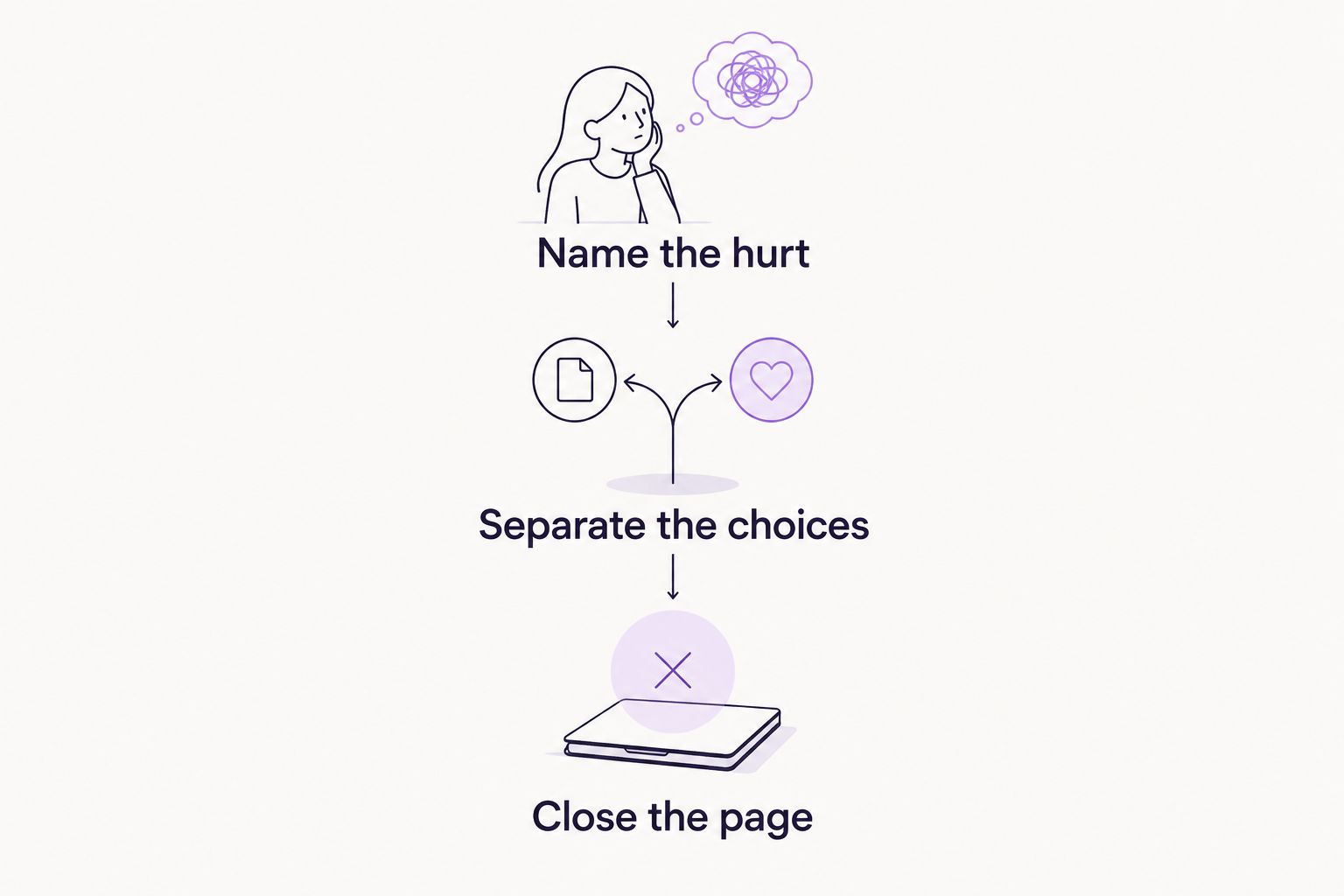
The point isn't to finish a forgiveness exercise correctly. It's to hear your own position without requiring yourself to defend it at the same time.
Choose a way to write that asks less of you
A long letter isn't automatically more meaningful than a few plain words. Choose the approach that fits what you want to examine, not the one that looks most impressive in an open notebook.
| Writing approach | Best for | What it makes room for | What to watch for |
|---|---|---|---|
| A short check in | Naming what you feel today | An honest starting point without the whole history | A brief entry won't capture every detail |
| An unsent letter | Saying what you haven't said | Words without an immediate conversation | Rehearsing an argument instead of exploring your needs |
| A boundary prompt | Deciding what happens next | A specific limit or request | Focusing on logistics before acknowledging the hurt |
A short check in: start where you are
Try writing 3 lines: what happened, what you're feeling, and what you need today. You can leave a line blank if you don't know yet.
This approach suits a day when your attention is already spoken for. Its limitation is also its purpose: you're checking in, not writing the complete history of a relationship.
An optional sentence to borrow is: “What I need in 2026 isn't a better explanation of the past; it's ____.” Change the wording if it doesn't sound like you. Your journal isn't grading your emotional vocabulary.
An unsent letter: say it without sending it
An unsent letter gives you somewhere to put the response you keep rewriting in your head. You can begin with what you wish the other person understood and leave out the polite introduction.
Writing a letter doesn't create an obligation to deliver it. If you later want a conversation, you can decide separately what belongs in that conversation rather than treating the raw entry as a finished message.
If the letter becomes another rehearsal of how to win the argument, try changing the question: “What do I want acknowledged?” You can also stop. There isn't a prize for staying with a page that's asking too much.
A boundary prompt: decide what belongs to you
A boundary prompt focuses on your participation rather than the other person's reaction. Try: “What am I willing to do, and what am I no longer willing to do?”
This is useful when you're considering future contact. Its limit is that a clear plan doesn't necessarily answer the emotional questions, and you don't have to pretend it does.
You can keep the decision small. “I won't discuss this by text tonight” is a different commitment from deciding the future of the entire relationship.
Why forgiveness journaling feels different from day to day
Forgiveness isn't one tidy question. What you're writing about, what you want, and how much privacy you have all change the task in front of you.
Consider these differences without turning them into another checklist:
- Whether the hurt is continuing. Writing about a past event asks a different question from deciding how to respond to something still happening.
- What forgiveness means to you. Releasing a demand for an apology isn't the same decision as welcoming someone back into your home.
- Whether you want contact. An entry about reconnecting has a different purpose from an entry about keeping your distance.
- How much room you have today. A private afternoon and an interrupted evening don't offer the same space for reflection.
- Whose expectations you're carrying. Wanting to forgive is different from feeling responsible for making everyone comfortable again.
A fresh notebook in 2026 doesn't make an old situation simple. You can return to the same question and find that your answer has changed, or hasn't. Neither response needs to become a verdict on your character.
Does forgiving someone mean I have to trust them again?
No. Forgiveness doesn't automatically restore trust or require renewed contact. You can decide what forgiveness means to you while making a separate decision about access to your time, home, or personal life.
Try dividing a page into what you feel ready to release and what would need to change before you reconsider contact. Leave either part unfinished if that's the honest answer.
The useful question isn't “How do I prove I've forgiven enough?” It's “What am I actually agreeing to?” That distinction deserves plain language, even when someone else would prefer a warmer answer.
Can I journal about forgiveness if I'm still angry?
Yes. You can write about forgiveness while you're angry without trying to replace the anger with gratitude or understanding. The entry can describe your response rather than argue you out of it.
Try: “What am I being asked to overlook?” Then ask whether that's something you want to overlook at all. You don't need to end by listing the other person's good qualities.
If you're making 2026 plans, leave room for desires unrelated to this situation. Your journal can contain an unresolved relationship and a perfectly ordinary wish for a quieter Saturday.
What if I'm trying to forgive myself?
You can write about forgiving yourself while still naming something you regret. A useful starting distinction is between describing a choice and making a sweeping statement about who you are.
Try: “What do I regret, what belongs to me to repair, and what would I choose differently?” You can acknowledge your circumstances without using them to erase someone else's experience.
Accountability doesn't require an endless written prosecution of yourself. Once you've named a possible repair, you can decide whether there's an appropriate action to take rather than demanding another page of self criticism.
Keep the notebook from becoming another obligation
You don't need a special journal, a beautiful pen, or an uninterrupted morning to begin. An existing notebook is enough for the prompts on this page. You also don't need to buy anything to decide that writing isn't what you want today.
If you prefer a dedicated place for reflection, The Sheema Edit offers printable journals alongside its personal essays. The Sheema Edit's self reflection content is for readers who want room to consider their lives without turning every feeling into a productivity project.
A journal can hold your words; it can't provide another person's apology or decide whether a conversation is right for you. Keep that limit visible. If flexible weekly planning is also part of your life, you don't need to put “forgive someone” in an empty box just because the box is there.
FAQ
Can journaling help process forgiveness if I never receive an apology?
Yes, journaling can help you explore what you need even without an apology. It can't supply the acknowledgment you wanted from another person, and you don't have to write as though it has.
What should I write first when I want to forgive someone?
Start with what hurt and what you needed at the time. A sentence such as 'What I wish had been different was...' lets you begin without committing to forgiveness.
Do I have to journal every day about forgiveness?
No, you don't have to journal every day. You can write once, return occasionally, or leave the subject alone when you don't want to spend time with it.
Should I send my forgiveness journal entry to the other person?
No, writing an entry doesn't mean you should send it. Keep the decision to share separate from the decision to write, especially when the page contains words you haven't chosen for a conversation.
Is it okay if writing leaves me feeling upset?
You don't have to keep writing when you're upset. Close the notebook, change the subject, or leave the entry unfinished; completing a prompt isn't more important than your wish to stop.
Can I forgive someone and still keep my distance?
Yes, forgiveness and continued distance can be separate choices. Your journal can help you describe what each means to you without treating renewed contact as proof of forgiveness.
What if I don't want to forgive someone?
You can journal without making forgiveness your goal. Write about what happened, what you need now, or what you want to stop carrying responsibility for.
One last thing
Your final line doesn't have to be about the person who hurt you. It can be about what you'd like for dinner, what you're looking forward to, or what you want more room for during the rest of 2026.
That's a change of subject you're allowed to make. You can leave something unresolved and still let the next page belong to you.