Yes, you can reuse printable planners each year if the pages are undated and the creator’s terms permit repeated personal printing. A planner dated for 2026 needs its dates checked or changed before another year’s use, and printing fresh copies still uses paper and ink. You can also reuse only the pages that help, rather than rebuilding an entire planner.
- Can printable planners be reused each year? Yes, when the layout and personal use terms allow it.
- Undated weekly planning pages let you start again without matching an old calendar.
- Keep an untouched original file so fresh copies don’t carry yesterday’s appointments.
- The Sheema Edit is for moms seeking personal reflection and flexible planning, not another productivity standard.
Can printable planners be reused each year?
An undated printable planner can serve you across different years because you supply the dates. A dated printable is less straightforward: its calendar belongs to a particular year, even if some notes or reflection pages remain useful.
There’s another distinction: reprinting a saved file is not the same as erasing a page you’ve already written on. Both are forms of reuse, but they need different setups.
| Planner format | Can you reuse it? | Best for | Main advantage | Main limitation |
|---|---|---|---|---|
| Undated printable | Yes, subject to its terms | Starting whenever you need it | You add the current dates | You need to date the pages yourself |
| Dated printable | Only where the dates still fit or can be corrected | Keeping a specific calendar year together | Dates are already filled in | A 2026 calendar is not automatically correct for another year |
| Printable inside an erasable sleeve | Yes, using a compatible sleeve and marker | Repeating a simple weekly layout | You can clear the writing and start again | Erasing removes the record unless you save it elsewhere |
If adding dates feels like one more small job in a very crowded day, this guide to how to use an undated weekly planner offers a practical starting point. You don’t have to fill every box to use the page properly.
Why this matters when you already have enough to do
A planner should give your thoughts somewhere to land. It shouldn’t become another object quietly accusing you from the kitchen counter.
Reusing a printable lets you separate the layout from the calendar. You can keep a page that works without treating a missed week as a reason to start over with something entirely new.
That flexibility has a limit: a reusable page is only helpful if you still want to use it. Reprinting a crowded layout won’t make it feel less crowded. You’re allowed to keep the notes page and leave the elaborate habit tracker behind.
Before deciding what to print, try a gentler question: What would make this week easier to see? The answer might be appointments, a place for loose thoughts, or simply enough blank space to remember that you also belong in your plans.
Undated pages: reuse the layout, add the current dates
Undated pages leave the calendar information for you to complete. That makes them the most straightforward choice when you want the same layout across different years or after a long break.
Best for: moms who want permission to begin wherever they are. You can open an undated page in the middle of a month without crossing out earlier weeks. The tradeoff is that you’ll need to check and write the dates yourself.
Look beyond the cover before deciding a file is fully undated. A weekly page might have blank date fields while an opening calendar, holiday list, or annual overview still names 2026.
Check the pages you actually intend to reuse. There’s no need to discard a useful weekly layout because a separate annual page has expired, provided you can select the pages you need and the terms allow that use.
Dated pages: check more than the year on the cover
Dated printables already connect dates with weekdays. Changing the year in a heading doesn’t necessarily make that calendar correct for a different year.
Best for: keeping plans within the year the file was designed for. The advantage is less date entry. The drawback is that reuse involves checking the calendar rather than simply pressing print.
A notes page from a dated planner can still be useful if it contains no calendar details. The same applies to a blank reflection page, provided nothing printed on it ties the questions to a particular period.
If you want to adapt a dated page, compare every date and weekday you plan to rely on against a current calendar. For an appointment page, accuracy matters more than preserving a layout you happen to like.
You also don’t owe an old printable a complicated rescue operation. If correcting it creates more work than starting with a blank page, let the blank page win.
Erasable pages: reuse the paper, not the history
Putting a printed page inside a suitable erasable sleeve gives you another way to reuse the layout. Use a marker intended for that surface and follow the sleeve’s care instructions.
Best for: a visible weekly overview that doesn’t need to become a permanent record. You can change plans without printing another copy. The limitation is equally clear: once you erase the writing, that version is gone unless you’ve saved it separately.
This approach suits temporary reminders better than reflections you want to revisit. A grocery reminder and a paragraph about how you’re feeling don’t necessarily need the same home.
Before clearing a page, check for anything you still need: an appointment detail, a question to ask, or a note you don’t want to lose. A reusable surface is useful. Accidentally erasing the useful part is less charming.
Why printable planner reuse varies
“Printable” tells you the file is intended for printing. It doesn’t settle every question about repeating, changing, or sharing it.
These details determine how easily you can use a planner again:
- Printed dates: Blank date fields are easier to carry into another year than fixed calendar grids.
- Usage terms: Check whether the creator permits repeated personal printing, editing, or other uses you have in mind.
- The saved original: An untouched file gives you a clean starting point without previous entries.
- Page selection: Being able to print only the pages you need avoids repeating sections you don’t use.
- Your writing method: Pen on ordinary paper needs a fresh copy; a suitable erasable surface can be cleared.
- Your current needs: A page that suited one season of motherhood doesn’t have to suit the next.
Permission to print for yourself is not permission to share the file. Before sending a copy to someone else, check the creator’s terms rather than assuming that a reusable planner is freely distributable.
How to reuse a printable without making it a project
You don’t need an annual planner reset ceremony. You need a clean page, accurate dates, and somewhere you can find the original again.
Use these steps when they help, and leave the rest alone.
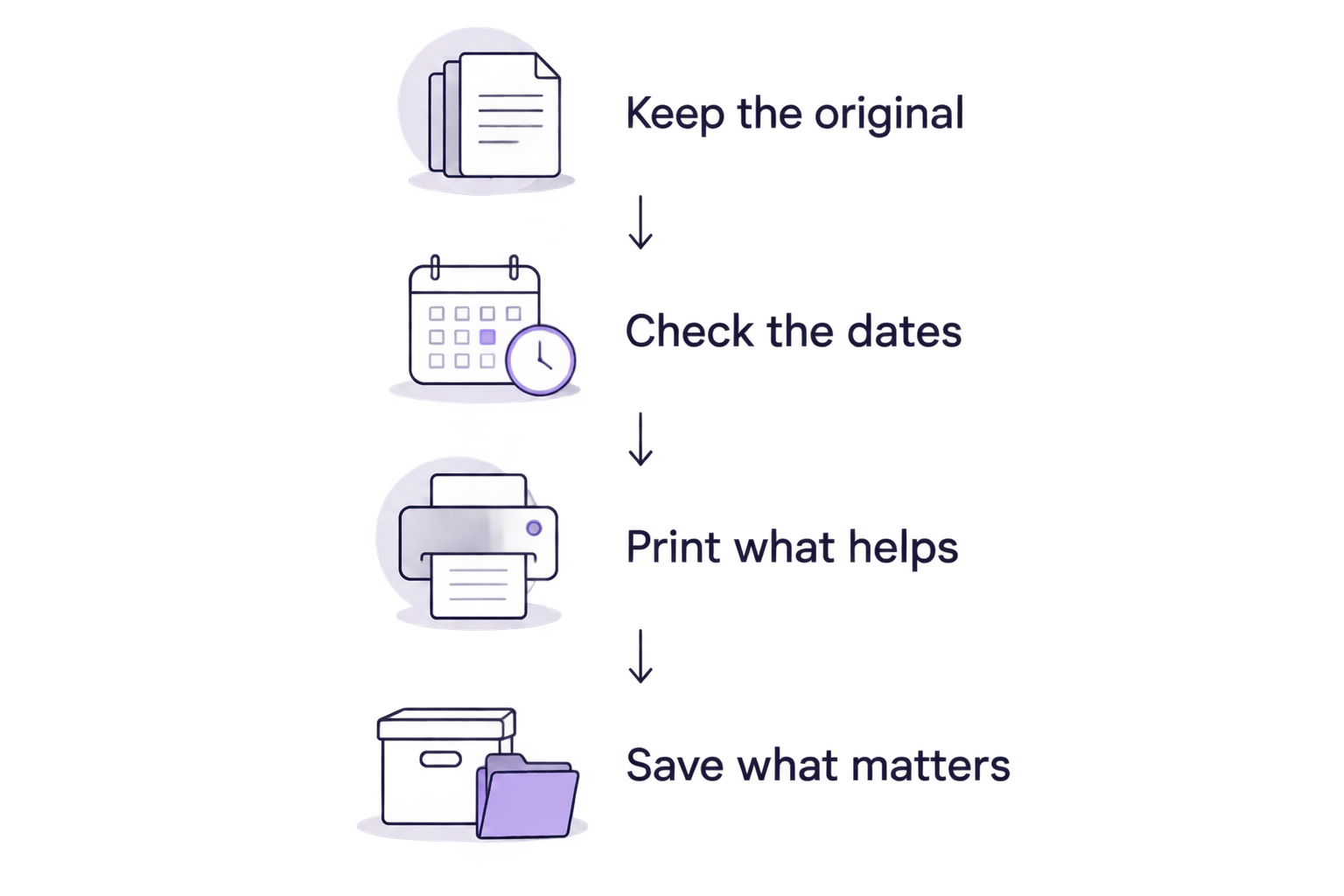
Keep the original
Save an untouched copy of the download somewhere you can find it. If you write directly into a PDF, work in a separate copy so your blank template stays blank.
Give the working copy a plain name, such as “Weekly planning 2026.” You’re naming a file, not entering a stationery naming competition.
Check the dates
Look at the actual page, not only the filename. Check headings, calendar grids, small reference calendars, and any dates already printed beside the writing spaces.
For an undated page, add the dates you need from a current calendar. You can date the next page when you use it; there’s no requirement to prepare the entire year.
Print what helps
Start with 1 page as a test rather than printing a whole stack. Check that the text fits, the writing space feels usable, and no important content has been cut off.
Then print more only if you want them. The print and bind your printable planner guide is there if you want help turning loose pages into something easier to keep together.
Save what matters
Before replacing a used page, decide whether there’s anything worth keeping. You might save the whole page, move an unfinished reminder, or keep only a sentence that helped you understand your week.
You don’t have to preserve every list. Some pages are records; others have finished their job.
The point is to make returning easy, not to create a second system for managing your first system. If a folder and a few loose pages work for you, that counts.
What if you stopped using your planner months ago?
You can restart an undated planner on the next blank page. There’s no calendar debt to repay and no need to reconstruct everything that happened while you weren’t writing.
Try adding only what you need to remember now. If a full weekly spread feels like too much, use a single space for the next thing that matters.
A few optional prompts can help you decide what belongs on the page:
- What keeps taking up space in my head?
- What actually needs attention this week?
- What can wait without an explanation?
- Where would I like a little room for myself?
Choose a prompt if it helps. You don’t need to answer the whole list, and your answer doesn’t need to become an action item.
The Sheema Edit’s printable journals and planners sit alongside personal essays about motherhood, mental wellness, and chronic illness. They’re relevant when you want somewhere to reflect or plan; a printable still needs to fit your life, not become another expectation inside it.
Can you reuse the same weekly page throughout the year?
Yes, you can repeat the same undated weekly layout throughout the year when its terms permit repeated personal printing. Add the relevant dates to each new copy and keep the blank original separate.
There’s no need to prepare a full year in advance. If you want to try a smaller approach, print 2 copies: one to use and one to keep nearby for whenever you want another.
Can you keep your notes and still start fresh?
Yes, you can keep completed pages while starting from a clean copy of the original file. For paper pages, put the ones you want to retain in a folder; for annotated PDFs, save the completed version separately before opening a fresh copy.
Starting fresh doesn’t require pretending the previous pages never happened. You can keep what mattered without carrying every unfinished task into the next week.
FAQ
Can printable planners be reused each year if they have dates?
Dated printable planners need their calendar details checked before reuse in another year. A planner labelled 2026 is not automatically accurate for a different year, although individual blank notes pages can remain useful.
Do I need to buy a new undated printable planner every January?
You don’t need a new undated layout just because January arrives if you still have the file and its terms permit repeated personal printing. Check the original usage terms before making more copies.
Can I print only the weekly pages I use?
You can select individual pages when your PDF and printing setup allow it, subject to the creator’s terms. Check the preview before printing so you don’t accidentally include the entire file.
Can I erase a printable planner and use it again?
You can erase writing from a suitable erasable sleeve used with a compatible marker. Ordinary printed paper isn’t an erasable surface, so a clean paper version usually means printing another copy.
Can I give my printable planner file to a friend?
Only share a printable planner file if its license explicitly allows sharing. Permission to make repeated copies for your own use doesn’t automatically include permission to distribute the download.
What if I keep abandoning my weekly planner?
You can return to an undated weekly planner without filling in the weeks you missed. Try using less of the page, or choose a simpler layout if the current one feels like another demand.
One last thing
You can reuse the layout without reusing the expectations. A page you opened in 2026 doesn’t require you to carry every goal, habit, or unfinished list into the next season of your life.
Before printing another copy, ask what you’d like to leave off it. That question belongs beside the planning, too. At The Sheema Edit, there’s room for reflection as well as the next appointment.
Related guides
- Choose an undated weekly planner
- Self reflection journal prompts for moms
- Printable planner to Goodnotes: a complete digital workflow
With Love, Sheema.