Printing and binding a planner costs the total of your printed pages, paper, binding, finishing, and any applicable tax or delivery charges; an itemized quote is the reliable way to establish your 2026 total. A binding quote alone doesn’t tell you what the finished planner will cost, so ask whether printing, covers, and other finishing work are included before you approve it.
- How much does printing and binding a planner cost? Get an itemized total, not a binding quote alone.
- The Sheema Edit suits readers who want thoughtful reflection alongside flexible planning, rather than another productivity assignment.
- For printable planners, separate printed pages from paper sheets when requesting quotes.
- Choose planner binding around how you write and whether you want to rearrange pages.
Why this matters
You’re allowed to want a planner that feels lovely without turning its assembly into a second job. Between choosing paper, checking print settings, and figuring out binding, a simple PDF can suddenly require more decisions than dinner.
The useful question isn’t just what binding costs. It’s what your usable, finished planner will cost. If you want the practical assembly steps alongside this cost guide, the print and bind your printable planner workflow covers that next part.
A planner doesn’t need a decorated cover or a whole year of pages to deserve space on your table. Start with what you actually want to use, then ask for a quote on that version.
How much does printing and binding a planner cost?
Your 2026 planner total depends on the exact job you ask someone to produce. Give each provider the same file and instructions so you’re comparing the same finished object, not different interpretations of it.
Ask for these items to be separated in the quote:
- Printing: The charge for reproducing your selected pages, with your chosen color settings.
- Paper: The paper included in the quote and any charge for changing it.
- Binding: The method used to hold the planner together.
- Finishing: Covers, trimming, punching, or other requested preparation.
- Additional charges: Applicable tax, delivery, collection arrangements, or file preparation.
Not every job needs every item. You don’t need to order extras just because they appear on a list; you need to know which ones you’re paying for.
Also keep the printable file separate from the physical production quote. If you’re purchasing a PDF, confirm what that purchase includes rather than assuming printing or binding comes with it.
Count printed pages and paper sheets separately
A printed page and a sheet of paper aren’t interchangeable. Printing on both sides changes the sheet count without changing how many page images you print.
For example, 52 printed pages use 26 sheets when printed on both sides, before adding separate covers or blank sheets. Printing those same 52 pages on one side uses 52 sheets.
For a smaller example, 12 printed pages use 6 sheets when printed on both sides. These are planning examples, not recommended planner lengths or quoted packages.
Ask whether the provider’s printing charge applies to each printed side, each sheet, or the complete job. Don’t assume that using fewer sheets automatically changes every part of the bill.
Which printing and binding setup fits your planner?
The best setup depends on whether you want to keep changing the planner or settle into a fixed collection of pages. Both are reasonable. Your planner doesn’t need a permanent personality before you’ve written in it.
| Setup | Best for | Useful feature | Limitation | What to clarify in the quote |
|---|---|---|---|---|
| Home printing with a ring binder | Readers trying layouts or replacing pages | Pages can be removed and rearranged | You handle printing, punching, and assembly | Paper, ink or toner, binder, and supplies you need |
| Print shop printing with a ring binder | Readers wanting printed pages they can reorganize | Printing is handled separately from the reusable binder | You still need compatible punching and a binder | Whether punching and assembly are included |
| Coil binding | Readers keeping a fixed set of pages together | Pages remain attached as one book | Rearranging pages isn’t as straightforward as opening binder rings | Binding, covers, and the finished page size |
| Disc binding | Readers wanting removable pages in a book format | Compatible punched pages can be removed and replaced | Paper needs the appropriate punch pattern | Punching, discs, covers, and assembly |
Choose a ring binder for easy rearranging; consider coil binding when you’re ready to keep the pages together. Disc binding is another removable page option, but check the required supplies before choosing it.
None of these methods makes you better at planning. A plain binder holding pages you use is doing its job perfectly well.
Why printing and binding costs vary
For a useful 2026 comparison, hold the specifications steady. Changing the paper, page count, and binding between quotes makes it difficult to see what explains the difference.
These are the details to settle before requesting a total:
- Page selection. A full PDF and a selected set of weekly pages are different print jobs. Specify the pages you want, including repeated copies.
- Color settings. Ask for black and white or color explicitly. A decorative heading doesn’t necessarily mean you personally need a color printout.
- Paper choice. Specify the paper option being quoted. If you have a preferred pen, ask about testing it before committing to the full job.
- Finished size. State the size you want to write on, not just the size of the paper going into the printer. Confirm any trimming needed.
- Binding and covers. Name the binding method and say whether you want separate covers. Ask what the binding line includes.
- Preparation and delivery. Clarify file adjustments, page ordering, punching, assembly, and any delivery arrangement rather than treating them as automatic inclusions.
You don’t have to become a printing expert. A clear description and a written total are enough to begin.
How do you get a useful planner printing quote?
You can make your 2026 quote request specific without writing a miniature instruction manual. The goal is to remove the decisions that someone else would otherwise have to make for you.
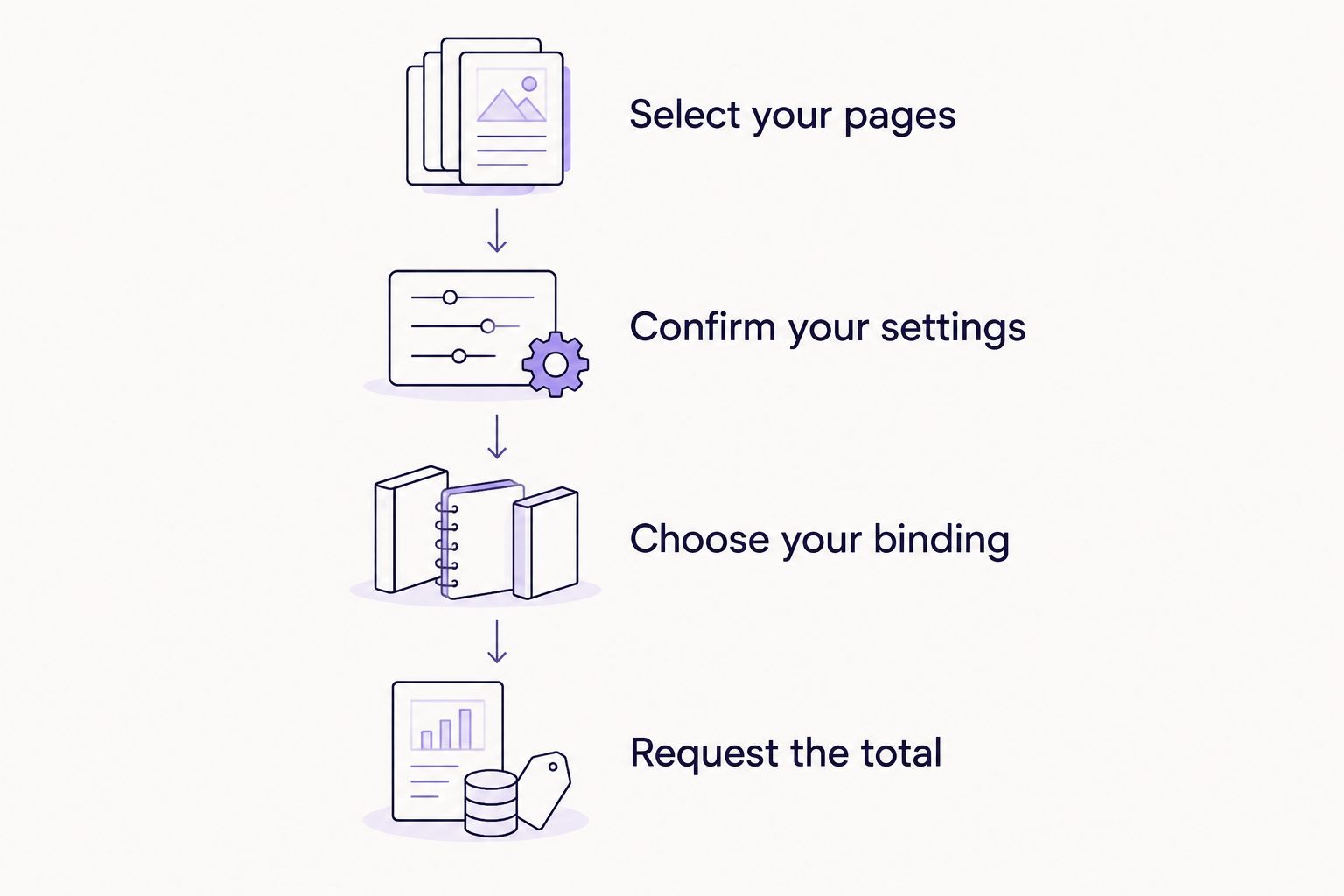
1. Select your pages
Open the PDF and decide what belongs in the first version. Include weekly planning pages, reflection pages, or other sections only if you want them there.
For an undated planner, you can begin with a smaller selection rather than assembling a full year. That’s an option, not homework. Blank pages don’t need to become evidence against you.
2. Confirm your settings
Choose the finished size, color setting, and whether you want printing on one side or both sides. Tell the provider if the file has intentional blank pages.
Check that writing space near the binding edge remains usable. Before printing the entire file, ask to see a sample with the intended settings.
3. Choose your binding
Think about how you’ll use the planner at the table, on the sofa, or wherever a quiet moment finds you. Do you want to remove a page, rearrange sections, or keep everything attached?
Ask to see an example of the binding method if you’re unfamiliar with it. There’s no prize for confidently ordering something you’ve never held.
4. Request the total
Ask for the complete finished total and an explanation of what it includes. Confirm whether you’ll receive loose pages, punched pages, or an assembled planner.
If you compare providers, send the same specifications to each. Keep the quote alongside those specifications so you can check the finished job against what you requested.
Is printing a planner at home cheaper than using a print shop?
Home printing isn’t automatically the cheaper choice. Your comparison needs to include the paper, ink or toner, binding supplies, and any supplies you would have to buy specifically for the job.
A printer already sitting on your desk doesn’t make the consumables disappear. Equally, a print shop quote isn’t automatically the better choice simply because someone else handles the machine.
Compare the supplies you need to buy with the complete shop quote. Then consider the work you’re willing to do: changing settings, checking page order, punching holes, and assembling the planner.
For an overwhelmed mom, that last part deserves an honest answer. You can enjoy making something yourself, or you can decide that you’d rather not spend your available quiet time negotiating with a printer.
Can you print only part of a planner?
You can select pages for printing when your file permissions and printing setup allow it. Check the printable’s instructions and personal use terms before making copies or asking a shop to reproduce it.
An undated weekly layout gives you a natural stopping point: print the pages you want to begin with, then decide what comes next after you’ve used them. There’s no need to manufacture a yearlong commitment out of a useful little page.
The Sheema Edit’s printable journals and planners belong in that decision only if their purpose fits what you want: room for reflection or a place to plan. Choose the purpose first, then decide how much paper it needs.
A few optional questions can help:
- What would I genuinely like to see on my desk this week?
- Which pages would I use without feeling supervised by them?
- Do I want somewhere to make plans, somewhere to hear myself think, or both?
- What can stay out of this first version?
Those answers can shape your print request without turning it into another productivity checklist.
What should you check before approving the print job?
Before approving a 2026 print job, check the sample as something you’ll write in, not just something that looks tidy on a screen. Small details become much more noticeable when your hand meets the page.
Look at the text size, writing space, page order, and orientation on the reverse side. Check whether the binding will cover anything you need to read or write on.
If you can test your usual pen on the chosen paper, do that too. Paper preferences are personal, and an attractive sample doesn’t answer every practical question.
Finally, confirm that the quote matches the sample settings. If you change the paper or binding after seeing the sample, ask for the updated total before approving production.
FAQ
How much does printing and binding a planner cost in 2026?
Printing and binding a planner requires an itemized total for your chosen pages, paper, binding, and finishing. Ask whether applicable tax, delivery, covers, and preparation are included before approving the quote.
Does a binding quote include printing the planner?
A binding quote doesn’t establish that printing is included. Ask for a finished planner total and confirm whether the provider expects you to supply already printed pages.
How many sheets do I need for 52 planner pages?
52 printed pages use 26 sheets when printed on both sides, before separate covers or blank sheets. Printing the same pages on one side uses 52 sheets.
What's the best binding if I want to rearrange planner pages?
A ring binder is a straightforward choice when you want to rearrange pages. Disc binding also allows removable pages, but you need compatible punching and supplies.
Should I print a whole undated planner at once?
You don’t need to print a whole undated planner at once. If the file permissions allow it, select the pages you want to try and leave the rest for another time.
Can a print shop print my purchased planner PDF?
Check the PDF’s personal use terms and ask the print shop whether it can accept the file. Confirm your printing permissions before submitting the job.
Is color printing necessary for a printable planner?
Color printing isn’t necessary simply because a planner has decorative color. Check a black and white sample to make sure the text, lines, and sections remain clear enough for you.
One last thing
Before paying to bind the full planner, try writing on a loose sample page. Put an actual appointment in it. Add the reminder you keep carrying around in your head. See whether the layout leaves room for your handwriting and your life.
The Sheema Edit is about making room for yourself, not proving you can maintain an impressive stack of paper. Choose the version you’ll feel comfortable returning to, including after a week when you didn’t touch it.
With Love, Sheema.