
When you don't know what to write in your journal, start with what's happening right now: something you noticed, a feeling you can name, or the sentence “I don't know what to write because…” You don't need a meaningful topic, a complete page, or a lesson tucked into the ending. Choose something small enough to tell the truth about, and stop whenever you've said enough.
- How to journal when you don't know what to write: describe something ordinary before asking yourself a bigger question.
- The Sheema Edit is for readers who want honest self reflection without another productivity assignment.
- Use sentence starters, fragments, or a simple description; complete paragraphs are optional.
- Journaling and weekly planning serve different purposes. Your feelings don't need to become tasks.
How to journal when you don't know what to write
Start with something specific, not something profound. The cup you reheated, the conversation you're replaying, or the quiet you wanted all count as places to begin. You aren't submitting an essay about your inner life.
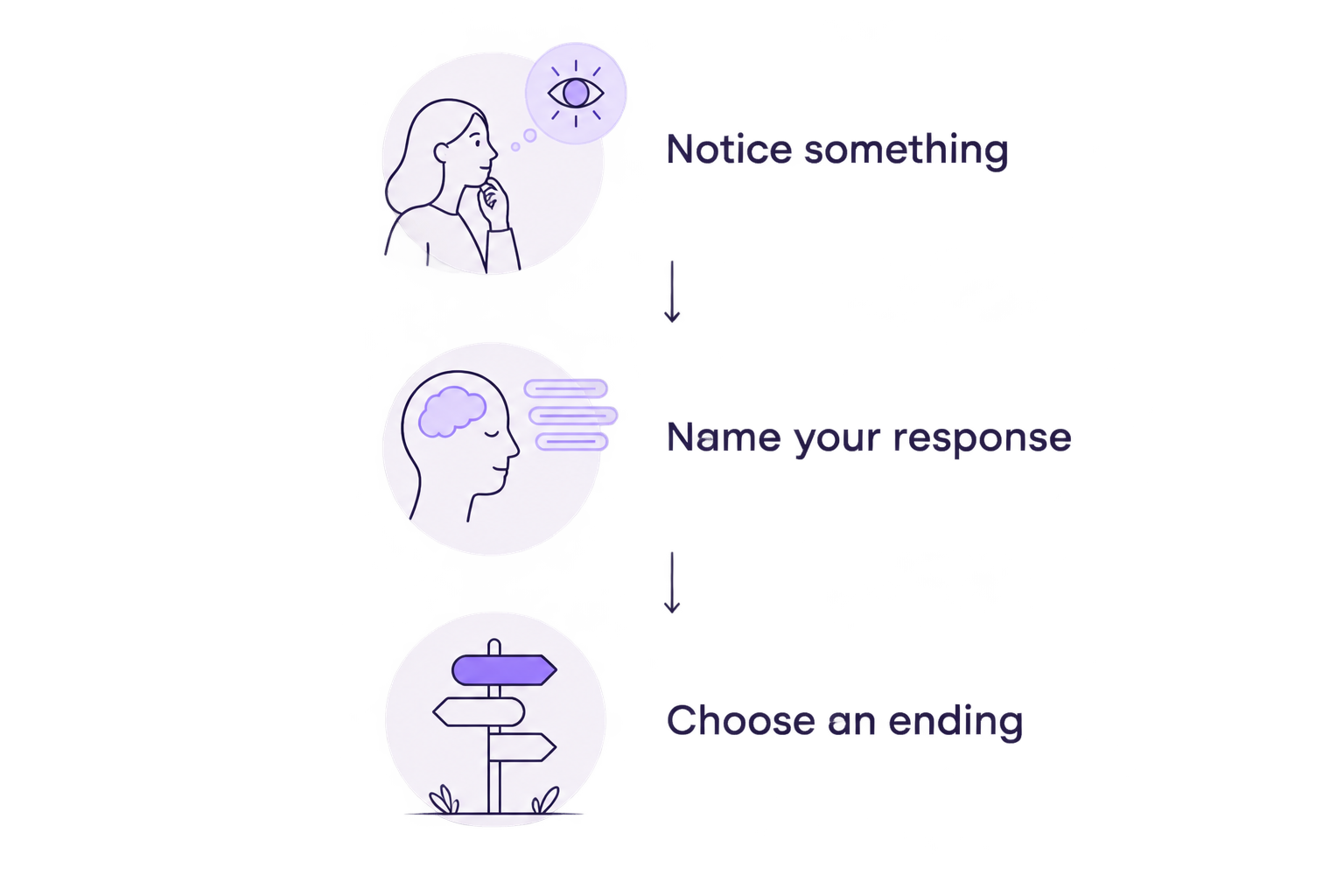
If a blank page feels too open, try this short sequence. For another entry point, choose from these self reflection journal prompts for moms, but let yourself ignore any question that doesn't fit today.
- Notice something. Write a plain observation: what happened, what you see, or what's taking up your attention. Keep it smaller than your whole day.
- Name your response. Add what you thought, wanted, enjoyed, or found difficult. “I'm not sure how I feel” is an honest response, too.
- Choose an ending. Continue if you want to, or finish with what you'd like to leave on the page. You don't owe the entry a solution.
For example, an entry might begin with waiting outside school and end with realizing you wanted a few quiet minutes before the next conversation. That's enough material. It doesn't need to become a statement about motherhood as a whole.
Why this matters
When other people need things from you all day, even an empty notebook can look suspiciously like another person waiting for an answer. You sit down for a little space and somehow end up interviewing yourself.
Your journal doesn't need to be useful to anyone else. It can hold an unfinished thought without turning it into a better attitude, a parenting lesson, or tomorrow's action plan.
The Sheema Edit's approach to self reflection journaling makes room for ordinary life, not just the parts that produce a tidy takeaway. You can write about loving your family and wanting everyone to stop saying your name for a moment. Both thoughts fit on the same page.
Choose an opening that asks less of you
Different openings ask different things of you. A sentence starter supplies direction; a list lets you skip the connecting words. Neither is the correct way to journal.
Choose according to what you want from this particular page, rather than what looks like serious journaling.
| Opening | Best for | What it offers | Where it gets awkward |
|---|---|---|---|
| Sentence starter | Wanting a little direction | A clear place to begin | The question can feel like homework |
| Fragments | Not wanting to explain | Room for words without transitions | Connections stay unstated |
| Ordinary scene | Not wanting to name feelings yet | Something concrete to describe | Description can leave the bigger thought untouched |
| Unsent note | Having something you want to say | A person or situation to address | You might not want to revisit that conversation |
Sentence starters: best for wanting a little direction
Complete whichever beginning feels easiest: “Today took more out of me than I expected because…” or “Something I haven't had room to say is…” You can also start with “Nothing dramatic happened, but I noticed…”
A prompt gives you a doorway, not an assignment. Skip any question that asks for more honesty, certainty, or emotional energy than you want to offer.
Fragments: best for not wanting to explain
Write a few disconnected words: tired, irritated, relieved, laundry, unanswered message. You don't need to explain why those words belong together.
Fragments leave room for uncertainty. Their limitation is that they don't explain much, so add a sentence later only if you want one, not because the entry looks unfinished.
Ordinary scene: best for avoiding a big emotional question
Describe where you are, what you hear, and what's happening around you. Perhaps there's a cold drink beside you or a pile of clothes you're choosing not to discuss at this time.
You can stay with the description. If a feeling follows, write it; if it doesn't, the observation still belongs in your journal.
Unsent note: best for having something you want to say
Address a person, a situation, or an earlier version of yourself without planning to send the entry anywhere. Begin with what you wanted to say, not the perfect explanation.
This opening isn't a requirement to revisit a painful exchange. If the conversation feels like too much today, choose something less personal or close the notebook.
Why finding words feels different from day to day
Not every blank page asks the same thing of you. Before deciding you're bad at journaling, consider what you're asking yourself to do:
- Choose a topic. “Write about anything” leaves the entire decision with you; a specific observation narrows the starting point.
- Find the exact feeling. You can describe an event without knowing whether you're disappointed, angry, or simply done talking.
- Write something polished. Complete sentences, neat handwriting, and a satisfying ending are extra requirements you can remove.
- Explain something private. A page that someone else might read isn't the same as a page you feel comfortable keeping to yourself.
- Finish before an interruption. An entry that's allowed to end mid thought asks less of you than a page you feel obliged to complete.
These aren't problems you need to solve before writing. They're places where you can make the invitation smaller, or decide that writing isn't what you want right now.
Try a smaller invitation, not a stricter routine
If you'd like a clear boundary, try writing for 2 minutes. That's an optional stopping point, not a recommended dose or a test of commitment. You can finish sooner.
You could instead write 3 words that describe today, or 1 sentence about something you wish had gone differently. The point isn't to reach a minimum. It's to give yourself permission to stop before the page starts feeling like a chore.
Here are a few invitations you can borrow:
- Something that felt good, even briefly, was…
- What I wanted to say earlier was…
- A small thing I'm tired of carrying is…
- I don't have an answer for this yet, but…
- Something I want to remember about today is…
- Right now, I'd rather write about…
Choose the question you can answer, not the one you think you should answer. A funny observation about your afternoon is no less welcome than a difficult realization.
If a prompt produces nothing, leave it. You don't have to keep digging until you find a feeling worthy of the notebook.
What if you really don't want to write about your feelings?
You can journal without naming or explaining your feelings. Record an ordinary moment, something you liked, a question you're considering, or a detail you want to remember.
Try describing a conversation without interpreting it. What was said? What stayed with you afterward? You can leave the meaning undecided instead of making yourself arrive at an answer.
You can also keep an entry entirely about enjoyment: a meal, a song, a ridiculous thing someone said. Your journal doesn't have to be the place where everything difficult goes.
What if your journal keeps turning into a list of chores?
A list of chores belongs on the page if that's what you need to write, but you don't have to turn every reflection into a task. “I'm tired of deciding dinner” doesn't automatically need to end with a meal plan.
If you want both reflection and planning, give them separate spaces. One can hold what's on your mind; the other can hold the appointment you need to remember. Neither has to take over the whole page.
The Sheema Edit offers printable journals and planners for readers who want those kinds of writing spaces. A printable gives you somewhere to begin, but it doesn't supply the words or require you to use it daily; an ordinary notebook works, too.
For flexible weekly planning, leave room for what changes. You don't need to schedule your feelings into becoming more convenient by Thursday.
How do you stop without feeling like you left something unfinished?
You can end a journal entry before you understand it. An unresolved thought isn't a failed entry, and a difficult day doesn't need a hopeful final paragraph.
Try a simple closing line: “That's what I have words for today.” Or write what you're choosing to do next, even if it's just putting the notebook away.
You can return to the subject later without promising that you will. Leaving something on paper isn't a contract to keep working on it.
FAQ
What should I write first when my mind goes blank?
Write a plain observation about the moment you're in. Describe where you are, what just happened, or what's on your mind without trying to explain its significance.
Can I write that I don't know what to write?
Yes, you can make that your entire entry or use it as your opening sentence. Adding “because” gives you somewhere to continue, but you don't have to continue.
How long should I journal when I don't have much energy?
You can try 2 minutes as an optional boundary, or stop after a sentence. There isn't a minimum length you need to reach for the entry to count.
Do I need to journal every day for it to count?
No, journaling doesn't require daily entries. You can write when you want space, return after a gap, and leave the unwritten days alone.
Is it okay if my journal is just a list?
Yes, a journal entry can be a list, fragments, or disconnected observations. You don't need paragraphs or a finished story unless you want to write them.
What if I don't want anyone reading my journal?
Choose what to record according to the privacy you actually have. You don't owe the page identifying details, and you can leave a subject unwritten if keeping it would feel uncomfortable.
Should I keep writing if the topic feels too upsetting?
You don't need to keep writing about an upsetting topic. Stop, choose something more ordinary, or put the journal away; finishing the entry isn't an obligation.
One last thing
Before you close the notebook, check whether you've quietly turned a feeling into a criticism of yourself. There's a difference between “I felt impatient today” and “I'm an impatient mother.” You can record the moment without making it your whole identity.
Let the entry describe today, not deliver a verdict on you. That's the kind of room The Sheema Edit's self reflection journaling is here to make: somewhere to be honest without having to become a finished person by the bottom of the page.
Related guides
- Self reflection journal prompts for boundaries
- How to use an undated weekly planner
- Can journaling replace therapy?
With Love, Sheema.