
To start a healing journal after trauma, choose somewhere private to write and begin with what you need today, not a detailed account of what happened. Try a single sentence, give yourself permission to stop, and leave anything you don’t want to explore untouched. Your journal can hold ordinary life, uncertainty, and unfinished thoughts without becoming another assignment you’re supposed to get right.
- Wondering how to start a healing journal after trauma? Begin with present needs, not a detailed retelling.
- The Sheema Edit centers gentle self reflection, not pressure to turn painful experiences into a lesson.
- Choose paper or digital journaling for privacy and ease, not appearance or a perfect routine.
- Journaling is optional personal writing, not a replacement for professional trauma support.
Why this matters when you’re already carrying enough
You don’t owe a notebook your hardest memories. You also don’t have to turn every difficult feeling into something useful before you’re allowed to rest.
If you’re an overwhelmed mom, even finding a quiet corner can feel like an ambitious household project. This page offers choices, not a daily routine. The distinction between journaling and therapy matters here: personal writing isn’t a substitute for care from a qualified professional.
The Sheema Edit is for overwhelmed moms who want self reflection without another productivity checklist. That means the page should serve you, rather than become another place where you feel behind.
How to start a healing journal after trauma
Begin with a small decision you control. You choose the subject, the length, the format, and whether the writing stays afterward.
You don’t need a complete story or a meaningful opening line. These steps offer a starting point; you can leave out anything that doesn’t fit.
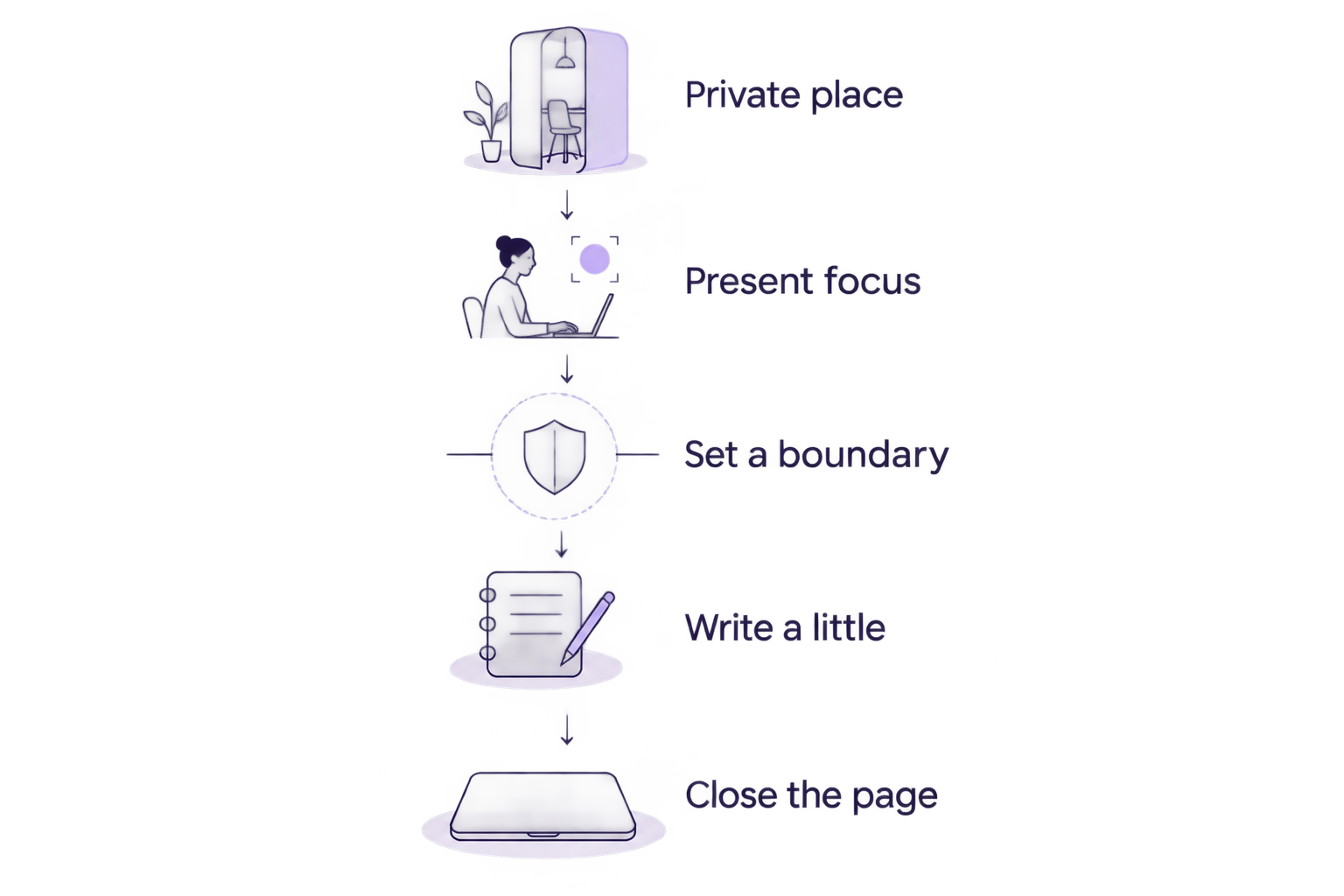
1. Choose a private place
Think about who can access your writing before deciding where to keep it. A notebook in a shared room and a document on a shared device raise different privacy questions.
For paper, consider where you’ll store it. For digital writing, check device access, account sharing, and whether files appear on other devices. Don’t assume a journal app or a closed notebook is automatically private.
A neutral file name such as Notes 2026 is an organizational choice, not a security measure. Choose based on actual access, not how discreet the cover or file name looks.
2. Pick a present focus
Your first entry doesn’t have to explain the past. It can describe what you want from the rest of today.
Consider an opening such as:
- Today feels crowded because…
- Something I don’t want to discuss right now is…
- What would make this evening less demanding is…
These are invitations, not questions you must answer. If even a sentence feels like too much, a few words are enough for the page you’re choosing to make.
3. Set a boundary
Before writing, decide what you’re leaving outside this entry. You might choose not to name anyone, revisit a particular event, or reread earlier pages.
A boundary can be plain: Today, I’m writing about what I need, not what happened. You don’t need to justify that choice to the notebook. It has no credentials and, thankfully, no follow up questions.
4. Write a little
Try 1 sentence if you want a concrete place to begin. That’s an optional starting point, not a recommended dose or a measure of effort.
You can write in fragments, use a list, cross something out, or stop halfway through a thought. Grammar isn’t the assignment. Neither is producing an insight before someone calls for you from another room.
5. Close the page
Ending doesn’t require solving what you wrote about. You can add a simple line such as I’m leaving this here for now, then put the writing away.
Choose an ordinary next activity if that feels helpful: getting a drink, opening a window, or returning to whatever you had planned. If writing leaves you overwhelmed or distressed, stop rather than pushing through to finish.
Choose a format that doesn’t create more work
The right format is the one you’re comfortable using and can keep appropriately private. Appearance is optional. A beautiful notebook still has to live somewhere, and a digital file still has access settings.
There’s no need to buy something specifically labeled for trauma. Compare the practical tradeoffs instead.
| Format | Best for | What it offers | What to consider |
|---|---|---|---|
| Plain notebook | Writing without a screen | Space to write without choosing prompts or settings | Physical storage and access matter |
| Printable pages | Choosing individual pages | You decide which pages to print and keep | Printing and storing loose pages add tasks |
| Digital document | Editing or rearranging thoughts | You can revise text without rewriting a whole page | Shared devices, accounts, and syncing need attention |
You don’t need to move an existing writing practice just because another format looks more intentional. Familiar can be useful, especially when learning a new system is the last thing you want.
The Sheema Edit offers printable journals and planners for readers who want a prepared place for reflection or planning. That format fits readers who prefer using a page rather than building one; printing and storing it still take effort. It’s an option, not a requirement for beginning.
Why your starting point can look different
A journal doesn’t need one fixed role. You can use it for a practical question today and leave it untouched tomorrow.
Consider these everyday factors when deciding what belongs on your page:
- Privacy. Write only what you’re comfortable recording in the space available to you. You’re allowed to leave details unwritten.
- Available attention. A quiet afternoon and an interrupted evening don’t call for identical expectations. Choose accordingly.
- Your purpose. Naming a need is different from recording an event. Decide which task, if either, you want today.
- The format. Loose paper, a bound notebook, and a digital document each involve different storage choices.
- Your response. Pay attention to whether you want to continue. Finishing a prompt isn’t more important than stopping when you need to.
There’s no need to explain why yesterday’s approach doesn’t fit today. Changing the plan isn’t breaking the practice; it’s making a choice about your own writing.
What can you write when you don’t want to tell the story?
Write around your present life instead of asking yourself for a detailed retelling. You can describe a preference, a practical need, or something you want less of this week.
Choose one prompt, or choose none. This isn’t a questionnaire with a missing answer penalty.
What do I need today?
Try completing: Something that would make today less demanding is…
Your answer can be ordinary. An easier dinner, fewer messages to answer, or time without conversation doesn’t need a deeper meaning to belong here. You’re naming a preference, not submitting a case for why you deserve it.
What am I not discussing today?
Try completing: I’m allowed to leave this subject alone today…
You don’t have to fill in the subject. The sentence can stand as written, especially if naming it would take the entry somewhere you don’t want to go.
What would I like more room for?
Try completing: In 2026, I’d like more room for…
Keep the answer as small as you want. This isn’t a request for a reinvention plan. More unhurried breakfasts is a complete answer; so is not knowing yet.
What can remain unfinished?
Try completing: I don’t have an answer about…
Then stop if you want. You don’t need to follow uncertainty with reassurance, gratitude, forgiveness, or a lesson. An unfinished thought is still something you were allowed to write.
How long should your first journal entry be?
1 sentence is enough for a first entry if that’s what you choose. You don’t need to fill a page or stay with a topic for a set amount of time.
You might write 3 words instead: Tired. Angry. Unsure. Those words don’t need an explanation underneath them, and choosing a shorter entry doesn’t create a debt for next time.
Avoid turning a suggested length into a rule. If you start with one sentence and want to continue, you can; if you stop before finishing it, you can do that too.
Do you have to write about the trauma itself?
No, starting a personal journal doesn’t require describing the trauma. You can write about current needs, everyday decisions, or something entirely unrelated.
A page about what you want for lunch is still your page. So is a page about a conversation you don’t want to have. You don’t have to earn ordinary subjects by addressing the hardest one first.
If you want help deciding whether or how to explore traumatic experiences, bring that question to a qualified mental health professional rather than treating a prompt as an instruction.
What if writing leaves you feeling worse?
Stop the writing rather than making yourself complete it. Put the page away and choose whether you want company, practical support, or a conversation with a qualified professional.
You don’t need to reread the entry to prove anything about what happened. You also don’t need to try again tomorrow simply because a guide suggested journaling.
If distress continues or you’re concerned about your response, seek professional support. Personal writing is optional; getting help doesn’t depend on having the right words in a notebook first.
How do you leave room for real life?
Don’t give the journal attendance requirements. If you return after a long gap, begin where you are instead of reconstructing every day you missed.
An entry headed November 2026 doesn’t owe an explanation for the blank pages before it. You can write today’s thought and leave the gap alone. No catch up essay required.
For a crowded week, keep reflection separate from planning if combining them feels like extra work. A private thought doesn’t automatically need to become a task, a goal, or something you’ll improve by Friday.
You might write these 2 prompts on separate lines:
- What am I carrying?
- What actually needs doing?
Answer either, both, or neither. The distinction simply gives you a way to notice that a feeling and an appointment don’t need the same kind of space.
FAQ
How do I start a healing journal after trauma if I don’t know what to say?
Begin with a sentence about what you need today, or write that you don’t know what to say. You don’t need to explain what happened or turn the entry into a complete story.
Do I need a special journal to begin?
No, you can begin with paper or a digital document you’re comfortable using. Consider privacy and storage before choosing a format.
Do I have to journal every day after trauma?
No, personal journaling doesn’t require daily entries. You can skip days, leave gaps, or stop without making up missed writing.
Can I start a healing journal without writing about what happened?
Yes, you can write about present needs, preferences, or ordinary life instead. A personal journal doesn’t require a detailed account of trauma.
Should I keep going if a journal prompt upsets me?
No, you don’t need to finish a prompt that leaves you upset or overwhelmed. Stop writing and seek support from a qualified professional if distress continues or concerns you.
Can a healing journal replace trauma therapy?
No, a personal journal isn’t a replacement for trauma therapy or professional assessment. You can ask a qualified mental health professional whether writing has a place alongside your care.
Do I have to reread or keep every journal entry?
No, rereading and keeping entries are personal choices. You can leave an entry unread and decide what you’re comfortable storing, while remembering that digital deletion doesn’t necessarily remove every copy.
One last thing
The word healing on a cover doesn’t create an obligation to show progress inside it. You can have a journal in 2026 without making recovery your annual project.
You’re allowed to make a page smaller than the thing you’re carrying. A few honest words, a boundary, an ordinary wish: none of them needs to tell the whole story.
If you close this page and decide not to write today, that choice belongs to you too. There’s no blank notebook somewhere keeping score.
Related guides
- Self reflection journal prompts for boundaries
- Can journaling help process grief?
- Self reflection journal prompts for moms
With Love, Sheema.