
A healing journal is worth it in 2026 if you want a private place to reflect and the format feels easy enough to return to. It isn't a promise of healing, and buying one doesn't create the time or privacy to use it. Choose it for the space it gives your thoughts, not for the person its cover suggests you should become.
- Is a healing journal worth it in 2026? Yes, for reflection; no, as a promise of recovery.
- The Sheema Edit suits moms seeking reflective essays and printable journals, not another productivity assignment.
- Choose self reflection prompts for feelings and flexible weekly planning for practical commitments.
- Try a page you already own before deciding whether a guided journal fits.
Why this matters when you're already carrying plenty
When you're managing family life, your own thoughts can end up somewhere behind the laundry and the appointment you still need to reschedule. Wanting somewhere to put those thoughts makes sense. Wanting that space without another obligation makes sense, too.
The Sheema Edit brings together personal essays and printable journals and planners for readers seeking that kind of reflection. The useful question isn't whether you can become a journal person. It's whether a page offers something you actually want: room to be honest without immediately turning honesty into a task.
A journal doesn't need to earn its place by making you more productive. But you don't need to buy one just because you're having a hard season, either.
Is a healing journal worth it in 2026?
Yes, when the pages match what you need to express. Skip it when the format asks more of you than it gives back. A guided page, an ordinary notebook, and a weekly planner serve different purposes; choosing between them starts with the job you want the page to do.
| Option | Best for | What it offers | What to watch for |
|---|---|---|---|
| Guided journal | Readers who want somewhere to begin | A question or theme to respond to | Prompts can feel too personal or simply irrelevant |
| Blank notebook | Readers who want complete freedom | Space for words, lists, sketches, or unfinished thoughts | An empty page offers no starting point |
| Printable journal | Readers who prefer working on paper | A format you can print and write on | Printing adds a practical step |
| Undated weekly planner | Readers sorting commitments and available time | A view of what belongs in a week | A schedule isn't the same as space for reflection |
None of these formats wins for everyone. A beautiful guided journal is still the wrong choice if you dislike answering questions. A plain notebook isn't automatically better if the blank page makes starting feel like homework.
For your 2026 choice, ask what you want to put on the page before choosing what the page should look like.
A guided journal: best for a starting point
A guided journal makes sense when you want to write but don't know where to begin. A question gives you something specific to answer, rather than asking you to summarize your entire inner life before bedtime. That's a large assignment for someone who still hasn't found the missing lunch container.
The limitation is fit. A prompt about gratitude might feel welcome today and irritating tomorrow. A question about forgiveness doesn't deserve an answer simply because it appears next in the book.
Before choosing a guided journal, read any sample prompts provided. Ask yourself whether the language leaves room for an honest answer, including an ordinary, annoyed, or uncertain one.
Choose a guided journal if the questions feel like invitations. Skip it if they feel like instructions for having better feelings.
A blank notebook: best for freedom
A blank notebook makes sense when you already know what you want to say, or you want permission to change subjects halfway through. You can write about feeling overlooked, then remember something funny, then stop. The page doesn't need a tidy emotional arc.
Freedom has a drawback: nobody supplies the opening line. If that's where you get stuck, try borrowing a simple beginning: Today, the part I haven't said out loud is…
You don't have to turn an ordinary notebook into a polished journal practice. A shopping list on the next page doesn't cancel the honest paragraph before it.
Choose a blank notebook if flexibility matters more than guidance. Skip it if finding your own prompt is the very task you want help with.
A printable journal: best for writing on paper
A printable journal makes sense when you prefer handwriting and want a prepared page rather than an empty notebook. Before choosing one, look at the actual layout. Notice whether the writing space suits the way you write, not just whether the page looks lovely in a preview.
The practical limitation is printing. You'll need a way to print the pages and somewhere to keep them that offers the privacy you want. A file sitting unopened isn't a personal failure; it might simply be a format that adds a step you don't need.
You can also decide that handwriting isn't important enough to justify that step. The format should serve the writing, not become a project of its own.
Choose a printable journal if paper suits your everyday life. Skip it if managing loose pages already sounds tiring.
An undated weekly planner: best for practical space
An undated weekly planner makes sense when your main question is not what am I feeling, but what actually fits this week? It gives practical commitments somewhere to go without requiring you to begin with the current calendar page.
Its limitation is purpose. A weekly layout can hold appointments and reminders, but that doesn't make it the right place for a complicated feeling. You don't need to turn an emotional need into a scheduling problem.
If you're choosing a planner in 2026, look for a layout that lets you leave space without treating the empty space as something to fix. Not every open afternoon needs a new responsibility.
Choose an undated weekly planner for organizing commitments. Skip it as a substitute for the reflective space you actually wanted.
Why a healing journal's value varies
A journal's usefulness depends on its fit with your real life, not the seriousness of its title. These are the differences to examine:
- The language. Look for questions you can answer honestly, without pretending to be grateful, forgiving, or ready.
- The structure. Decide whether you want a starting prompt or room to choose your own subject.
- The physical format. Consider whether printing, handwriting, and storing pages feel manageable.
- The privacy. Think about where you'll write and where the pages will live afterward.
- The expectation. Choose a format you can leave and return to without treating the gap as a debt.
Privacy deserves more attention than a pretty cover. Before writing something sensitive, consider who can access the notebook, printed pages, or device you're using. You don't owe a page details you aren't comfortable recording.
Try a page before choosing a journal
You don't need a new purchase to find out whether you like reflective writing. For a small 2026 experiment, use paper you already have and offer yourself 2 minutes, not a new identity. Stop earlier if you want.
Notice
Choose something specific from today rather than trying to explain your whole life. Perhaps you agreed to something you didn't want, enjoyed a quiet moment, or felt irritated without knowing quite why. Ordinary moments are enough material.
Write
Write 1 sentence beginning with: What I wanted in that moment was… Leave the answer plain. You don't need to make it generous, insightful, or suitable for anyone else's reading.
Leave
Close the page without adding a lesson or action item. Later, decide whether that format felt useful, uncomfortable, boring, or simply unfinished. Any of those answers gives you something to consider when choosing a journal.
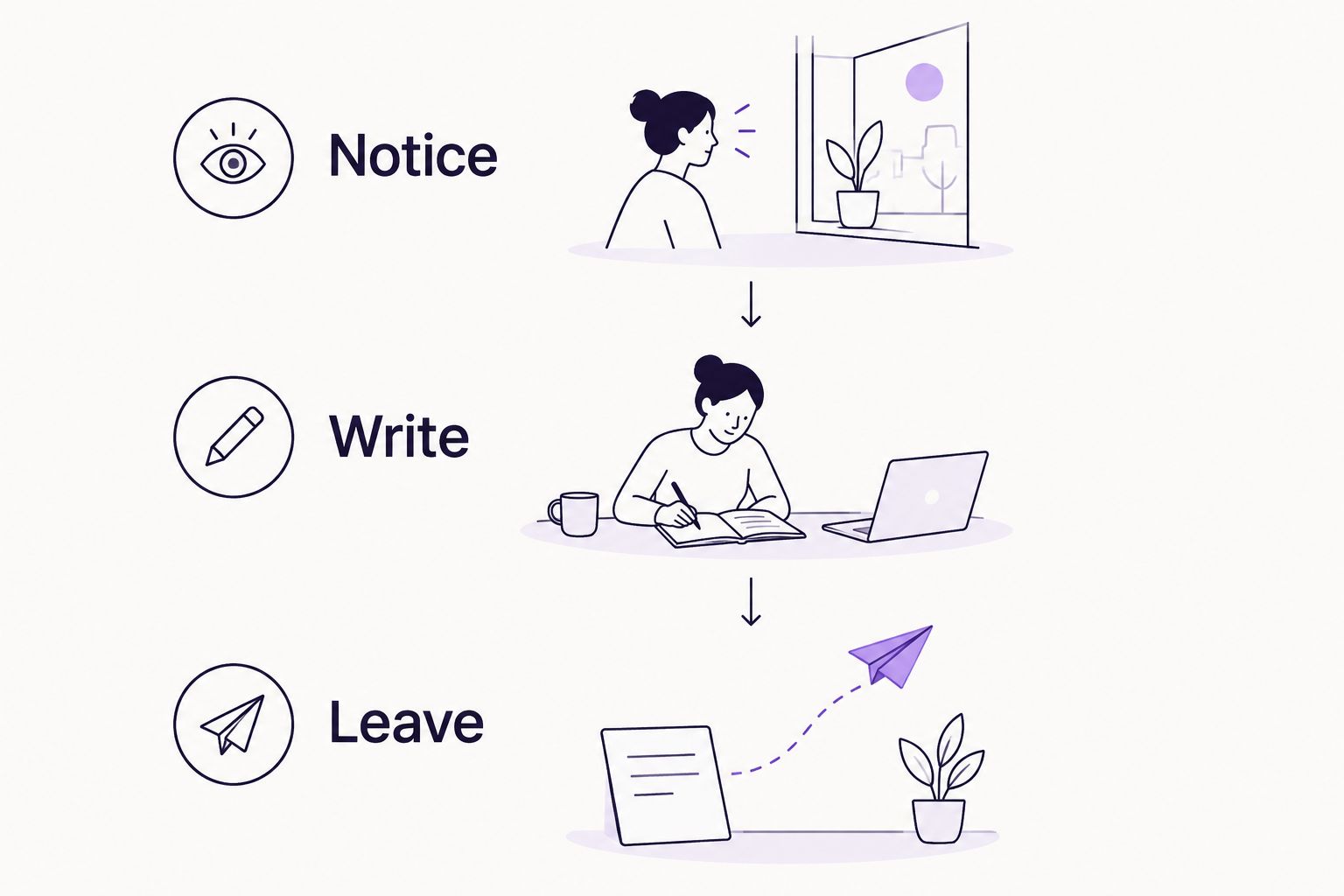
The point isn't to complete an exercise perfectly. It's to notice whether you wanted a prompt, more room, a different medium, or no writing at all. That is a more useful buying guide than imagining a future version of yourself who always has uninterrupted evenings.
What if the prompts feel too personal?
Skip them. A printed question doesn't have authority over what you're ready to put into words. You can change the subject, answer only part of it, or close the journal.
Here are 3 prompts that keep the focus on ordinary needs rather than asking you to explain everything:
- What would I like someone to understand about today?
- What did I need that I didn't ask for?
- What can remain unfinished tonight?
If the second question feels useful, these self reflection journal prompts for boundaries offer another place to begin. You don't need to follow every question or turn an answer into an immediate conversation.
Writing something down doesn't commit you to fixing it tonight. Sometimes the honest answer is all you wanted from the page.
Is a healing journal better than a planner?
A healing journal is better for reflection; a planner is better for arranging commitments. Neither replaces the other, and you don't need both unless you genuinely want both jobs covered.
Before choosing another tool in 2026, finish this sentence: I want somewhere to put… If the answer is appointments, choose planning space. If the answer is the feeling you haven't had room to name, choose reflective space.
Can you use a healing journal without writing daily?
Yes, you can use a healing journal whenever you want to write. Daily entries aren't a requirement for having somewhere to return to.
You can leave a gap without explaining it on the next page. Start with what's present now instead of producing a report on everything that happened while you were away.
Where The Sheema Edit fits
The Sheema Edit is best for moms who want reflective essays and printable journals rather than another productivity checklist. The shop is relevant if you've decided that a printable format suits you; it doesn't need to be the starting point.
The limitation is the same as with any printable journal: you'll still need to print it, make room for it, and decide whether its pages fit your needs. Read the product description before choosing. If your existing notebook already does the job, keep using it.
FAQ
Is a healing journal worth it in 2026 if I've never journaled?
A healing journal is worth considering in 2026 if you want a starting point for reflection. Try a simple prompt on paper you already own before deciding whether you want a guided format.
Do I have to write in a healing journal every day?
No, you don't have to write in a healing journal every day. You can return when you want to reflect without filling in the days you missed.
Can I use a regular notebook instead of a healing journal?
Yes, a regular notebook can hold your reflections. A guided journal adds questions or structure, so choose it only if that guidance is something you want.
What if I don't want to answer a journal prompt?
Skip any journal prompt you don't want to answer. You can rewrite the question, choose another subject, or stop without finishing the page.
Does a healing journal replace professional support?
No, a healing journal doesn't replace professional support. Treat it as a place to write, not a promise of recovery or a substitute for care.
Is The Sheema Edit suitable if I want printable journals?
The Sheema Edit offers printable journals and planners alongside personal essays. Check the individual product description to decide whether a particular printable matches how you want to write.
One last thing
The page that says nothing profound still counts as a page you were allowed to have. You don't owe your journal a breakthrough, a grateful ending, or handwriting fit for a framed quotation.
For 2026, choose the format that asks the least pretending of you. And if the most honest decision is not another thing right now, that's a complete answer, too.