A self care planner is worth it in 2026 if it gives you somewhere to notice your needs and make room for them without becoming another obligation. It isn't worth it if keeping the planner starts taking more out of you than the planning gives back, and it cannot create the time, support, or rest you need on its own.
- Is a self care planner worth it in 2026? Yes, if it supports you without demanding consistency.
- The Sheema Edit favors self reflection and flexible weekly planning over another productivity checklist.
- Choose an undated planner for flexible planning, a journal for reflection, or an existing notebook to explore both.
- Blank pages aren't a debt, and you don't need to write daily to make a planner useful.
Is a self care planner worth it in 2026?
Yes, when the page helps you name a need and choose a realistic next step. No, when the page becomes another place to feel behind. That distinction matters more than how much space you fill.
Imagine opening your planner after a week that went sideways. Can you use the next available page without explaining yourself? Can you write that you need less on your plate instead of finding room for more?
Those are useful things to look for. If dated pages leave you feeling behind, this guide to using an undated weekly planner offers a different starting point.
| Option | Best for | What it gives you | What to watch for |
|---|---|---|---|
| Undated weekly planner | Seeing commitments alongside personal needs | A place to consider the week without assigning every page a fixed date | You still need to decide what belongs on the page |
| Guided journal | Exploring feelings or questions | A prompt to respond to when a blank page feels awkward | A prompt won't always match what you want to discuss |
| Existing blank notebook | Trying reflection and planning without choosing a new format | Freedom to make the page as simple as you like | An open page offers less direction |
None of these options wins for everyone. If you want help making sense of a feeling, more calendar boxes aren't necessarily the answer. If you keep losing track of commitments, a long reflection prompt isn't a substitute for somewhere to record them.
Why this matters when everyone needs something from you
A planner can hold your appointments beautifully and still leave you out of the picture. School reminders, work commitments, household errands, and everyone else's needs can fill the space before you've asked what you need.
Self care planning doesn't have to mean adding a separate routine to that list. It can mean noticing that the list is already too full. Sometimes the useful entry is something you're choosing not to do.
The Sheema Edit centers self reflection and flexible planning because your needs belong in your ordinary life, not only in the leftover spaces. You don't have to turn them into an ambitious personal improvement project.
In 2026, you can evaluate a planner with a plain question: does this help you include yourself in your plans? A lovely page can be enjoyable. It still needs to be a page you can actually use.
Choose the kind of space you actually need
An undated weekly planner: best for seeing your week
An undated weekly planner suits you when you want commitments and personal needs in the same view. You choose when to start, and you can return after a gap without filling in earlier dates.
Its limitation is that open dates don't automatically create flexibility in how you treat yourself. You can still turn an undated page into a very demanding little supervisor.
Before choosing one, look at a sample layout if one is provided. Ask whether there's room for what matters to you, not just whether you could find something to write in every box.
A guided journal: best for finding words
A guided journal suits you when the main question isn't what to do next, but what you're feeling or carrying. A prompt can give you something specific to respond to without asking you to invent an opening sentence.
The limitation is fit. A question about gratitude might not be the question you want on a difficult afternoon. You can skip it, change it, or write about something else entirely.
Choose prompts you can disagree with. A journal doesn't need your cooperation at the expense of your honesty.
An existing notebook: best for trying the idea
An existing notebook suits you when you're interested in self care planning but unsure what kind of structure you want. You can put a reflection on one page and a short weekly plan on another.
The limitation is that you create the structure yourself. If deciding what to write feels like extra work, a few printed prompts or a prepared layout might suit you better.
You don't need a new planner to find out whether you want space to reflect. Start with what you have if that's the easiest way to begin.
Why a self care planner's usefulness varies
The question isn't whether you're organized enough to use a planner. It's whether the planner fits the support you're looking for. Consider these factors when deciding what belongs in your life:
- Your purpose. Recording commitments, exploring feelings, and remembering personal needs are different jobs. Choose the one you want help with first.
- The amount of structure. Prompts offer direction, but they also ask specific questions. Blank space gives you freedom, but leaves the starting point to you.
- Your response to gaps. If missed dates feel accusatory, an undated format removes the need to return to those particular boxes.
- The practical effort. Consider where you'll keep the planner and what opening it involves. A format you don't want to retrieve isn't a useful fit.
- Your available support. A page can record a request for help. Someone still has to respond, and writing the request doesn't make you responsible for handling everything alone.
You don't need to resolve every factor before trying a page. Choose the one that matters most right now and let that guide the decision.
Try a page before committing to a system
You don't need a daily routine to assess whether a planner belongs in your life. Try this small exercise when you have room for it, then leave it alone until you want to return.
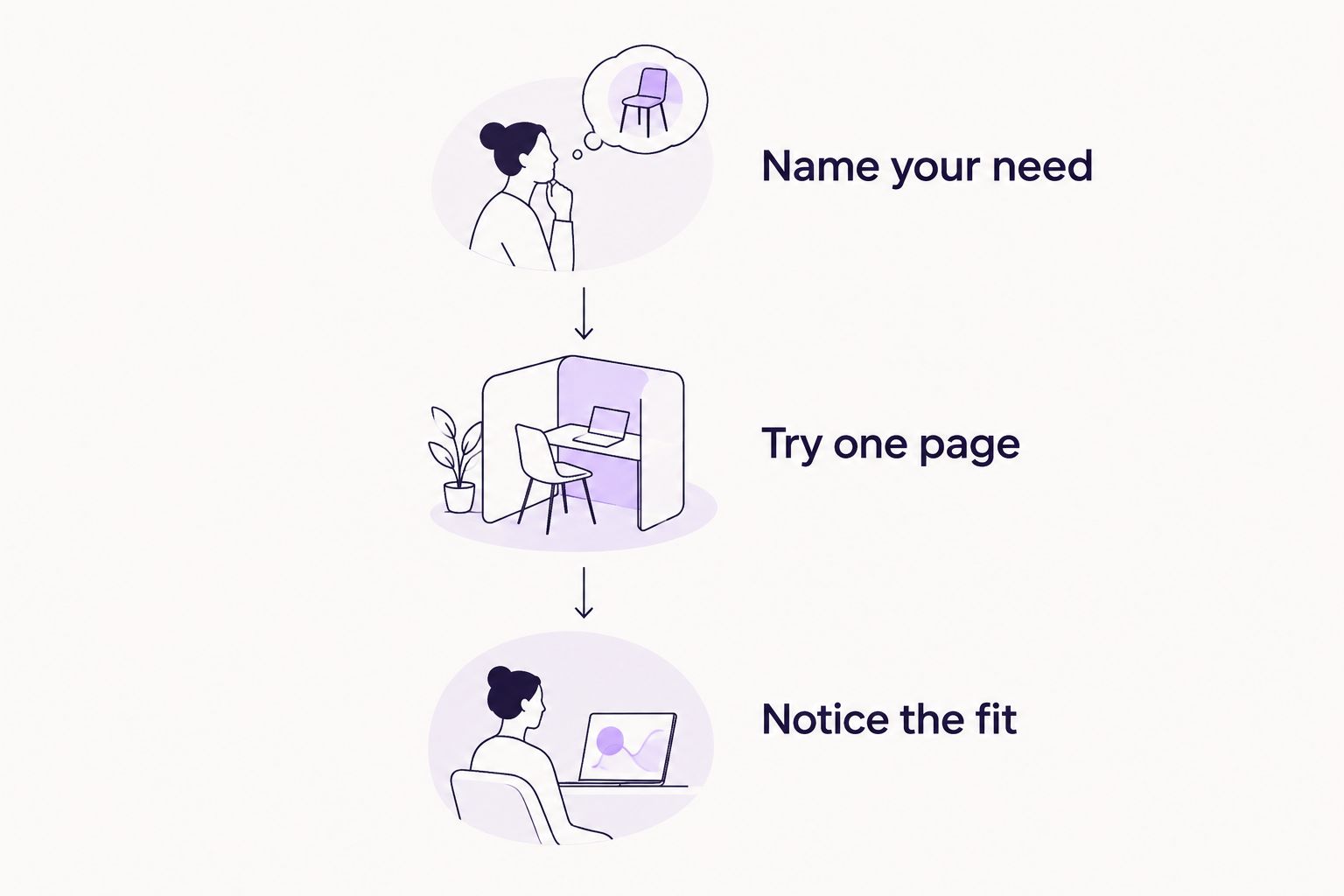
1. Name your need
Write 1 sentence about what you want help holding. That might be remembering your own appointments, finding words for a difficult week, or noticing when you've agreed to too much.
Keep the sentence ordinary: I want somewhere to put what I need before I forget it again. You don't have to make it profound. Profound can wait until after lunch.
2. Try one page
Give yourself an optional 2 minutes with a page and these 3 prompts:
- What am I carrying right now?
- What needs my attention, and what can wait?
- What would I like to ask for or make room for?
Answer whichever question fits. A phrase counts, and stopping midway doesn't turn the exercise into an unfinished assignment.
3. Notice the fit
After an ordinary week, ask whether you wanted to return to the page. Did the format give you somewhere useful to put a thought, or did you spend more attention managing the format?
You aren't testing your discipline. You're trying a tool and noticing whether you want to keep using it.
A trial like this doesn't prove that any planner will suit you forever. It gives you something more useful than an imagined future routine: an experience with a page, in your actual life.
What makes a planner worth keeping in 2026?
A planner worth keeping lets you write an honest version of your week. That includes unfinished tasks, changed plans, and needs that don't come with a neat action item.
Look for permission in how you use it, not just in the wording printed on it. You can cross out an irrelevant section, use a notes box differently, or leave a whole page blank.
You can also record a boundary instead of a goal. Something as simple as not volunteering for another task deserves space if that's what you need. These journal prompts for boundaries offer a place to begin if finding the words is the difficult part.
A useful planner also leaves you free to stop. You don't owe a notebook continued attendance because you were enthusiastic when you chose it.
When is a self care planner not worth it?
A self care planner isn't worth keeping when using it has become an obligation you don't want. You don't have to turn every private feeling into a written entry or make every quiet moment productive.
Set it aside if you find yourself inventing goals to fill the layout, catching up on pages you don't care about, or judging your week by how complete it looks. You can return later, change formats, or decide planning on paper isn't what you need.
There's also a difference between needing a place to reflect and needing practical help. If you need someone to share a responsibility, a beautifully written plan doesn't replace that conversation.
Rest doesn't need a completed planner page to count. Neither does asking for support.
Where The Sheema Edit fits
The Sheema Edit is best for readers who want personal essays alongside printable journals and planners. That combination is relevant if you're looking for relatable reading as well as somewhere to reflect or plan.
The shop includes printable journals and planners, but that doesn't mean a printable format is right for you. Consider whether you actually want to print and keep pages before choosing a download.
Read any available description carefully rather than assuming a journal includes a particular prompt or a planner includes a particular layout. Choose the format for the use you have in mind, not for a routine you feel you ought to want.
FAQ
Is a self care planner worth it in 2026 if I'm already overwhelmed?
A self care planner is worth it in 2026 only if it offers useful space without adding an obligation. Start with a page you already have and notice whether you want to return to it.
Do I have to use a self care planner every day?
No, you don't have to use a self care planner every day. You can return when you have something to record, a week to consider, or a question you want to explore.
Is an undated planner better than a dated planner?
An undated planner is the better fit if you want to leave gaps without passing unused dates. A dated planner can suit you if you prefer a calendar already laid out; neither format requires perfect attendance.
Can I use a regular notebook instead of a self care planner?
Yes, a regular notebook can hold reflections, commitments, and reminders about your needs. Its freedom is useful if you want to choose your own structure, but it offers less direction than prepared prompts.
What should I write when I don't know what I need?
You can write that you don't know what you need. If you want a starting question, try asking what feels like too much right now, without requiring yourself to solve it.
What if my planner makes me feel guilty?
You can change how you use the planner or stop using it. Blank pages don't require catching up, and a format that leaves you feeling judged doesn't need another chance just because you chose it.
Does The Sheema Edit offer journals or just personal essays?
The Sheema Edit offers personal essays alongside a shop of printable journals and planners. Check the description of any item you're considering rather than assuming it includes a specific layout or feature.
One last thing
You can put an enjoyable thing on the page without making it a reward. Reading for pleasure doesn't have to wait until every household task has been handled. A quiet moment doesn't need to earn its place by making you more useful afterward.
If you keep a self care planner in 2026, let it hold something you want, not only something you need to fix. You belong in the week you're planning.
Related guides
- Choosing an undated weekly planner
- Self reflection journal prompts for moms
- Self care planners for working moms
With Love, Sheema.