Nurses' self care planning is making room for your own needs around work and home, with the aim of protecting personal time rather than filling it. A self care planner for nurses in 2026 should fit changing shifts, interrupted plans, and the parts of your life that don't belong to work.
- Choose a self care planner for nurses with flexible space, not a daily writing requirement.
- The Sheema Edit's self reflection approach suits readers who want personal space rather than another productivity checklist.
- Use undated weekly planning to place work commitments beside rest and personal needs.
- Keep private reflections separate from patient information and workplace records.
Why self care planning matters for nurses
When your week doesn't follow a neat Monday through Friday rhythm, a planner built around that rhythm asks you to do extra translation. If you're also a mom, the same page might need to hold a shift, a school event, and a very reasonable wish to be unavailable for a little while.
The useful planner makes room for you without asking you to become a project. It can hold a practical reminder and an honest thought. It doesn't need to turn either into a goal.
For your 2026 planning, start with the week you actually have, not the routine you'd maintain under entirely different circumstances. This guide to using an undated weekly planner is a useful companion if fixed dates already feel like pressure.
A personal planner also has limits. It isn't a solution to staffing problems, a record of patient care, or a substitute for support when you need it. Its job here is smaller: give your own needs somewhere to land.
Build a page that fits your actual week
You can try these ideas on paper you already own. Choose what feels useful, leave the rest, and don't worry about making the page attractive enough to photograph. Handwriting that looks like it survived a shift still counts as handwriting.
Start with the commitments you can't move
Draw a loose weekly view in a notebook or use a blank document. Add confirmed work commitments first, then anything at home that genuinely has a fixed time. Leave the remaining space open before deciding what belongs there.
For a night shift, write the start and finish clearly enough that tomorrow's version of you won't need to solve a calendar puzzle. You can mark a shift across adjoining dates rather than squeezing it into a conventional daytime box.
If you're a mom, distinguish an appointment from a task that simply needs doing sometime. A school pickup and sorting the outgrown clothes don't need equal authority on the page.
- Mark work commitments and fixed appointments.
- Write shift start and finish times when they cross dates.
- Separate timed responsibilities from flexible tasks.
- Leave open space instead of assigning every hour.
Name what you need before choosing a habit
A habit tracker starts with an action. A reflection starts with a question. Before deciding you should meditate, stretch, read, or journal, ask what you actually want more room for.
Try an optional 2 minute note: “What feels crowded right now?” Then write what comes to mind without turning the answer into an assignment. Wanting quiet doesn't automatically mean you need a new morning routine.
Some weeks the answer will be practical, like fewer errands. Other weeks it will be harder to name. “I'm tired of being needed” is still a complete sentence, even without an action plan underneath it.
- Finish the sentence, “I'd like more room for…”
- Name something you don't want to add this week.
- Distinguish a personal wish from someone else's request.
- Leave a question unanswered if the words aren't there.
Choose a format you won't resent opening
Use a notebook or a notes app first to find out what you actually want to record. If drawing the same layout becomes annoying, a printable is another option. Check the actual page before choosing it; a label like self care doesn't tell you how much writing it expects.
The Sheema Edit's self care planning approach is best for readers who want reflection without a productivity checklist. The Sheema Edit offers personal essays alongside a shop of printable journals and planners. Choose any printable by its displayed contents, not by assuming every journal includes a weekly view or every planner includes reflection prompts.
For a 2026 setup, ask whether the format leaves enough room for your real schedule. An undated page is useful when you want to return after a gap without filling in everything you missed. The limitation of a printable is practical: you still need to print and keep track of the pages.
- Start with 1 page rather than assembling an entire binder.
- Check the page preview for the sections you need.
- Choose an undated layout if gaps bother you.
- Decide whether paper or a phone is easier to access privately.
Make a small version for demanding days
Your planner doesn't need the same amount of attention every time you open it. Make a smaller version that still feels like yours when a shift runs over or home needs more of you than expected.
Try 3 lines: “What needs attention?”, “What can wait?”, and “What would feel kind?” None of those lines requires a cheerful answer. Sometimes the kind thing is removing a task rather than adding an activity under the heading of self care.
This isn't a minimum you have to meet. It's an option for days when a full page feels like another person asking you for something.
- Keep the short version somewhere easy to find.
- Move unfinished optional tasks instead of copying them automatically.
- Let a practical request count as caring for yourself.
- Close the planner when the page has done enough.
Protect a little space between work and home
If you arrive home and immediately switch into family logistics, consider whether your planner could hold a request for a transition. That might mean quiet before conversation, changing clothes before tackling tasks, or arranging who handles a particular responsibility.
Write the request in ordinary language. “I need a little quiet when I get home” is clearer than “prioritize wellness.” When another person is involved, the note is a starting point for a conversation, not proof that the arrangement has been agreed.
Keep any work reflection focused on your own feelings and needs. Don't write patient names, identifying details, photographs, or clinical notes in a personal journal. Follow your workplace's rules for work information.
- Name what you want the transition to feel like.
- Write a specific request you can discuss at home.
- Separate your feelings from details about other people.
- Keep workplace records in approved workplace systems.
Return without catching up
When you reopen a planner after a gap, begin with the present. You don't owe the blank pages an explanation, and you don't need to reconstruct a difficult week for the sake of a complete record.
Read the last page only if that feels helpful. Ask whether a task still matters before moving it forward. Something that felt urgent earlier might no longer deserve space, which is useful information rather than evidence that you planned badly.
The Sheema Edit's emphasis on self reflection fits this gentler question: “What do I want to notice now?” That's different from asking how quickly you can get back on track.
- Date the page you're using now.
- Carry forward only tasks that still matter.
- Remove prompts that feel like homework.
- Keep one useful observation and leave the rest behind.
Compare formats before choosing a planner
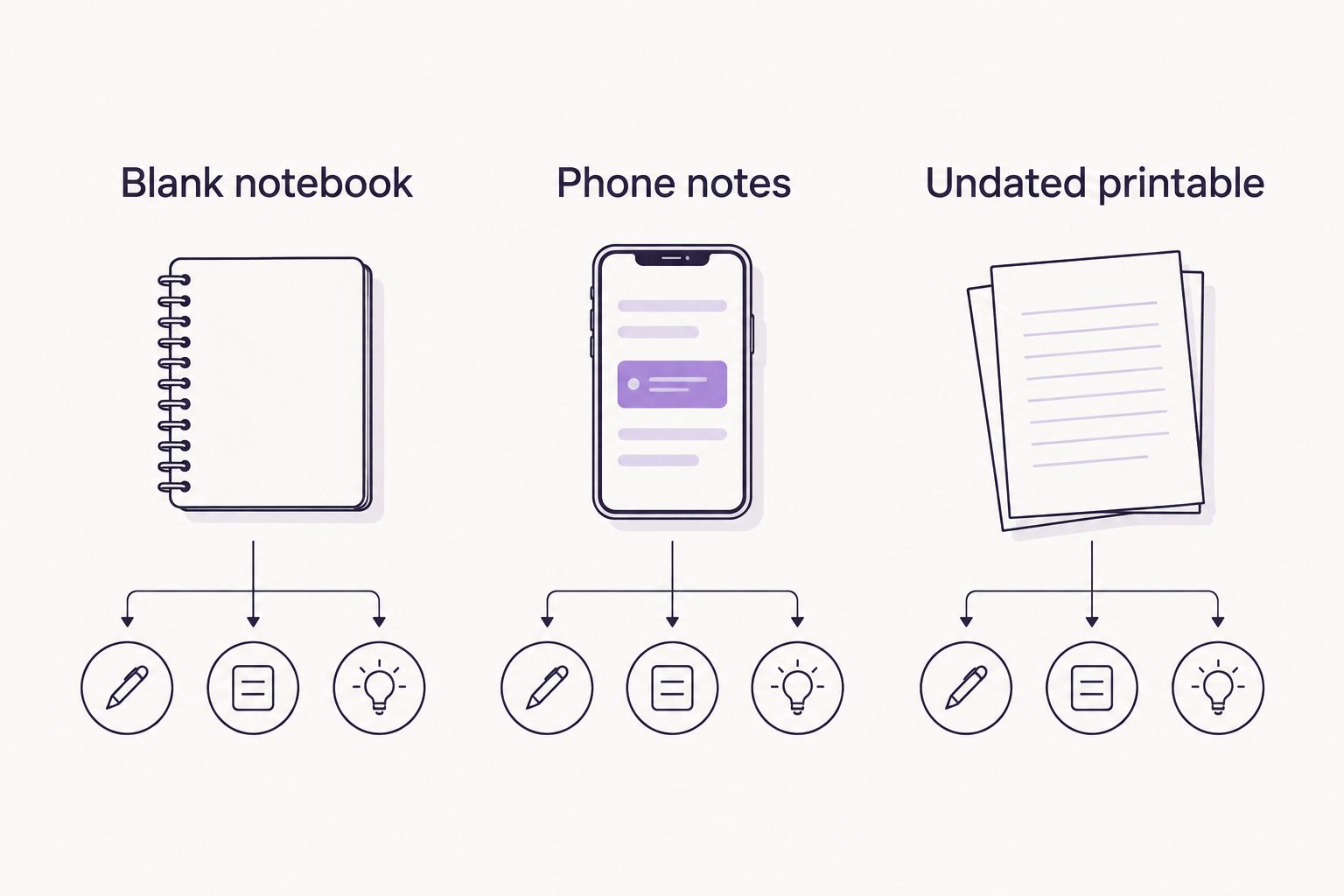
Choose by the amount of structure you want, not by how ambitious the sample page looks. These are format options for your 2026 setup, not rankings of named products. Each gives you something useful and asks something of you in return.
| Option | Best for | What it offers | Key limitation |
|---|---|---|---|
| Blank notebook | Nurses who want open reflection space | You choose the questions, layout, and amount of writing | You create any weekly structure yourself |
| Phone notes | Nurses who prefer brief notes without carrying paper | A place for short reflections and flexible lists | Notes share space with other phone activity |
| Undated printable | Nurses who want a reusable planning structure | You can select a layout and add dates when you use it | Printing and keeping pages together take effort |
The simplest distinction is this: choose a blank notebook when freedom matters most, phone notes when carrying less matters most, or an undated printable when you want an existing structure. None requires a daily streak.
If you choose something from The Sheema Edit's journal and planner shop, check its description and preview against those same needs. A reflection page and a scheduling page do different jobs; you don't have to make either one do everything.
Common planning traps to skip
These aren't character flaws. They're ways a well meant tool can become one more thing to manage.
Treating an off day as an empty day
A day without a scheduled shift isn't necessarily available for errands, family plans, and every postponed task. Decide what belongs there before other commitments fill the space. You can leave part of a day unassigned without giving it a more impressive name.
Building the page around an imaginary routine
If your work pattern changes, a fixed morning checklist might not fit. Use flexible labels such as “after waking” or “before work” only if they're helpful. You don't need to imitate a routine designed for someone else's hours.
Mixing a private reflection with a work record
A personal journal is not the place to document patient care. Keep reflections about your own experience free of identifying information. When something needs workplace documentation or reporting, use the appropriate process rather than treating journaling as the next step.
Turning self care into another score
An empty box doesn't measure how well you cared for yourself. If tracking creates pressure, remove the tracker. A sentence about what you need can be more useful than a page of completed squares, and a blank page is allowed too.
FAQ
What's the best self care planner for nurses with changing shifts?
The best fit is a flexible layout that lets you record changing shifts without requiring daily entries. Look for enough space to show shifts that cross dates and room for personal needs beside work commitments.
Should nurses choose an undated planner?
An undated planner suits nurses who want to use pages as needed without unused dated sections. You add the dates yourself, so check whether that feels freeing or like extra setup.
How do I use a self care planner when I'm also a mom?
Put fixed work and family commitments on the page before adding optional tasks. Then leave room for something you need, without turning that need into another responsibility to complete.
Do I need to write in my planner every day?
No, a personal planner doesn't require daily writing. Use it when you want somewhere to think, plan, or make a request clearer, and return without filling in missed days.
Can I write about a difficult shift in my personal journal?
Keep personal journaling focused on your own feelings and needs, without patient information or identifying details. Follow workplace privacy rules and use approved processes for documentation and reporting.
Is a printable planner better than a notebook?
A printable is better when you want an existing layout; a notebook is better when you want to create your own. The printable requires printing and page storage, while the notebook asks you to make any structure you need.
Can a self care planner fix work stress?
A planner cannot fix working conditions or replace support. It can give you a place to name what you need, organize a personal commitment, or prepare a conversation about boundaries.
One last thing
Before you choose a new layout for 2026, try removing a section from the one you already use. Not adding a better habit. Not finding a more disciplined version of yourself. Just taking away a box that keeps asking for an answer you don't need to give.
A useful page has room for your life. That includes the parts you haven't figured out how to organize.
Related guides
- Choosing an undated weekly planner
- Self reflection journal prompts for boundaries
- An undated weekly planner for working moms
With Love, Sheema.