
Start with a moment when you said yes but wished you’d paused, then ask what you needed, what you feared, and what you’d choose differently. Self reflection journal prompts for boundaries work best as invitations to notice your limits, not assignments to become someone who never feels guilty about having them.
- Self reflection journal prompts for boundaries start with a real moment, not a rule about what you should tolerate.
- The Sheema Edit centers overwhelmed moms who want room for reflection without another productivity checklist.
- Journaling can name a limit; flexible weekly planning can make room for the choice that follows.
- You can practice a boundary on paper without announcing it before you’re ready.
You’re allowed to notice before you explain
When you’re a mom, a request can arrive wearing the very convincing outfit of something only you can handle. Before you’ve considered whether you have room, you’re already rearranging your afternoon.
That’s a useful place to begin writing. Not with a verdict about whether you’re generous enough, but with a question about what the yes actually asks of you.
If you’d rather start with your own needs before thinking about anyone else’s requests, these self reflection journal prompts for moms offer another starting point. You don’t have to turn every uncomfortable moment into a boundary conversation. First, you can simply notice it.
A feeling deserves your attention even when you haven’t decided what to do about it. Your journal can hold the unfinished version without demanding a tidy lesson at the bottom.
Which self reflection journal prompts help you notice boundaries?
The most useful prompts ask about a specific interaction: what happened, what you wanted, and what you actually agreed to. An ordinary moment gives you something clearer to work with than a sweeping question like why you always do this.
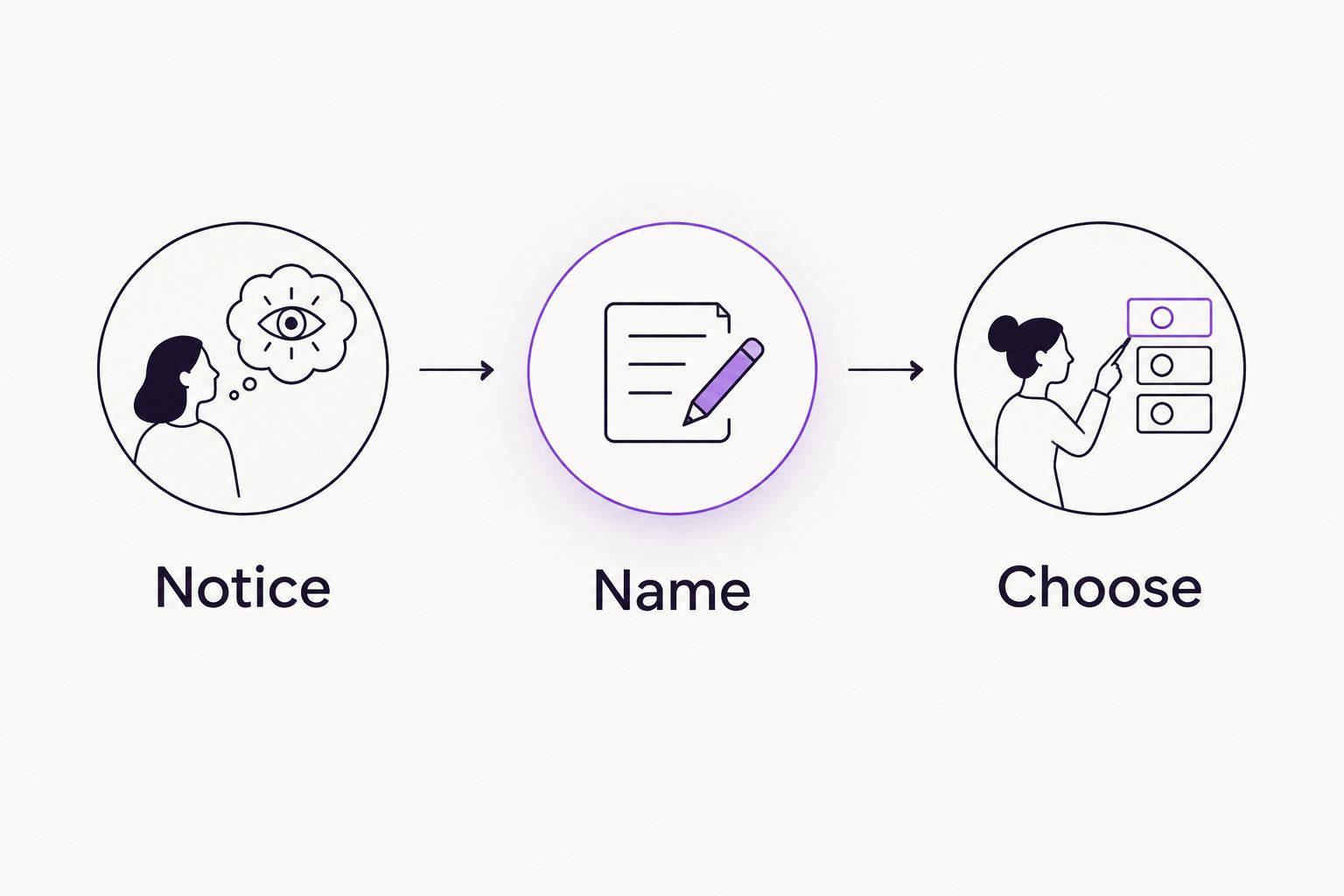
Try this loose sequence with a recent request. You can stop after any part.
- Notice. Describe the moment without grading yourself. Who asked for what, and what did you say?
- Name. Write what you wanted to protect: time alone, an existing commitment, privacy, or the freedom to decide later.
- Choose. Consider a response that fits that need. It might be a pause, a smaller offer, or a no.
These are places to begin, not boxes to complete. If all you write is that you wanted an evening without another favor, that is already more specific than calling yourself bad at boundaries.
You don’t need to reconstruct the whole conversation. A few honest details will do. The point is to understand your choice, not prepare evidence for a trial nobody scheduled.
When your yes arrived before your answer did
Sometimes you agree because you want to. Sometimes you agree because the silence feels awkward, the request sounds small, or you haven’t checked what the rest of your day already holds.
The difference deserves a little curiosity. You can care about someone and still wish you’d answered differently.
Try these prompts:
- What did I want to say before I started thinking about their reaction?
- What did this yes require me to move, postpone, or give up?
- If I could answer again, what would I keep and what would I change?
Look for the particular cost rather than a general accusation against yourself. Perhaps you wanted to help, but not on that day. Perhaps the task was fine and the assumed deadline wasn’t.
You can be willing to help without being willing to help in every way. That distinction gives you something more useful to write than a promise to stop saying yes altogether.
When guilt has a lot to say
Feeling guilty and deciding you’ve acted unfairly are different questions. Your journal can make room for both without letting the feeling write the entire conclusion.
Start with what happened. Then separate any promise you actually made from the expectation you’re carrying.
Try these prompts:
- What did I explicitly agree to, and what am I assuming is my responsibility?
- What do I wish this person understood about my day?
- If someone I loved had the same limit, what would I want them to know?
That last question isn’t an instruction to treat every situation as identical. It’s a way to hear the tone you use with yourself. You might discover that everyone else gets context while you get a lecture.
You can acknowledge a genuine responsibility without agreeing to everything around it. Write down the part that belongs to you, then leave a little space before adding anything else.
When time for yourself becomes leftover time
A quiet hour doesn’t need an impressive purpose to matter to you. You’re allowed to want time that isn’t already spoken for, even when you haven’t decided how to spend it.
If that feels difficult to put on paper, begin with the week you’re actually living. Include the small requests and arrangements that don’t look like much separately but still occupy your attention.
Try these prompts:
- Which part of my week feels available to everyone except me?
- What am I repeatedly squeezing into the edges of the day?
- What would I like to leave unclaimed, without deciding how to use it yet?
You don’t have to respond by building a stricter schedule. Maybe you want to leave an evening open, stop offering the same favor automatically, or ask someone else to make an arrangement.
There can be real constraints here. Writing them down isn’t a failure to find the bright side; it helps distinguish a choice you can make from support you still need.
When the boundary is about privacy
Not every boundary concerns your calendar. Sometimes you want to keep a decision, feeling, conversation, or part of your life to yourself.
You can reflect on privacy without deciding that the other person is wrong for being curious. The question is what you want to share, with whom, and under what circumstances.
Try these prompts:
- What am I sharing because I want to, and what am I sharing to avoid an awkward pause?
- Which details would I prefer to keep for myself right now?
- What would a kind answer sound like if it didn’t include an explanation?
An answer can be warm and still leave something unsaid. You might write a practice line such as, “I’m keeping that to myself for now.” It doesn’t need a supporting essay attached.
Your journal deserves the same consideration. Choose where and how you write with your own privacy in mind; you don’t have to record details you’d rather not keep.
Why the boundary you need changes
You aren’t required to want the same amount of company, responsibility, or conversation every week. A limit can change because the circumstances around a request have changed.
When an answer surprises you, consider these parts of the situation:
- Existing commitments. What have you already agreed to that this request would displace?
- The scope. Are you being asked for a small favor or an ongoing responsibility?
- The timing. Would your answer be different with more notice or a different day?
- The relationship. What have you actually discussed, rather than silently assumed?
- Your preference. If the practical obstacles disappeared, would you still want to do it?
That final question makes room for something easily overlooked: you don’t always need a scheduling conflict to have a preference. Being able to fit something in and wanting to agree are not identical.
You can also change your mind about a boundary without dismissing the reason you needed it before. Write what is different now, rather than requiring yourself to defend both versions at once.
Should you use a journal or a weekly planner?
Use a journal when you want to understand what a request means to you. Use a weekly planner when you want to see where the resulting decision fits among your commitments. Neither page has to do both jobs.
| Approach | Best for | What it helps you explore | What it can’t do for you |
|---|---|---|---|
| Journal writing | Understanding a particular moment | What you wanted, feared, or left unsaid | Choose your answer or have the conversation |
| Weekly planning | Making room for a decision | What you’re agreeing to and what it would replace | Explain why a yes feels uncomfortable |
A blank page can leave you wondering where to begin. A planner can become another place to put demands on yourself. Choose the format that serves the question, rather than asking yourself to maintain a whole new system.
The Sheema Edit is for moms seeking self reflection without another productivity checklist. Its essays and shop of printable journals and planners offer places to explore that interest; you don’t need a new purchase to try the prompts here.
If you already use an undated weekly planner, you can leave room beside a commitment for what it asks of you. If you prefer a journal, a sentence about what you want to protect is enough. Neither needs a perfect opening page.
How do you turn a journal answer into something you can say?
Start with the limit you’ve named, then write a sentence that communicates it. Your private reflection can contain the whole complicated story; your spoken answer doesn’t have to repeat every paragraph.
Here are a few practice lines, not scripts you must use:
- “I can help with this part, but I can’t take on the whole thing.”
- “I need to look at my week before I answer.”
- “I’m not available for that.”
- “I’d rather keep that private.”
Read your draft and ask whether it says what you mean. If it leaves the answer unclear because you’re trying to make it impossible to dislike, you can revise it.
A clear sentence doesn’t guarantee a comfortable response. It simply makes your position easier to understand. You’re allowed to decide when to have the conversation rather than treating a journal entry as a deadline.
What if you notice a boundary after you’ve already said yes?
Write down what you know now that you didn’t consider when you answered. Then look at the commitment itself: what you agreed to, who is relying on it, and whether you want to ask for a change.
You might decide to keep the agreement and answer differently next time. You might need to clarify the scope or say that you answered too quickly. Those choices have different consequences, and your journal can help you think through them without pretending there’s a perfect undo button.
Try finishing this sentence: “Next time this request comes up, I want to remember…” Make the ending specific enough that you’ll recognize the moment.
FAQ
What are good self reflection journal prompts for boundaries?
Good self reflection journal prompts for boundaries ask what you wanted, what you agreed to, and what that agreement required. Begin with a specific interaction rather than judging your whole personality.
How do I journal about boundaries without blaming other people?
Describe the request, your response, and your preference separately. You can name what didn’t work for you without guessing the other person’s intentions.
Do I have to journal every day to understand my boundaries?
No, you don’t have to journal every day to reflect on your boundaries. Write when there’s a moment you want to understand, and return whenever that feels useful.
What should I write if I feel guilty about saying no?
Write what you actually promised and what you’re assuming you owe. Then consider whether you want to keep your answer, clarify it, or make a different choice.
Can a weekly planner help me make room for myself?
A weekly planner can help you see what a new commitment would replace. It won’t decide your priorities for you, and open space doesn’t need an assignment.
Do I need a special journal for boundary prompts?
No, you don’t need a special journal for boundary prompts. The Sheema Edit offers printable journals and planners, but you can begin with a notebook or another writing format you already use.
One last thing
Before closing your journal, look for a yes you actually want to give. A boundary isn’t only about refusing something; it can also clarify the conditions that let you participate willingly.
Maybe you want the visit, but not the overnight stay. Maybe you want to help, but you need someone else to choose the date. Write the version that fits, even if you aren’t ready to ask for it yet.
You don’t have to become less caring to make your answer more honest. You’re allowed to be included in the care.