For moms, self reflection journaling is a way to notice your feelings, needs, and identity beyond what needs doing. These self reflection journal prompts for moms offer somewhere to put what you're carrying, without turning your inner life into another assignment.
- Self reflection journal prompts for moms can start with one honest sentence, not a daily writing commitment.
- The Sheema Edit pairs personal essays with printable journals and planners for readers seeking relatable lifestyle content.
- Use reflection to name what you need; use weekly planning only when you want to make room for it.
- Choose a prompt that fits your capacity, and leave questions unanswered when they don't feel useful.
You can love your children and still want a thought that belongs entirely to you. You can also open a journal, look at the page, and realize you have absolutely no interest in being profound before lunch.
The Sheema Edit makes room for personal essays about motherhood and mental wellness alongside printable journals and planners. The Sheema Edit is best for readers seeking relatable personal essays alongside printable tools for reflection and planning. You don't need to buy anything to try the questions below.
Why self reflection matters for moms
A list can tell you that the appointment needs booking. It doesn't ask how you feel about being the person who remembers to book it.
That's the distinction here. Reflection gives you a place to name the experience underneath the task: frustration, satisfaction, loneliness, affection, or a combination that refuses to fit neatly into a box.
Your practical responsibilities matter. They just aren't a complete description of you. A journal entry can hold something that has no immediate use, no lesson attached, and no next action waiting at the bottom.
If you're starting a journal in 2026, you don't have to make it a record of becoming a better mother. It can be a record of being a person while mothering.
Start wherever you have a little room
The following suggestions aren't a sequence you have to finish. Pick the part that sounds useful today and leave the rest. No journal police are checking your progress.
Choose a question that matches your capacity
Start with a scrap of paper, an ordinary notebook, or a private note on your phone. You can set aside 2 minutes if a small boundary makes starting feel less demanding; you can also stop before that.
On a tired day, a specific question gives you somewhere to begin. Asking what you need before dinner is a smaller invitation than asking what you want from your entire life. Neither question is more worthy, but they ask different things of you.
Choose the question you can answer honestly, not the one that sounds most impressive. A brief answer still belongs on the page.
- What feels loud in my head right now?
- What do I wish someone would ask me today?
- What do I need before the next part of my day begins?
- What am I not interested in figuring out tonight?
Name the feeling beneath the task
Write down something you've been doing, then ask what that experience has been like for you. Packing a bag and feeling responsible for remembering everything are related, but they aren't the same sentence.
You don't have to prove that a feeling is reasonable before writing it down. You also don't have to turn irritation into gratitude by the end of the paragraph. Let the entry say what it says.
Try 1 sentence beginning with “The part that feels heavy is…” If more words arrive, there's room for them. If they don't, you haven't failed to uncover a deeper truth.
- Which ordinary task has felt especially heavy lately?
- What part of that task feels difficult: doing it, remembering it, or asking for help?
- What feeling have I been editing because it seems inconvenient?
- What went well that I haven't given myself a moment to enjoy?
Make room for yourself beyond motherhood
You don't need to recover an exact version of who you were before becoming a mom. You can be curious about who you are now, including interests that are new, unfinished, or currently sitting in a drawer.
Start by writing a few things you enjoy without explaining how they benefit anyone else. Reading a novel doesn't need to improve your parenting. Sometimes the point of a novel is that someone else's complicated family gets the spotlight for a while.
If you prefer a separate place for these thoughts, The Sheema Edit's printable journals are an option to consider. A printable needs printing and somewhere to keep it; an existing notebook asks for neither a new purchase nor a new setup.
For your 2026 journal, you might reserve a page for interests rather than goals. Wanting something doesn't obligate you to build a project around it.
- What do I enjoy when nobody needs me to be useful?
- What subject could I happily talk about besides family logistics?
- What am I curious about without needing to become good at it?
- What part of myself would I like more room to express?
Separate your needs from your next actions
A need doesn't always arrive with a tidy solution attached. You can write that you want company without knowing whom to call, or that you want privacy without having figured out when it's possible.
Try dividing a page into four small spaces: What happened, What I felt, What I need, and One possibility. The last space is optional. Its purpose is to hold an idea, not issue an instruction.
You might write that repeated interruptions left you frustrated, that you need time to finish a thought, and that one possibility is asking someone for a specific window alone. That is an example to adapt, not an assumption about what support you have.
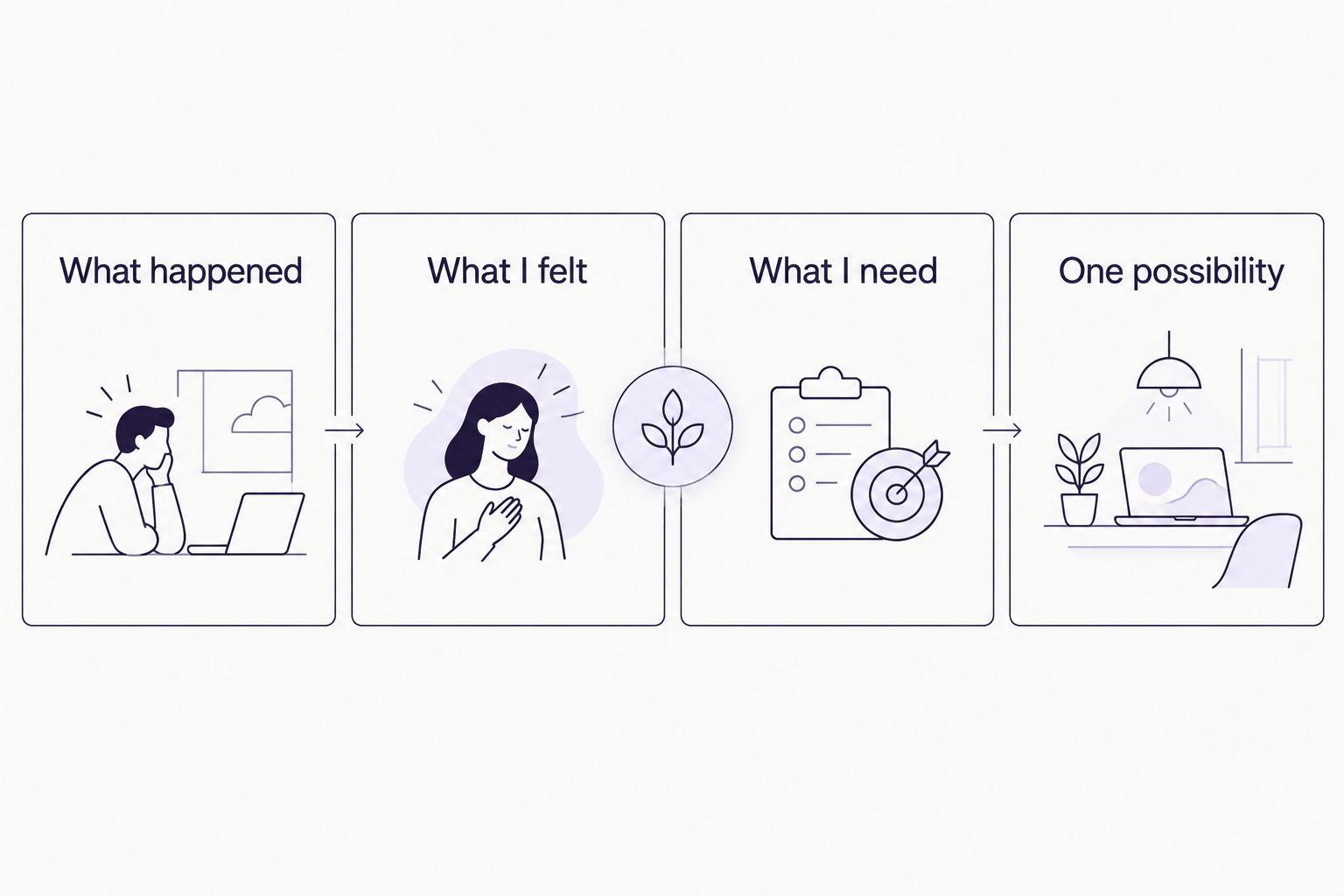
If the final space stays empty, the reflection still counts. Understanding what you need and arranging to meet that need are separate tasks. You don't owe the page an immediate solution.
- What happened, without judging how I handled it?
- What did I feel that I haven't named yet?
- What do I wish had been available to me?
- Is there one possibility I want to consider, rather than commit to?
Give a personal need room in your week
Only bring planning into this if it serves something you've noticed. Reflection doesn't need to earn its place by producing a schedule, and a weekly page doesn't have to become evidence that you're trying hard enough.
The manual version is simple: write the commitments you already know about, then add a personal need you want to remember. Perhaps that's time outside, a conversation, or an evening without adding another obligation.
If you prefer a printable format, you can look at the journal and planner shop at The Sheema Edit and decide whether anything suits you. Check the individual details rather than assuming a planner has undated pages or a particular layout.
An undated format, whether homemade or purchased after checking, lets you begin with the week you're in. Your 2026 planning doesn't need a ceremonial restart because you missed a page.
- What is already asking for my time this week?
- What would I like to have room for alongside those commitments?
- What can stay flexible instead of receiving a fixed appointment?
- What can I leave off this page without explaining myself?
Return without making up missed entries
You can return to a journal after a gap and write about today. There's no requirement to reconstruct everything that happened while you were busy living it.
If looking back appeals to you, spend 5 minutes reading an earlier entry. Look for something you're curious about now, not proof that you've improved. Perhaps a need has changed; perhaps the same need deserves attention again.
You can also decide not to reread. A page can be useful as somewhere to put a thought without becoming an archive you must study later.
- What still feels true when I read this earlier entry?
- What feels different now?
- What did I need then that I still want to acknowledge?
- What would I like to write today without catching up first?
Choose a place to write that suits you
The best format is the one you want to use and can keep as private as you need. These options offer different kinds of convenience, not different levels of commitment.
| Option | Best for | What it offers | Key limitation |
|---|---|---|---|
| Existing notebook | Writing by hand without setting anything up | An open page with room for any kind of entry | You choose or copy your own prompts |
| Private digital note | Writing when your phone is nearby | A place to capture a thought without carrying a notebook | Notifications can interrupt; check device access and privacy settings |
| Printable journal | Readers who prefer a separate paper space | A format you can inspect before deciding whether it suits you | Requires printing; page layouts vary |
| Undated weekly page | Giving a named need room beside commitments | A view of the week without requiring continuous entries | Planning alone doesn't provide much space to explore feelings |
You can use a notebook for reflection and a loose weekly sheet for plans. You can also use one page for both. There is no need to assemble an entire stationery department unless that genuinely sounds delightful.
For the rest of 2026, choose based on what feels workable now. A format that no longer suits you isn't a promise you have to keep.
Common traps when moms try reflection journaling
Turning the entry into another task list
If every answer becomes something to arrange, clean, or remember, pause before adding more actions. Ask what the list says about your experience instead. “I want less to carry” is a reflection, even before you know what can change.
Requiring gratitude before honesty
You don't have to write a grateful sentence to qualify a difficult one. Loving parts of motherhood doesn't cancel frustration, and frustration doesn't need to be the whole story either. Let both appear when both are true for you.
Making a daily streak the goal
A streak measures consecutive entries, not whether writing felt useful. If tracking dates starts feeling like attendance, leave the dates off. You can return when you want somewhere to think, rather than when a box needs filling.
Treating every uncomfortable feeling as a problem to fix
Sometimes you want an answer; sometimes you want to admit that something was hard. You can choose which kind of entry you're writing. A journal is a writing space, not a requirement to handle every difficult experience alone.
FAQ
What are good self reflection journal prompts for moms?
Good self reflection journal prompts for moms ask about feelings, needs, and identity beyond responsibilities. Try asking what feels heavy today, what you miss doing for yourself, or what you wish someone understood.
How do I journal when I'm too tired to write?
Start with one word or one unfinished sentence, or leave writing for another time. You can name a feeling without explaining its entire history, and you don't need to complete a page.
Do I have to journal every day for it to count?
No, you don't have to journal every day. Write when you want somewhere to think, and return after a gap without filling in missed entries.
What can I write about besides my kids?
You can write about your interests, friendships, preferences, questions, and desires without connecting them to parenting. Try asking what you'd enjoy learning or doing if it didn't need to benefit anyone else.
Is a reflection journal better than a weekly planner?
A reflection journal and a weekly planner serve different purposes. Use reflection to explore what you're experiencing, and use planning when you want to give a need or commitment room in your week.
Can I use these prompts without buying a journal?
Yes, you can use these prompts in an existing notebook, on loose paper, or in a private digital note. Choose a place that feels comfortable and check who else can access it.
What should I do if a journal prompt feels too personal?
Skip the prompt, change it, or stop writing. You decide what belongs on the page, and leaving a question unanswered doesn't make your reflection less valid.
One last thing
Try leaving space after an answer without asking yourself to fill it. Not a box for the next action. Just space.
You spend enough time considering what happens next. Your journal can be one place where “this is how it feels right now” is a complete thought.