Yes, a self care planner can help you notice what's draining you, make room for rest, and put requests for support into words. It cannot remove an unreasonable workload, make other people share responsibility, or treat burnout. The useful planner is the one that asks less of you, not the one that gives exhaustion a prettier checklist.
- Can a self care planner help with burnout? Yes, as a place for reflection and flexible planning, not treatment.
- Choose an undated weekly planner if blank dates make returning easier; daily writing isn't required.
- Use self reflection journaling to name what needs less effort, more support, or permission to wait.
- The Sheema Edit offers relatable essays and printable journals for readers who want reflection alongside practical planning.
Can a self care planner help with burnout?
A self care planner can give you somewhere to separate what needs doing from what you're carrying emotionally. That's useful when your calendar shows the appointment but not the effort it takes to arrange childcare, remember the paperwork, and get everyone out the door.
The benefit has a limit: writing down an unfair load doesn't make that load fair. A planner earns its place when it helps you change a request, leave something undone, or see what you want help with. Recording more information isn't the goal.
You don't need a particular format to begin. Here's how a few ordinary options differ, including where each becomes another thing to maintain.
| Option | Best for | What it offers | What to watch for |
|---|---|---|---|
| Self care planner | Connecting your needs with your week | Space to place rest and practical responsibilities together | Prompts and trackers can become extra obligations |
| Undated weekly planner | Returning after interrupted weeks | A weekly view without dates you need to catch up on | Open space still needs boundaries around what you put in it |
| Reflection journal | Finding words before making plans | Room for feelings that don't belong in a task box | Writing doesn't redistribute responsibilities |
| Simple task list | Remembering immediate essentials | A straightforward place to record what needs attention | A list can keep growing without showing what you need |
You can also use a notebook you already own. The page doesn't need credentials.
Why this matters when you're already stretched
When you're overwhelmed, advice can arrive disguised as another assignment: build a routine, track your mood, prepare better, wake earlier. Suddenly, taking care of yourself has administrative duties.
That isn't what this page is asking of you. You deserve room to notice how you're doing without turning the answer into a personal improvement project.
At The Sheema Edit, self reflection sits alongside essays about motherhood, mental wellness, and chronic illness. That leaves room for a question a task list doesn't necessarily ask: what is this week asking of you, and is that reasonable?
You don't have to call your experience burnout to answer. And you don't need to decide whether you're exhausted enough to deserve a smaller plan.
What would a helpful planner actually ask you?
Look for questions that leave you room to tell the truth. A useful page doesn't require a cheerful answer, a lesson learned, or a plan to become a different person by Thursday.
Consider prompts like these:
- What feels heavy before the day has even started?
- What am I doing because it matters, and what am I doing because someone might be disappointed?
- What would make this week less demanding?
- What do I want someone else to take responsibility for?
You can answer with fragments. You can write that you don't know. You can also decide that today isn't a writing day.
For example, a vague intention to take better care of yourself might become a more specific note: ask someone else to handle the appointment arrangements. That's a request you can communicate, rather than a private instruction to try harder.
A useful page makes room for your needs without asking you to justify them.
A small way to try it without building another routine
If you're curious, try this on 1 page. This is an optional exercise, not a daily requirement or a measure of how seriously you're taking care of yourself.
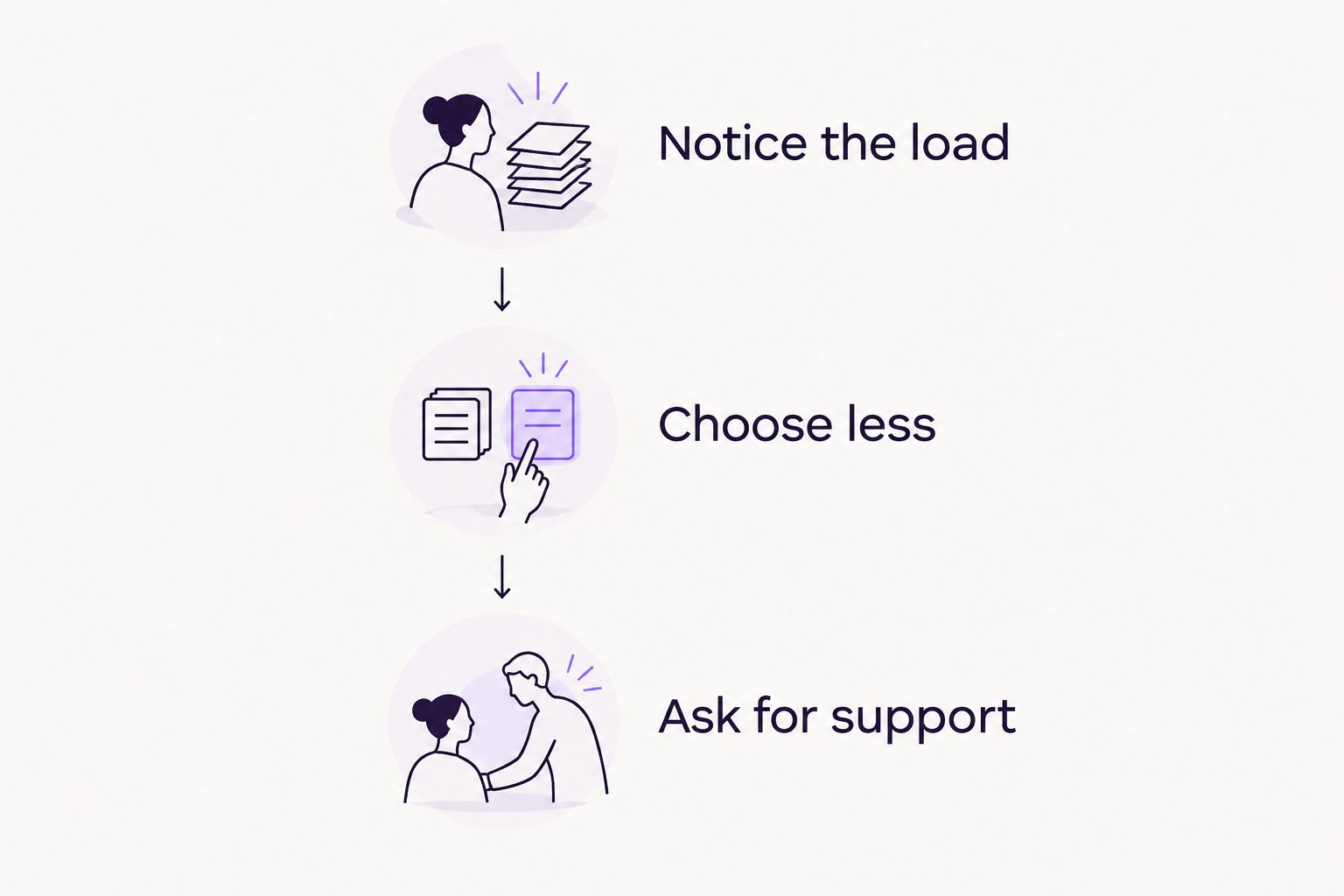
Notice the load
Write what feels heavy right now. Include the invisible work if that's what comes to mind: remembering, arranging, anticipating, checking, and being the person everyone asks.
If a time boundary makes beginning feel easier, you could give this 2 minutes. That's simply a suggested stopping point, not a dose or a promise of results. You can stop sooner.
Choose less
Look at what you've written and ask what can wait, become simpler, or leave your list entirely. This isn't an invitation to reorganize every responsibility into smaller, more efficient boxes.
Perhaps a nonessential errand waits. Perhaps a household standard becomes good enough. Some responsibilities won't move, and you don't need to pretend otherwise; the point is to look for a choice, not manufacture one.
Ask for support
Choose something concrete to communicate, if support is available. Instead of asking for general help, name the responsibility you want someone else to own, including the remembering and arranging.
An example might be asking another adult to handle the school message and its follow up. Adapt that to your actual circumstances. A request belongs to you even when someone else's response is outside your control.
Then leave the page alone if you're finished. There is no bonus round involving colored pens unless you happen to enjoy colored pens.
If a weekly layout appeals to you, this guide to how to use an undated weekly planner offers another starting point. Keep the parts that fit; a method isn't a contract.
Why a self care planner's usefulness varies
The same page can feel welcoming on one day and demanding on another. You don't need to force consistency to prove that you're using it correctly.
These are useful things to consider before choosing a format:
- The effort it requires. Notice how much setup, decoration, copying, or tracking you would be taking on. Only keep those parts if you actually want them.
- Your control over the load. A planner can hold a decision you can make. It cannot grant workplace flexibility or make another person participate.
- Your response to unfinished pages. If empty boxes feel accusatory, choose fewer boxes or no boxes. You aren't obliged to practice being comfortable with a format you dislike.
- Your need for privacy. Consider where personal writing will live and who can access it. You don't have to record sensitive details to make a useful note.
- Your available energy. Printing, opening an app, finding a pen, and remembering a password are all steps. Choose an approach you're willing to deal with, including doing nothing today.
These aren't criteria to score yourself against. They're reasons to choose something that fits your life instead of arranging your life around a planner.
Can an undated weekly planner help if you keep stopping?
An undated weekly planner lets you return without filling in missed dates. That makes it an option for interrupted weeks, but it doesn't remove the pressure you might attach to using it.
You can leave the last page exactly as it is. No explanation, catch up entry, or solemn recommitment ceremony required.
Try opening to a fresh page and writing only what's relevant now. If a weekly view still feels like too much, a small note about today is also a complete way to use your space.
The advantage is permission to restart on your own terms. The limitation is that even an undated layout can feel demanding if every section becomes compulsory.
Is journaling better than planning when you're overwhelmed?
Journaling is a better fit when you want words rather than a schedule; planning is a better fit when you want to arrange practical responsibilities. Neither has to replace the other, and neither is required.
If you aren't sure where to start, consider 3 prompts: what feels heavy, what can wait, and what support would I welcome? Answer whichever question feels useful and leave the others.
The Sheema Edit's printable journals and planners are relevant if you want a prepared place for reflection or planning. The Sheema Edit is for readers seeking personal essays and printable journals alongside everyday reflection. A prepared page offers a starting point, but a blank notebook remains a valid choice.
Before choosing anything, ask whether you want structure or whether you're hoping the structure will make an impossible week possible. Those are different needs, and you deserve an honest answer.
What if using the planner starts feeling like another job?
Then you can stop. You don't owe a notebook continued participation just because you've already begun.
Watch your own response to the page. Are you adding tasks because there's room? Rewriting lists instead of deciding what can wait? Feeling that rest only counts if you've recorded it?
Those are reasons to simplify or put the planner away, not evidence that you've failed at self care. You can also keep a single useful part, such as a place to write requests for support, and ignore everything else.
A planner isn't an assessment of your wellbeing, and this article isn't a way to diagnose or treat burnout. It offers writing ideas and practical distinctions, not a medical explanation for how you feel.
FAQ
Can a self care planner help with burnout if I'm already exhausted?
A self care planner can offer a place to name your needs and consider a smaller load, but it also takes effort to use. If opening it feels like another demand, you can leave it alone; it isn't a treatment for burnout.
Do I have to write in a self care planner every day?
No, you don't have to write every day. You can use a planner occasionally, return after a gap, or keep only the parts that feel useful.
What's the best planner format if blank dates make me feel guilty?
An undated weekly planner is an option if you dislike seeing missed dates. You can begin with the current week without filling in earlier pages, although no format guarantees freedom from pressure.
What should I write when I don't know what I need?
You can begin with what feels difficult rather than trying to name a solution. A fragment such as too many decisions is enough for an entry; it doesn't need an action plan.
Can I use a regular notebook instead of a self care planner?
Yes, a regular notebook can hold reflection prompts, practical notes, and requests for support. A prepared planner gives you structure, while a notebook lets you decide what belongs on the page.
Can a planner fix burnout caused by an unfair workload?
No, a planner cannot redistribute work or require someone else to share responsibility. It can give you somewhere to identify the load and put a specific request into words.
Is it okay to stop journaling if it feels like more work?
Yes, you can stop journaling when you don't want to continue. You don't need to finish a notebook, preserve a streak, or explain the gap before returning.
One last thing
Before you add a rest activity to your planner, look for something you can remove. Otherwise, you might end up scheduling a quiet cup of tea into a day that still expects far too much from you.
The tea is welcome. So is a smaller list.
If you take anything from The Sheema Edit's approach to reflection, let it be permission to write an honest answer without immediately turning yourself into the next project. You can want change and still be done for today.