Yes, a gratitude journal is worth it in 2026 if you want somewhere to notice good moments without pretending the difficult ones don't exist. It isn't worth turning into another obligation, and a page of gratitude doesn't replace the rest, practical help, or honest conversation you actually need.
- Is a gratitude journal worth it in 2026? Yes, when gratitude leaves room for honest feelings, not forced positivity.
- The Sheema Edit is for moms who want honest reflection, not another productivity assignment.
- Try a specific memory, a small comfort, or an acknowledgment of support. You don't need a daily streak.
- Choose gratitude journaling for noticing good moments; choose open reflection when you need room for the whole story.
Why this matters when everyone needs something from you
If you're an overwhelmed mom, even a lovely suggestion can arrive wearing the disguise of another job. Drink the water. Make the appointment. Appreciate your life. Apparently, having feelings now comes with administration.
Gratitude journaling doesn't have to join that list. You can use it as a place to record something you don't want to lose in the noise, rather than a place to prove you're handling everything gracefully.
If gratitude feels too narrow, these self reflection journal prompts for moms offer a different starting point. You're allowed to begin with what's true, not what's cheerful.
Is a gratitude journal worth it in 2026?
A gratitude journal is worth trying when noticing something good feels useful, not compulsory. Its purpose is small and specific: giving an appreciated moment somewhere to land. It doesn't need to explain your whole life or improve your mood on command.
The real decision is whether gratitude matches what you want from the page. Sometimes you want to remember a kindness. Sometimes you need to write that you're tired of being the person who remembers everything.
Neither entry is more deserving of space.
| Writing option | Best for | What it gives you room to do | The tradeoff |
|---|---|---|---|
| Gratitude journaling | Remembering something you appreciated | Describe a kindness, comfort, or welcome moment | A gratitude only prompt leaves less room for frustration |
| Open reflection | Saying what's actually on your mind | Write about mixed feelings without choosing a positive ending | A blank page gives you fewer starting cues |
| Weekly planning | Seeing what needs attention | Put commitments and practical needs somewhere visible | A schedule isn't the same as space to explore a feeling |
You don't have to choose a permanent identity here. Being a gratitude journal person is not a lifelong appointment. Use the kind of page that suits what you need to say today.
What makes a gratitude entry useful?
Specificity gives the entry something to hold. Instead of reaching for a sweeping statement about being grateful for your family, you could describe someone bringing you a drink without asking you to get up.
That doesn't make the smaller moment more important than your family. It simply makes the writing more concrete and less like something you're supposed to say.
A useful question is: Does this sentence sound like my actual experience, or like the acceptable answer? If it's the acceptable answer, you can leave it unwritten.
Gratitude journaling: best for keeping a small good moment
Choose gratitude journaling when something happened that you want to remember. It might be a conversation, a meal you enjoyed sitting down, or a quiet stretch when nobody needed an answer.
The strength of a focused gratitude prompt is that you don't have to decide what the entire entry should be about. You already have a place to begin: something you appreciated.
The limitation is that the prompt can feel too narrow when your day needs a fuller telling. You don't owe the page a pleasant conclusion just because gratitude appears at the top.
Try this optional prompt: What felt welcome today, even if the rest was complicated?
Open reflection: best for feelings that don't fit neatly
Choose open reflection when the grateful part isn't the part asking for attention. You can appreciate your child and still want uninterrupted time. You can love your home and still resent being responsible for its every moving piece.
The advantage is room. You don't have to organize those feelings into a lesson or make them sound especially wise.
The drawback is that an open page asks you to supply your own starting point. If that feels like too much, borrow this: What am I trying to talk myself out of feeling?
You can stop after answering. No closing argument required.
Weekly planning: best for naming what needs practical attention
Choose weekly planning when your main question is what needs to happen, what can wait, or where you need help. Reflection can name the frustration; planning can give a practical request somewhere to go.
A weekly page gives commitments a visible home. Its limitation is equally important: moving a task onto paper doesn't remove the work or supply the help.
For example, writing that you appreciated a quiet lunch is reflection. Making space for another quiet lunch belongs in planning, if that's something you want and can arrange.
Don't ask a gratitude journal to solve a scheduling problem. Appreciating a break and needing more breaks can both be true.
Why the value of a gratitude journal varies
The question isn't whether you're grateful enough to deserve one. It's whether this kind of writing fits your life and the purpose you have in mind.
- Your reason for writing. Remembering a kind moment is a different goal from working out why you're upset. Choose the page accordingly.
- The wording of the prompt. A question about something welcome gives you a different opening from an instruction to find the bright side.
- The room for mixed feelings. Decide whether you want gratitude alone or space to acknowledge what was difficult beside it.
- The effort involved. Finding a notebook, opening a file, or choosing a prompt is part of the experience. Keep the setup manageable for you.
- The expectation you attach to it. An occasional entry and an unbroken daily record are different commitments. You don't have to choose the latter.
For your own 2026 decision, judge the experience rather than the appearance of the notebook. A beautiful page is still the wrong page if you feel obliged to perform on it.
How to try gratitude journaling without adopting another routine
Treat this as an invitation, not a schedule. You can try it once, return later, or decide that another kind of writing suits you better.
Notice something
Choose something specific you appreciated. It doesn't need to be impressive, meaningful to anyone else, or evidence that everything is actually fine.
A warm drink counts as a subject. So does someone listening without immediately handing you advice.
Name the moment
Write 1 sentence about what happened and why you appreciated it. That sentence is an optional starting point, not a minimum requirement.
For example: I appreciated having lunch sitting down because I wanted a moment that didn't involve doing something else at the same time. This is an example, not a standard your entry needs to meet.
Leave room
If there's another truth beside the grateful one, let it stay. You might add: I still needed more help this afternoon.
You haven't spoiled the gratitude. You've declined to edit yourself out of the entry.
Stop there
Close the page when you've said what you wanted to say. You don't need to keep searching for enough good things to balance out everything difficult.
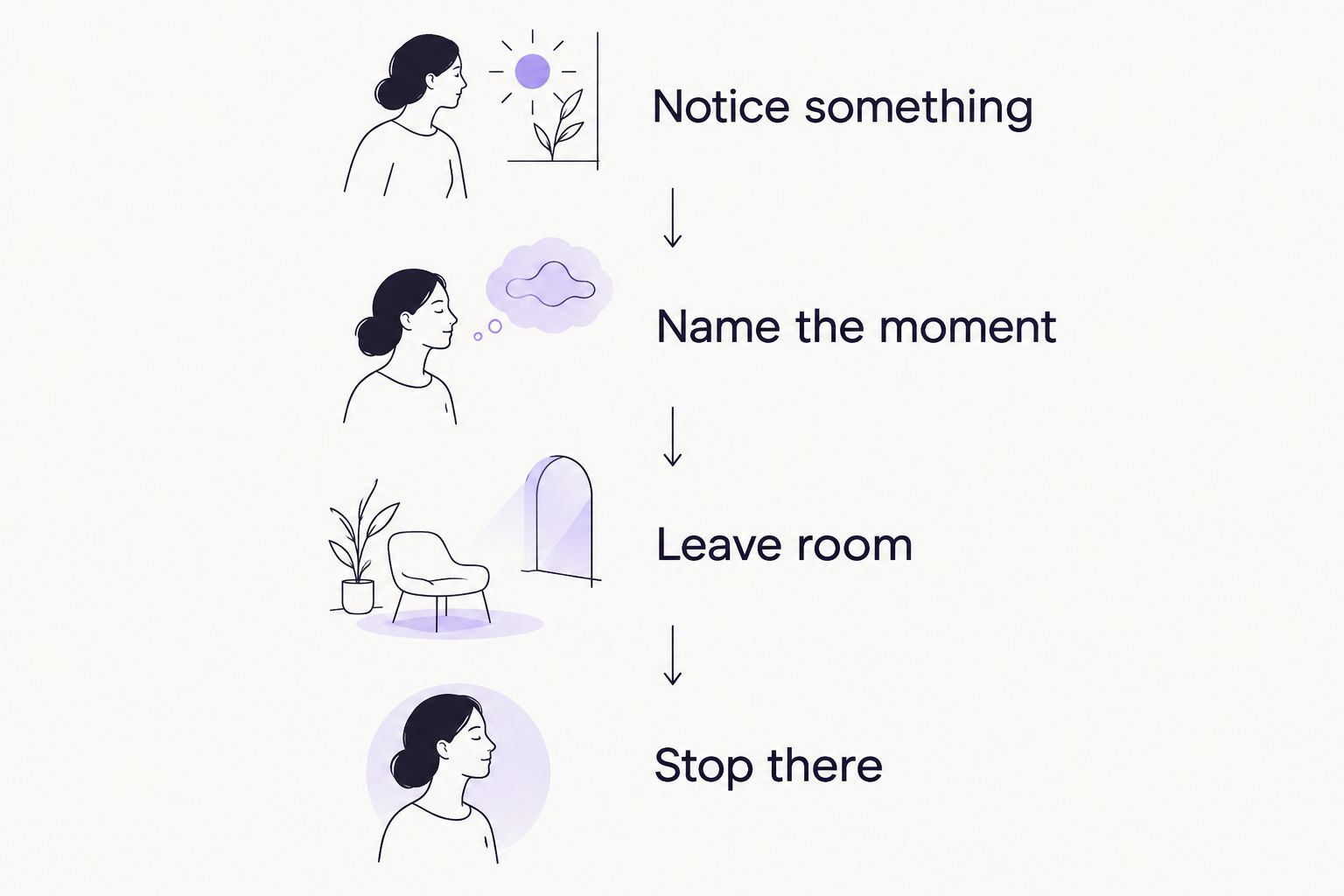
This approach asks for an observation, not a verdict on your life. You can appreciate what happened without claiming it made everything else okay.
What can you write when you don't feel especially grateful?
You don't have to manufacture a feeling to use a page. Start somewhere adjacent, or skip gratitude altogether and write what needs saying.
Here are 3 optional prompts for a day when the usual question feels like too much:
- What made something a little easier today?
- What did someone understand without making me explain it again?
- What would I like more room for?
The last question isn't strictly gratitude, and that's fine. Your journal isn't going to report you for changing the subject.
You can also write that nothing comes to mind. An honest blank is better than a sentence you don't believe. There is no requirement to finish an entry with a lesson.
How do you know whether the practice fits?
After you've tried writing, consider the experience itself. Did you get to say something real? Did the prompt give you a starting point, or did you spend the entry arguing with it?
Keep the parts you want to return to. Change the question if it keeps asking you for an answer you don't have.
If your main takeaway is that you need to say no more often, journal prompts for boundaries are a more direct place to explore that. You don't have to translate every need into appreciation first.
For 2026, a sensible measure of fit is whether you want to use the page again, not whether you can maintain a perfect record. Your unfinished notebook is not a character reference.
Do you need a dedicated gratitude journal?
No, you don't need a dedicated gratitude journal to try gratitude writing. A notebook you already have or a private document gives you somewhere to begin.
The Sheema Edit offers printable journals and planners for readers seeking space for reflection and planning. They are an option when you want a dedicated page, not a prerequisite for having something worth writing down.
Choose a format because you want to use it. A new notebook doesn't need to carry the additional responsibility of becoming a new personality.
Is gratitude journaling worth it if you don't write every day?
Yes, occasional gratitude writing can still serve the purpose of recording something you appreciate. You don't need entries for every day between the moments you want to remember.
Leave the gap alone. There is no emotional homework to catch up on before you're allowed to begin again.
Can you be grateful and still unhappy about something?
Yes, gratitude and dissatisfaction can appear in the same entry. Appreciating someone's kindness doesn't mean accepting an arrangement that leaves you overwhelmed.
A thank you and a request for change are different statements. You have room for both.
FAQ
Is a gratitude journal worth it in 2026 if I'm already overwhelmed?
A gratitude journal is worth trying in 2026 if it gives you somewhere to record something real without adding pressure. Skip it or change the prompt when it feels like another obligation.
What's the best gratitude journal for a busy mom?
The best fit is a journal you want to use without feeling obliged to fill it on a schedule. Start with the writing space you already have before deciding whether you want a dedicated format.
Do I have to list several things I'm grateful for?
No, you don't have to make a list. You can describe a single moment, write about mixed feelings, or leave the page for another day.
Is gratitude journaling better than regular journaling?
Neither is better for every purpose. Gratitude journaling focuses on something you appreciate, while open reflection leaves the subject and emotional direction up to you.
What if gratitude journaling makes me feel guilty?
You don't need to continue with a prompt that feels like a demand to be happier. Change the question, write honestly about the guilt, or put the journal aside.
Should I use a gratitude journal or a weekly planner?
Use a gratitude journal to record something you appreciate and a weekly planner to organize commitments or practical needs. Neither has to do the other's job.
Can I come back after leaving my journal untouched?
Yes, you can return without filling in the missing days. Begin with what you want to say now; the gap doesn't need an explanation.
One last thing
A gratitude entry doesn't have to be about something you received. You can also acknowledge something you chose: leaving a task unfinished, asking for help, or not explaining a reasonable boundary for the fifth time.
For 2026, try making room for appreciation without making yourself smaller. The Sheema Edit's invitation is honest reflection, not a better performance of being okay.
With Love, Sheema.