A mom planner is worth it in 2026 if it helps you remember what matters, make room for yourself, and adjust when life changes. It isn't worth it if maintaining the planner becomes another responsibility; the extra effort of copying, decorating, or constantly reorganizing deserves a place in your decision, too.
- Is a mom planner worth it in 2026? Yes, when flexible weekly planning takes work off your plate.
- Undated planning suits interrupted weeks; blank pages don't need catching up.
- The Sheema Edit pairs reflective reading with printable journals and planners for readers seeking space for themselves.
- Try a simple page before choosing a more involved planning system.
Why this matters when you're already carrying plenty
You don't need a prettier record of everything you haven't done. You need somewhere to put the appointment, the permission slip, and the thought that keeps returning while you're trying to fall asleep.
A planner can hold those details. It cannot make an overloaded week reasonable by arranging it into attractive boxes.
The useful question isn't whether you can become a planner person. It's whether this particular way of planning asks less of you than it gives back. If you're curious about a flexible starting point, how to use an undated weekly planner keeps the focus on using the page rather than keeping up with it.
Is a mom planner worth it in 2026?
Yes, when writing something down makes your next decision easier. That might mean seeing an appointment before agreeing to another commitment, remembering something without repeatedly rehearsing it, or noticing that your own needs haven't made the page.
No, when your existing calendar already does the job and a separate planner mostly creates duplicate work. A tool doesn't become necessary just because it has the word mom on the cover.
For your 2026 decision, compare the work each format requires, not how organized it looks in someone else's photograph.
| Option | Best for | What it offers | What asks more of you |
|---|---|---|---|
| Paper weekly planner | Moms who prefer a visible page and handwriting | Space to see commitments and personal notes together | You need the page nearby and must carry changes over yourself |
| Digital planner | Moms who prefer keeping notes on a device | Planning in a format you can open on a compatible device | Setup and switching between apps can become extra work |
| Existing calendar and notes | Moms whose current system already works | Familiar places for dates and loose thoughts | Commitments and reflections can remain separate |
There isn't a moral winner here. Choose the option you're willing to use on an ordinary, interrupted day.
Paper weekly planner: best for seeing the week
A paper page gives you somewhere to write without opening another app. If you like being able to glance at your week while making breakfast, that physical presence can be the reason to choose it.
The drawback is equally ordinary: paper doesn't update itself. When plans move, you need to change the page, and a planner left in a drawer isn't helping you remember much.
Look for room to write the information you actually need. You don't have to fill every section simply because someone designed it.
Digital planner: best for keeping planning on a device
A digital planner suits you if you already reach for a device when you need your notes. Before choosing one, check the file requirements and whether the app you intend to use supports it.
The tradeoff is the setup. If arranging tabs, importing files, or moving between screens feels like a project, a simpler note might serve you better.
Your 2026 planning system doesn't have to be digital to count as current. Nor does handwriting make it more thoughtful by default.
Existing calendar and notes: best for keeping things simple
You don't need a separate mom planner if your calendar reliably holds commitments and your notes already catch everything else. Keeping a familiar system is a valid choice, not a failure to invest in yourself.
Its limitation is separation. You might know when an appointment happens without having anywhere to notice how crowded that day feels.
Try adding a short personal note before replacing the whole arrangement. Sometimes the missing piece is a question, not a new format.
Why a mom planner's usefulness varies
A planner's usefulness depends on the relationship between the page and your actual week. These are practical differences to consider, not standards you need to meet.
- Where you look: A page on the counter and a file on your tablet serve different habits. Choose the place you naturally return to.
- How often plans change: An undated layout lets you add dates when you use it rather than assigning every page to a fixed week.
- What you need to remember: Appointments need a clear home. Personal reflections need room for something other than logistics.
- Who needs the information: Private notes and shared family commitments don't always belong in the same place.
- How much upkeep feels reasonable: Copying an appointment into several systems is still work, even in lovely handwriting.
You can use these questions when choosing an undated weekly planner. Start with what would make your week easier, then consider the format.
Try a small page before choosing a system
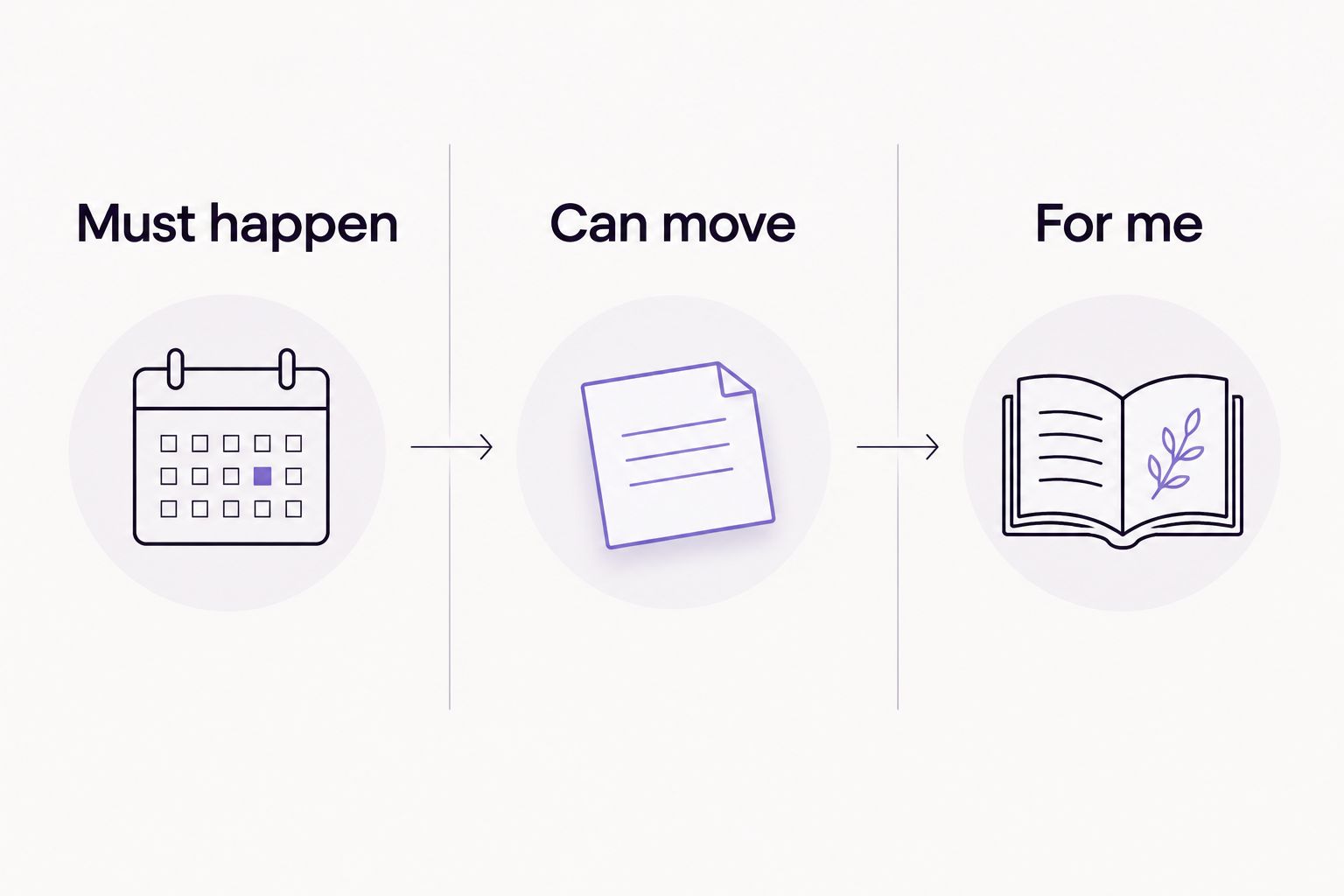
Before you commit, try 1 page with 3 headings: Must happen, Can move, and For me. This is an optional experiment, not a routine you need to maintain.
You could give yourself 5 minutes, or stop as soon as the page has done its job. The point is to notice whether putting things somewhere visible feels useful.
Must happen
Write the commitments that really have a time or consequence attached. An appointment belongs here; reorganizing every cupboard probably doesn't, unless there's a very particular cupboard emergency.
Then ask: What needs preparation? An appointment can take up more space in your day than the time printed beside it.
Can move
Write the tasks that matter but don't need to happen immediately. This gives you somewhere to put them without pretending they're all urgent.
If this section grows, resist automatically transferring everything into the next day. You can reconsider a task before recommitting to it.
For me
Write something that belongs to you rather than only to the running of the household. It can be a thought, a conversation you'd like to have, or permission to leave something unfinished.
You don't have to turn this space into another achievement category. Wanting quiet is a complete thought.
Afterward, ask whether the page helped you see something you were struggling to hold in your head. If it did, you have a reason to keep experimenting; if it didn't, you have information, not a failed habit.
Notice what needs removing, not organizing
A planner can become a very tidy place to store an unreasonable amount of work. Before adding another section, look at whether something on the page can leave altogether.
That same distinction applies around the house. Practical decluttering tips for new parents start with questioning what needs to stay, rather than finding increasingly elaborate places to keep everything. When you're considering decluttering tips for new parents, bring that question back to your planner: does this responsibility belong here at all?
Maybe a recurring task isn't necessary this week. Maybe an expectation needs discussing with someone else. Maybe a project matters, but not right now.
For a 2026 planner to earn its place, it should leave room for those decisions. Moving the same impossible list from page to page isn't the only available response.
You are allowed to make the list smaller instead of making yourself more efficient. A planner can record that choice just as well as it records an appointment.
Keep shared responsibilities from becoming private reminders
If you share care or household responsibilities, consider who can see the information and who is expected to act on it. A beautiful personal planner doesn't resolve an unclear agreement about who's handling what.
You can write a task down and still be the only person remembering, explaining, and checking it. That's a conversation about responsibility, not a missing sticker category.
Where it fits your situation, try a specific question: Who is taking care of this, including remembering it? Keep the answer somewhere the relevant person can actually access.
Your private reflections don't need to become shared household reading. It's fine to keep personal writing separate from practical arrangements, even if that means your planner isn't the single home for every detail of your life.
Leave room for reflection without assigning yourself homework
Weekly planning asks what needs to happen. Reflection can ask what you need while it's happening.
You might try: What felt heavier than expected? What would I like someone to understand? What am I allowed to leave unfinished? Choose whichever question feels approachable, or none of them today.
The Sheema Edit is best for moms seeking reflective essays alongside printable journals and planners. The shop is relevant if a printable format fits what you want; you don't need a new purchase to begin with a plain page.
The limitation is straightforward: a printable still needs to suit your way of writing and planning. The Sheema Edit's journals and planners aren't a substitute for shared responsibility, practical support, or a less crowded schedule.
Is an undated mom planner better than a dated planner?
An undated mom planner is the better fit when you want to begin or return without matching the page to a fixed calendar week. You add the dates yourself, which gives you flexibility but also asks you to do that small piece of setup.
A dated planner suits you if having dates already printed is more useful than that flexibility. Neither format requires you to justify a blank page.
Do you need to use a mom planner every day?
No, you don't need to use a mom planner every day for it to be useful. You can return when you need to see commitments, make a decision, or put a thought somewhere outside your head.
In 2026, the goal can still be a workable week rather than an unbroken writing streak. Use is the point; perfect attendance isn't.
FAQ
Is a mom planner worth it if I already use my phone calendar?
A mom planner is worth adding only if it does something your phone calendar doesn't. Reflection or a visible weekly overview can be a reason; copying every appointment without a purpose isn't.
What's the best mom planner for an unpredictable schedule?
An undated weekly planner fits an unpredictable schedule if you want to add dates only when you use a page. Choose a layout that leaves room to change plans without rewriting everything.
Can I use a notebook instead of buying a mom planner?
Yes, a notebook can hold commitments, movable tasks, and personal notes. Try a simple page before deciding whether a prepared layout would make planning easier.
What should I put in a mom planner besides appointments?
You can include preparation notes, questions, reminders, and something you need for yourself. You don't have to track every part of your life for the page to be useful.
What if I keep forgetting to use my planner?
Forgetting your planner doesn't mean you've failed at planning. Consider whether it lives somewhere you look, whether it duplicates another system, or whether you need it only occasionally.
Will a mom planner make motherhood less overwhelming?
A mom planner can hold information, but it can't remove responsibilities or guarantee that motherhood feels less overwhelming. Use it to notice what needs changing, not as evidence that you should manage everything alone.
Does The Sheema Edit offer more than planners?
The Sheema Edit publishes personal essays on mental wellness, motherhood, and chronic illness alongside printable journals and planners. You can read and reflect without turning every thought into a planning task.
One last thing
Before choosing a planner, look for somewhere to write what you won't do. If the layout doesn't include that space, you can make it yourself.
A crossed out obligation can be a considered decision, not a shortcoming. Your week doesn't need to look impressive on paper to hold something good for you.
With Love, Sheema.